This article is an on-site version of our Energy Source newsletter. Premium subscribers can sign up here to get the newsletter delivered every Tuesday and Thursday. Standard subscribers can upgrade to Premium here, or explore all FT newsletters
Hello and welcome to Energy Source, coming to you from New York, where market watchers experienced one of the most volatile days in oil trading history on Monday.
Concerns about war in the Middle East and the closure of the Strait of Hormuz caused Brent crude to surge to $119.50 when markets opened — its highest level since 2022. But by the afternoon a combination of comforting words from US President Donald Trump, who declared the war was “very complete, pretty much”, and discussion of co-ordinated releases of strategic oil stocks by International Energy Agency members calmed oil markets.
Brent crude settled below $99, which marked the largest drop from an intraday high to a closing price.

My FT colleague Malcolm Moore has written an in-depth analysis on whether releases from the strategic reserves can do enough to calm the markets.
Predicting the trajectory of the war over the next week will probably determine whether oil tests the four-year high again. Analysts forecast a short weeks-long interruption to flows through the Strait of Hormuz, whereas anything longer could ignite another fire under prices.
“This is not really a situation that we’ve seen before,” said Benjamin Hoff, global head of commodity strategy and research at Société Générale. “And so it’s very difficult to actually come up with quantitative analysis and historical precedents that are relevant in all respects.”
In today’s newsletter, Michael Pooler reports from São Paulo on a debt crisis at Brazilian biofuels group Raízen, one of Shell’s biggest bets on clean energy. If a solution can be reached, the ethanol producer could benefit indirectly from the current volatility in oil. Thanks for reading — Jamie
Shell’s Brazil biofuels venture in dire straits
In the wake of an oil shock sparked by war in the Middle East more than half a century ago, Brazil’s military rulers turned to an old-world commodity in search of energy independence.
A dictatorship-era policy in the 1970s promoting the production of ethanol from sugarcane paid off. Even after the discovery of massive offshore crude reserves 20 years ago, it remains a vital part of the South American nation’s energy mix, with roughly three-quarters of cars in the country able to run on both the biofuel and petrol.
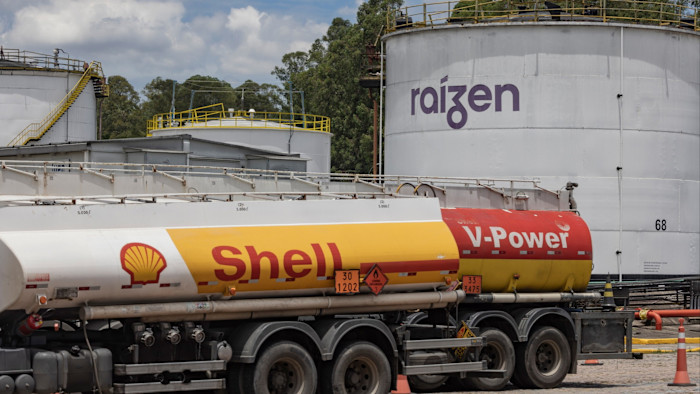
That success story is of little comfort today to investors in Raízen, the Brazilian company that is the world’s largest producer of sugarcane ethanol. The biofuels group, a joint venture between Shell and São Paulo-headquartered conglomerate Cosan, is in dire straits after being hit by a combination of poor harvests, high interest rates and costly investments.
With a debt pile of R$55bn (US$10.5bn) and accounts awash with red ink, Raízen’s share price has sunk and it is in desperate need of new funding — as much as R$20bn in the eyes of some creditors.
Yet despite intense discussions in recent weeks over a rescue package for the business, which has been selling off assets to shore up its finances, a capital injection has so far proven elusive.
The impasse has thrown into doubt the future of one of Shell’s main bets on clean energy. It’s also an unwelcome distraction for the UK group as it grapples with the worst disruption in the global oil market for decades as a result of the Iran conflict.
In parallel, the situation has stirred anxiety in Brasília, which wants to avoid one of the country’s largest companies failing in an election year. Raízen last month posted a R$15.6bn net loss in its third quarter.
The crisis deepened last week when Cosan pulled out of providing a financial lifeline for Raízen after Shell opposed a break-up of the company. (The pair each own 44 per cent of Raízen following its 2021 stock market listing).
Under the proposal that had been discussed, Shell was to pump in R$3.5bn of fresh capital, with R$1bn from Cosan and a further R$500mn from the Brazilian group’s founder and controlling shareholder, Rubens Ometto. Banks and bondholders were to be asked to convert some 35 per cent of their debt into equity under the restructuring.
Cosan and one of its top shareholders, the Brazilian investment bank BTG Pactual, had also hoped to tie the funding agreement to a spinout of Raízen’s fuel distribution arm, which operates nearly 9,000 Shell-branded petrol stations across Brazil, Paraguay and Argentina.
BTG wanted to acquire a stake in the new standalone unit, but Shell was not on board. And with Cosan having doubts about the effectiveness of the size of the proposed cash infusion, the deal fell apart.
Instead, the talks are now focused on a R$4bn shot — Shell’s R$3.5bn pledge, with half a billion from Ometto — alongside a debt-for-equity swap and maturity extension. This would likely involve a bigger hit to creditors — including Itaú Unibanco, Latin America’s largest lender, as well as Bank of America, Citigroup, JPMorgan and Mitsubishi UFJ Financial Group.
Yet there may be light at the end of the tunnel. Raízen hopes in the coming days to obtain the one-third approval of creditors required to begin an out-of-court restructuring process, according to people involved in talks. This would start the clock on a 90-day standstill period for negotiations, in which debt repayments are suspended.
One creditor says an “enormous distance” exists between the money on the table from Raízen’s shareholders and what is needed to fix its balance sheet. But they also acknowledged that pursuing an out-of-court process is preferable to a judicial reorganisation — the Brazilian equivalent of US Chapter 11 bankruptcy protection — which is typically longer, more complex and reduces creditors’ bargaining power.
“A judicial reorganisation is so damaging because it doesn’t just affect the financial side, it affects everything — employees and suppliers too,” says Marcelo Gasparino, an experienced board member at large Brazilian companies such as Vale. Mediation is another option, he adds.
Resolving the deadlock is important for Shell, which faces a potentially delicate political situation as the largest foreign oil and gas producer in Brazil. President Luiz Inácio Lula da Silva last month summoned the UK energy giant and other Raízen stakeholders to discuss how to salvage the business, said people familiar with the situation.
“He said it was unacceptable for the world’s largest ethanol producer, backed by one of the top oil majors and a major national group [Cosan], to enter into bankruptcy protection,” said one person present at the meeting.
Pessimists note that in addition to its debt problems, Raízen is competing with Brazil’s expanding output of corn-based ethanol, which is now often cheaper to produce than the sugarcane version.
But if a solution can be reached, the company could stand to benefit indirectly from current geopolitical turmoil. High oil prices, like those which gave birth to the country’s modern ethanol industry, tend to make the biofuel more competitive against petrol. (Michael Pooler)
Power Points
Saudi Aramco has said it will be able to export about 70 per cent of its normal crude oil shipments within days as its chief executive warned of “catastrophic consequences” for the world economy if the US-Iran war drags on.
Iran’s Kharg Island, a crucial oil export hub, has been left untouched by US-Israeli bombing. How the Trump administration deals with the tiny Gulf island could shed light on its longer-term strategy towards Tehran.
Investors are betting that central bankers could be forced to raise interest rates in response to the Iran war.
Energy Source is written and edited by Jamie Smyth, Martha Muir, Alexandra White, Rachel Millard, Malcolm Moore and Ryohtaroh Satoh, with support from the FT’s global team of reporters. Reach us at [email protected] and follow us on X at @FTEnergy. Catch up on past editions of the newsletter here.
Recommended newsletters for you
Moral Money — Our unmissable newsletter on socially responsible business, sustainable finance and more. Sign up here
The Climate Graphic: Explained — Understanding the most important climate data of the week. Sign up here