In a volatile turn for global energy markets, millions of barrels of Saudi Arabian crude continue to navigate the Red Sea, flowing from the Kingdom’s critical Red Sea coast to international destinations. This persistent flow defies explicit threats and recent attacks by Yemen’s Houthi militants, an Iran-backed faction, against Saudi shipping – actions that significantly escalate the potential for broader destabilization within the global oil trade.
Just days after the Houthi group declared a blockade of Saudi Arabia, maritime industry players are demonstrating a divided response. Western shipowners are actively recalibrating their strategies, either planning to circumvent the perilous Bab el-Mandeb strait, located at the southern gateway of the Red Sea, or electing to traverse it with their Automatic Identification Systems (AIS) transponders deliberately deactivated. Conversely, vessels affiliated with nations like China, which maintain ties with Iran, are notably observed continuing their transits through this vital choke point, often laden with Riyadh’s crude.
Navigating the Red Sea Chokepoint: A Critical Juncture for Global Supply
The Bab el-Mandeb strait represents a pivotal artery for global maritime commerce, particularly for energy flows. Its strategic importance has thrust oil tanker owners and commodity traders into a state of heightened alert, particularly following the Houthi’s blockade declaration on Monday and the subsequent assault on at least one Saudi-flagged vessel. This development spotlights the Red Sea port of Yanbu as an increasingly indispensable workaround, especially in light of historical attempts by Iran to impede oil transit through the Strait of Hormuz, the Persian Gulf’s eastern outlet.
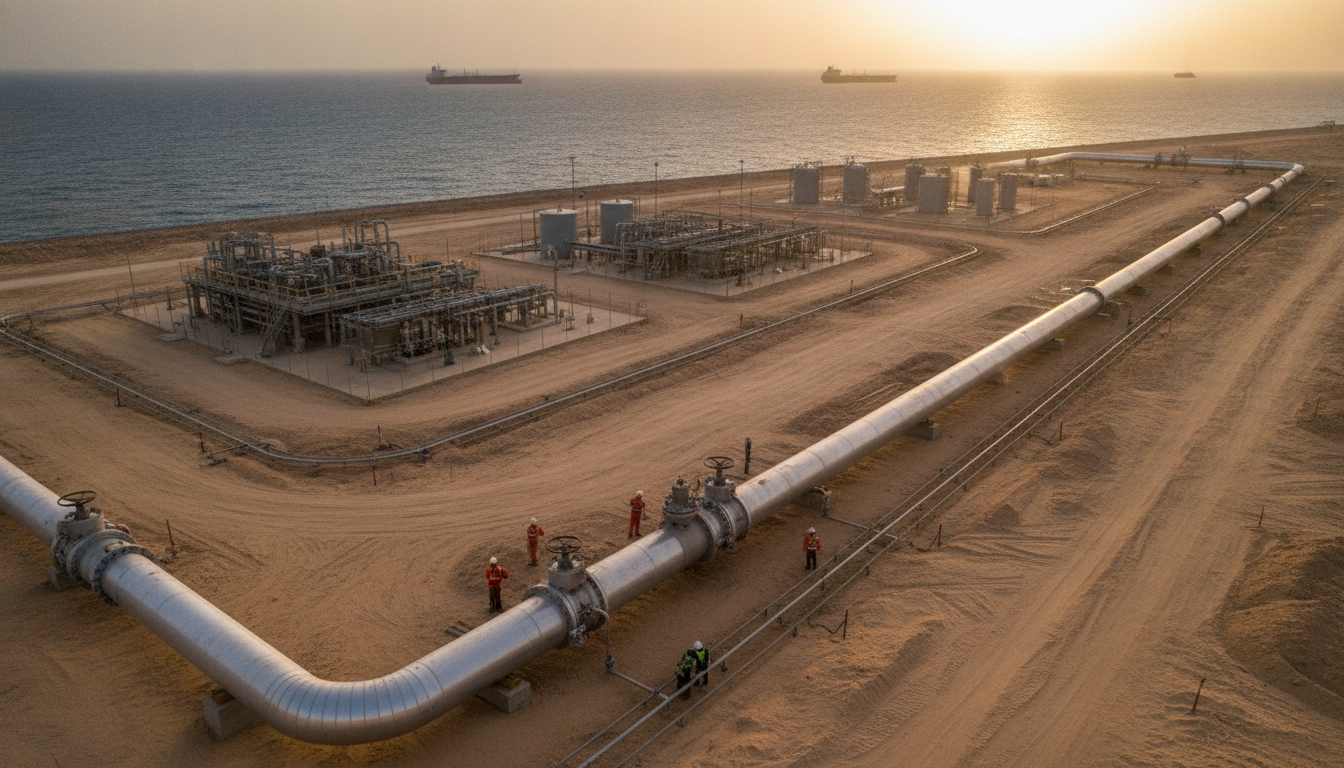
Despite the prevailing tension, recent satellite imagery from the European Union, captured two days post-blockade announcement, provides a clear indication of ongoing activity. The images reveal tankers actively berthed at four of Saudi Arabia’s seven crude export terminals along its Red Sea coast, underscoring the Kingdom’s determination to maintain its export cadence.
Detailed ship-tracking data further illustrates the evolving risk management landscape. The Greek-flagged tanker Merbabu, laden with Saudi crude, successfully exited the Red Sea through the Bab el-Mandeb strait, conspicuously with its transponder switched off. The vessel later re-emerged in the Arabian Sea, broadcasting its position late Thursday, with charter records indicating its destination as India. This incident exemplifies the tactical adjustments being made to mitigate perceived risks.
Concurrently, the Hong Kong-owned supertanker New Explorer, also carrying Saudi crude, was observed steaming towards Bab el-Mandeb after a period of idling since Tuesday. Earlier, two Chinese-flagged tankers had already successfully transited the same route. Moreover, non-Saudi oil traffic appears robust through the waterway, with numerous vessels, including those ferrying Russian barrels, actively moving towards India and other markets.
Tough Decisions and Costly Diversions for Western Fleets
For Western-operated vessels contracted to transport Saudi oil, the current scenario presents a complex dilemma. Shipowners face the critical choice of risking transit through Bab el-Mandeb’s increasingly dangerous waters or opting for significantly longer and costlier voyages around the African continent to reach Asian markets. This alternative route necessitates sailing north through the Suez Canal, a diversion that can nearly double some voyage times and consequently, freight costs, impacting profitability and delivery schedules.
The persistent uncertainty permeating the Red Sea has already prompted discernible shifts in shipping patterns. The Denmark-owned products tanker Torm Innovation, after loading cargo at Yanbu, executed a U-turn in the waterway, rerouting towards the northern passage through the Suez Canal, according to tracking data. This vessel is reportedly bound for Japan. This strategic pivot mirrors an earlier decision by the Asia-bound liquefied natural gas (LNG) carrier Gas King, which also opted for the Suez diversion two days prior and has since commenced its transit through the canal.
Beyond individual vessel routing, the geopolitical landscape is influencing strategic sourcing decisions among Asian oil buyers. Some are now reportedly engaging in discussions with Saudi Aramco to potentially re-route crude flows around Africa entirely, bypassing the Red Sea altogether. This forward-looking adjustment highlights a proactive approach to supply chain resilience.
In a notable development, at least one Very Large Crude Carrier (VLCC) has been provisionally chartered to collect a cargo from Egypt’s northern coast for onward delivery to South Korea via the Cape of Good Hope. Reports of this booking indicate a significant deviation from established patterns, marking the first such charter in several years and underscoring the severity of the perceived risk.
Further demonstrating this shift, the Greek-owned VLCC Olympic Luck is also heading north from Yanbu. Its automated data suggests the vessel is approximately half-full, a loading status that would permit its passage through the Suez Canal without requiring any offloading of its cargo. Fixture data for the Olympic Luck indicates a destination east of Saudi Arabia.
Escalating Risks and Opaque Shipping Data
The Houthi attacks inject a dangerous new dimension into the already fraught Middle East conflict, which previously saw shipping activity in the critical Strait of Hormuz sharply curtailed. On Friday, observable vessel tracking showed the Strait of Hormuz appearing almost deserted, with the supertanker Noble notably entering the Persian Gulf with its transponders off. In recent days, at least three other supertankers similarly exited the gulf “dark,” highlighting a broader trend of increased operational secrecy in the region’s vital maritime passages.
In response to the escalating threats, the European Union’s naval force has formally advised merchant ships calling at Saudi ports to deactivate their transponders. This guidance further contributes to the increasing opaqueness of maritime traffic in these strategic waters.
While loading activity at Yanbu, Saudi Arabia’s primary Red Sea export facility, does not appear to have significantly slowed, its visibility has undeniably diminished. Tankers are consistently switching off their AIS signals as they approach the loading jetties. Satellite imagery from the EU’s Sentinel 2 orbiter captured on Wednesday revealed tankers moored at four of the seven crude berths across Yanbu’s two terminals; however, only two of these vessels were detectable via automated tracking systems.
By Friday, automated position signals showed no tankers berthed at Yanbu. Yet, the disappearance of multiple ships from tracking screens as they approached the two terminals on Thursday strongly suggests that loading operations are indeed continuing. The true extent of activity levels, however, will remain unclear until these tankers reappear on tracking systems or updated satellite imagery becomes available, leaving investors to grapple with reduced transparency in a critical supply region.