AI-Driven Simulators: Reshaping the Future Workforce and Investment Landscape in Oil & Gas
The global energy sector, an industry defined by its colossal scale, intricate operations, and relentless pursuit of efficiency and safety, stands on the cusp of a profound transformation. As technological advancements continue to redefine industry paradigms, the very method by which skilled professionals are trained and gain experience is poised for a revolutionary overhaul. Esteemed entrepreneur and investor Mark Cuban recently articulated a vision that resonates deeply within the high-stakes environment of oil and gas: the emergence of the “next great AI application” as a sophisticated job simulator.
Cuban’s assertion, shared on social media on Thursday, July 24, 2026, posits that the traditional career trajectory, built upon extensive on-the-job interaction and mentorship, is nearing obsolescence. He forecasts a future where the acquisition of practical knowledge and critical judgment will diverge significantly from current practices. The rationale is compelling: as workplaces become more distributed and automated, employees will encounter fewer direct “touch points” for organic knowledge transfer within an organization. This historical pathway for developing crucial expertise and decision-making acumen is diminishing, necessitating a radical alternative.
Elevating Training Standards in a Capital-Intensive Industry
For the oil and gas industry, where operational errors can carry catastrophic financial and environmental consequences, the concept of advanced simulation is not entirely new. Drilling simulators have long been integral to training, as have control room emulators for refinery operations. However, Cuban’s vision, powered by cutting-edge artificial intelligence, suggests a leap into an unprecedented era of realism and comprehensive scenario planning. He draws parallels to elite professions such as commercial pilots and race car drivers, whose intensive training relies heavily on highly realistic simulations designed to prepare them for every conceivable real-world contingency without the inherent risks of live practice.
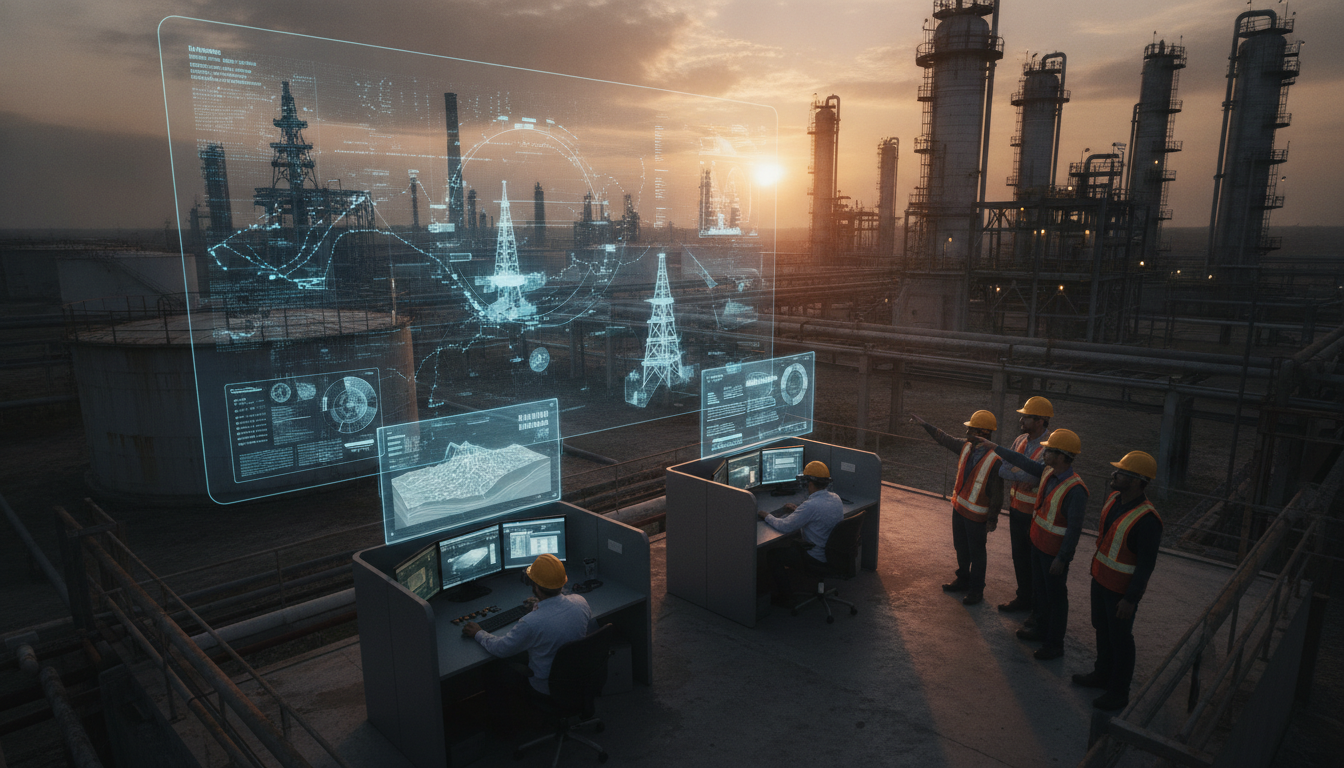
Imagine a newly onboarded deep-water drilling engineer navigating a virtual well control incident, or a refinery operator responding to a simulated process upset under extreme pressure. Picture a subsea pipeline technician practicing complex maintenance procedures in a digital twin environment, or an emergency response team rehearsing a platform evacuation scenario. These AI-powered simulators would transcend current capabilities, offering immersive, dynamic learning experiences tailored to the unique complexities and hazards of the energy sector. This evolution promises to significantly compress the time required for competency development, driving down training costs while simultaneously enhancing operational readiness and safety protocols, metrics closely scrutinized by astute investors.
Leveraging Domain Expertise for Strategic Advantage
A pivotal aspect of Cuban’s proposition lies in the collaborative creation of these advanced training tools. He advocates for “smart companies” to engage their most knowledgeable employees and stakeholders – the seasoned geologists, veteran reservoir engineers, experienced field operators, and logistics specialists – in the development of these simulators. By codifying their invaluable domain knowledge, companies can construct comprehensive virtual environments that expose trainees to every potential situation they might encounter, fostering unparalleled preparedness.
This approach fundamentally redefines corporate onboarding. Instead of protracted periods of shadowing and gradual exposure, new hires could rapidly achieve a baseline of operational proficiency and situational awareness. For investors, this translates into a swifter return on human capital, faster project ramp-ups, and a more resilient, adaptable workforce capable of navigating the dynamic challenges of energy exploration, production, and distribution. Moreover, it addresses the critical issue of an aging workforce in the sector, allowing invaluable institutional knowledge to be effectively transferred to the next generation of energy professionals.
The Academic Perspective and AI’s Complementary Role
While the concept of virtual training isn’t entirely novel – Professor Thomas Roulet, an organizational sociology expert at the University of Cambridge, notes that many organizations already utilize virtual reality for specific training modules like unconscious bias – the scale and sophistication proposed by AI-driven simulations represent a significant advancement. Roulet acknowledges that this trend is poised to become far more pervasive, particularly in an era where certain job functions are susceptible to AI automation.
Critically, Roulet highlights that roles resistant to full AI replacement are those demanding complex coordination, the synthesis of diverse skills, and rapid analytical judgment within specific contexts – qualities abundant in the intricate operations of oil and gas. AI, in this context, serves not as a replacement but as a powerful enabler, generating an endless array of realistic scenarios that support and accelerate human learning. Whether it’s a petroleum engineer analyzing simulated subsurface data or a control room operator managing complex process flows, AI enhances the capacity for critical thinking and problem-solving, making humans more effective, not redundant.
The Human-AI Synergy: A Prudent Investment Strategy
It’s important to underscore Cuban’s consistent messaging regarding the inherent limitations of AI. While formidable in processing data and executing defined tasks, AI currently lacks the nuanced “reading the room” capability or the emotional intelligence vital for effective human interaction and leadership. His outlook stresses that AI’s greatest value is realized not in isolation, but through strategic collaboration with human intellect and judgment.
For energy investors, this insight is paramount. The strategic integration of AI productivity tools, such as advanced job simulators, with the real-time capacity and seasoned judgment of human professionals represents the optimal pathway to maximizing returns on both technological and human capital investments. Companies that embrace this synergistic model will likely lead the charge in operational efficiency, safety performance, and talent development, positioning themselves for sustained growth and competitive advantage in a rapidly evolving global energy market. Investing in such forward-thinking firms promises exposure to a future-proofed operational model, where technology amplifies human potential, ensuring robust and responsible energy delivery for decades to come.