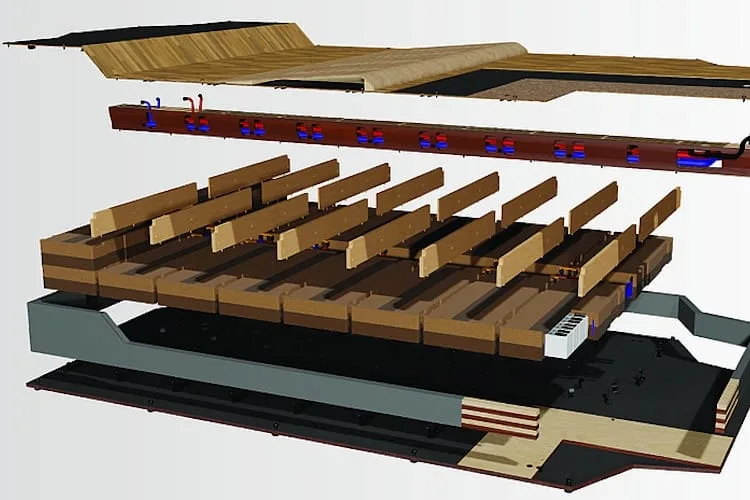
In a landscape increasingly defined by energy transition, an intriguing development in electric vehicle (EV) battery technology offers a fresh perspective for oil and gas investors. Researchers have unveiled an innovative protective housing for EV batteries that surprisingly incorporates wood and cork, significantly outperforming conventional aluminum designs in crucial safety tests, including fire resistance and crash protection. This breakthrough, which also boasts a superior environmental footprint, isn’t just a win for green tech; it subtly but powerfully shifts the calculus for long-term oil demand and investment strategies in an already volatile market.
The Sustainable Edge: Wood-Steel Battling Thermal Runaway
The core of this innovation lies in its counterintuitive material choice: a thin steel shell combined with a wood and cork filling. Traditional EV battery housings rely heavily on energy-intensive aluminum extrusion profiles, a standard that this new design completely eschews. In rigorous crash tests, including a demanding pole impact, the wood-steel housing demonstrated performance comparable to the aluminum battery housing of the Tesla Model S. More remarkably, where EV batteries present a notorious fire risk due to potential thermal runaway, the cellular structure of wood, coupled with the charring properties of cork, proved exceptionally effective. Tests exceeding 1,300 degrees Celsius showed the cork-insulated lid keeping temperatures approximately 100 degrees Celsius lower on the protected side compared to standard materials. This enhanced safety, combined with a significantly lower ecological footprint across primary energy demand, water consumption, and pollutant emissions, makes a compelling case for its widespread adoption and subsequent impact on the broader energy ecosystem.
Navigating Oil’s Volatility Amidst Accelerating EV Advancement
For oil and gas investors, the implications of such advancements are two-fold: immediate market dynamics versus long-term demand erosion. As of today, Brent crude trades at $90.38, marking a sharp 9.07% decline within the day, with WTI crude similarly down 9.41% to $82.59. This recent downturn follows a broader trend, with Brent having fallen over $20 per barrel, or 18.5%, since late March. Gasoline prices have also dipped, now at $2.93, a 5.18% drop. This significant short-term volatility underscores the acute sensitivity of oil markets to supply-demand imbalances, geopolitical events, and macroeconomic signals. However, innovations like the wood-steel battery housing represent a powerful, albeit slower-moving, force on the demand side. By enhancing EV safety, sustainability, and potentially cost-efficiency (given less energy-intensive manufacturing), they accelerate the pace of EV adoption, systematically chipping away at future oil demand. Investors must weigh the urgent need to capitalize on short-term price movements against the strategic imperative to account for these foundational shifts in energy consumption patterns.
Strategic Implications: What 2026 Holds for Oil Investors
Our proprietary reader intent data reveals a key question on many investors’ minds: “What do you predict the price of oil per barrel will be by end of 2026?” This forward-looking perspective is precisely where the confluence of immediate market drivers and long-term technological shifts becomes critical. In the coming weeks, a series of pivotal events will shape the short-to-medium-term outlook. Investors are keenly watching the OPEC+ Joint Ministerial Monitoring Committee (JMMC) meeting on April 18th, followed by the Full Ministerial meeting on April 19th. Decisions on production quotas from these meetings will directly influence supply dynamics. Subsequent API and EIA weekly inventory reports (April 21st, 22nd, 28th, 29th) and Baker Hughes Rig Count data (April 24th, May 1st) will provide further clarity on immediate supply and demand trends. Yet, these near-term factors operate within the shadow of accelerating EV adoption, bolstered by safer and greener technologies like the Bio!Lib housing. The researchers’ plans for follow-up projects, focusing on utilizing lower-grade wood and optimizing recyclability, signal further cost and sustainability improvements. For investors, predicting 2026 oil prices means not just analyzing OPEC+ moves and inventory reports, but also assessing the rate at which such EV innovations will erode gasoline demand, ultimately capping long-term price upside for crude.
A Shifting Paradigm: Materials, ESG, and Investor Focus
The transition away from aluminum, an extremely energy-intensive material to produce, towards wood and steel in battery housings highlights a broader industrial paradigm shift. This move aligns with growing ESG (Environmental, Social, and Governance) pressures on manufacturing and supply chains. For oil and gas companies, while not directly involved in battery housing production, this trend signals a future where energy demand is not only lower due to electrification but also sourced from cleaner, more diverse inputs for industrial processes. The investment community is increasingly scrutinizing the environmental footprint of all sectors, including the energy sources powering new sustainable technologies. Companies that can adapt their portfolios to either supply energy for these evolving green industries or diversify into adjacent sustainable technologies will be better positioned. The Bio!Lib project, by focusing on a positive environmental balance and future recyclability, embodies the kind of innovation that will increasingly attract capital, potentially diverting it from traditional fossil fuel investments in the long run.
In conclusion, while the day-to-day volatility of crude prices—currently reflected in Brent’s steep decline to $90.38—demands immediate attention, astute oil and gas investors must also integrate the transformative potential of innovations like the wood-steel EV battery housing into their long-term models. These advancements, by making EVs safer and more sustainable, accelerate the energy transition and reshape future demand curves for petroleum products. Navigating the energy market successfully means balancing the immediate impact of OPEC+ decisions and inventory data with the creeping, yet profound, influence of technological progress in the electrification of transport.