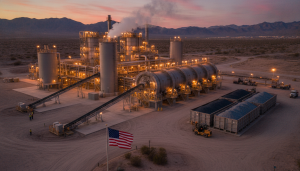
The global energy landscape is undergoing a profound transformation, characterized by shifting supply chains, geopolitical realignments, and an accelerating push towards electrification. Against this backdrop, a recent decision by the US Department of Commerce has sent ripples through the electric vehicle (EV) battery supply chain, imposing provisional anti-dumping duties of 93.5% on Chinese anode graphite. This move, which will effectively raise the total duty rate to 160% when combined with existing tariffs, is a critical development for investors tracking the energy transition, commodity markets, and the profitability of the EV sector. While designed to foster domestic production, this tariff hike introduces significant cost pressures and supply chain challenges that demand careful analysis.
The Immediate Cost Shock to EV Manufacturing
The imposition of a 93.5% provisional anti-dumping duty on Chinese anode graphite, leading to an effective total tariff of 160%, translates directly into higher costs for EV battery manufacturers. According to industry consultants, this tariff rate corresponds to an additional cost of $7 per kilowatt-hour (kWh) for an average EV battery cell. For a typical 60 kWh EV battery, this means an added cost of $420, while a larger 100 kWh battery will see its cost increase by $700. This is a substantial burden, particularly when considering the tight margins in battery production.
The impact is especially acute when juxtaposed with existing incentives. These tariffs are equivalent to approximately one-fifth of the tax credits offered under the Inflation Reduction Act (IRA) for battery manufacturing. For major battery producers, particularly those with significant US operations like Korean manufacturers, this cost increase could effectively wipe out profits for one to two entire quarters. This development has not been welcomed universally; leading EV manufacturers, including Tesla, have voiced concerns, highlighting their dependence on Chinese imports and the current inability of the nascent US industry to meet the necessary quality and quantity standards for anode graphite with a minimum purity of 90% carbon by weight. Investors asking about the performance of companies exposed to these supply chains, or generally seeking predictions for market movements, must factor in such policy-driven cost escalations which directly impact profitability and market competitiveness.
Broader Market Implications Amidst Energy Volatility
The graphite anode tariffs are unfolding within a volatile global energy market. As of today, Brent crude trades at $90.38 per barrel, experiencing a notable intraday decline of over 9% and operating within a wide daily range of $86.08 to $98.97. This sharp movement follows a significant 18.5% drop from $112.78 just two weeks prior, on March 30th. Similarly, WTI crude is at $82.59, down over 9% today, while gasoline prices have fallen to $2.93, a more than 5% decrease. This broader energy market volatility, characterized by falling crude and gasoline prices, creates a complex backdrop for the EV sector.
While lower fossil fuel prices might appear to reduce the urgency for EV adoption in the short term, the rising cost of critical EV components like graphite anodes introduces a different kind of headwind. If EV battery costs continue to climb due to tariffs and supply chain constraints, it could dampen consumer demand and slow the pace of electrification, thereby indirectly influencing long-term oil demand forecasts. Investors frequently inquire about the trajectory of oil prices by the end of 2026; factors such as the cost-competitiveness of EVs, heavily influenced by these tariffs, will play an increasingly important role in shaping that outlook. The interplay between traditional energy commodity prices and the cost dynamics of renewable energy components is now a central theme for sophisticated energy investors.
Geopolitical Chessboard and Supply Chain Re-evaluation
China’s commanding lead in graphite processing, accounting for two-thirds of the nearly 180,000 tonnes of graphite products imported into the USA, underscores the strategic vulnerability these tariffs aim to address. The US Department of Commerce’s decision reflects a broader governmental push to de-risk critical supply chains and foster domestic industrial capacity, a sentiment echoed by the American Active Anode Material Producers trade group. This group, comprising companies like Syrah Technologies (Louisiana), Novonix (Tennessee), Epsilon Advanced Materials (North Carolina), Anovion (New York), and SKI US (Georgia), advocates for policies that level the playing field against what they deem unfairly subsidized foreign competitors.
However, building out a robust domestic supply chain for high-purity anode graphite is not an overnight task. It requires substantial capital investment, technological expertise, and time to scale production to meet the stringent quality and volume demands of major automakers. Investors are increasingly focused on geopolitical risks and the implications of trade policies on global commodity flows and asset valuations. Questions about the stability of supply, particularly for essential raw materials, are paramount. The graphite tariffs serve as a stark reminder that national security and economic policy are increasingly intertwined with global commodity markets, prompting a re-evaluation of long-term investment strategies across the energy and materials sectors.
Forward View: The December 5th Decision and Beyond
The provisional tariffs are set to become final on December 5th, a crucial date for all stakeholders in the EV supply chain. This upcoming decision will solidify the cost structure for anode graphite imports and provide clarity for investment decisions in both domestic production and battery manufacturing. While market participants will also be closely watching near-term events such as the OPEC+ JMMC and Full Ministerial meetings on April 18th and 19th, which will shape immediate global oil supply, the December 5th graphite ruling represents a longer-term structural shift impacting the energy transition itself.
Ahead of this pivotal decision, investors should closely monitor the progress of domestic anode material producers and any policy signals indicating further support or potential adjustments. The tariffs, while increasing costs for battery manufacturers in the short term, create a powerful incentive for investment in US-based graphite mining and processing facilities. This presents potential opportunities for investors in these specialized materials companies. Conversely, EV manufacturers and their suppliers will need to adapt their procurement strategies, either by absorbing higher costs, diversifying supply sources away from China, or investing in localized production. The trajectory of EV adoption, and by extension, future oil demand, will hinge significantly on how effectively the industry navigates these new supply chain realities and the final outcome of the tariff decision.