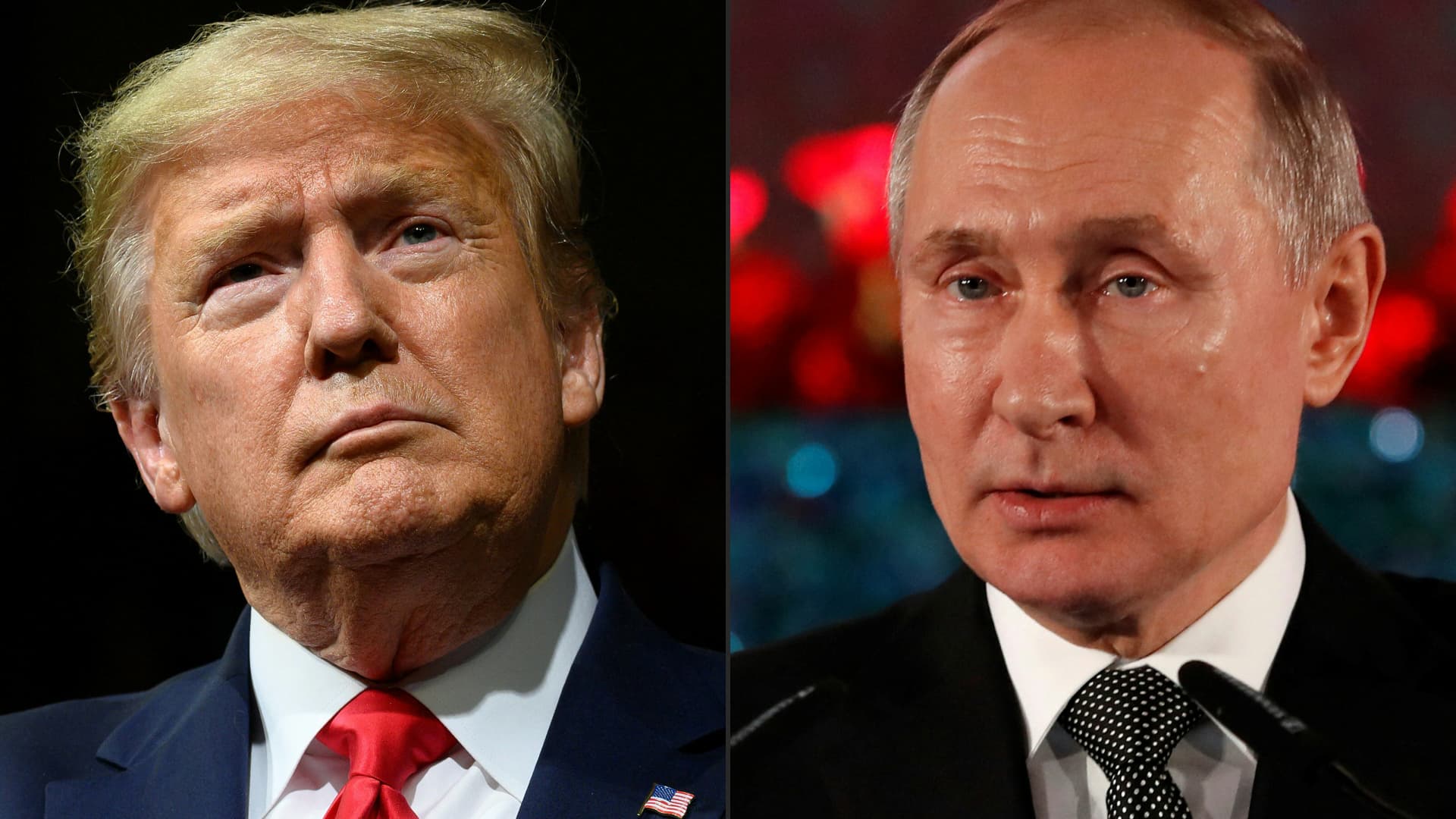
In a bold assertion that reverberated across global energy and geopolitical circles, former U.S. President Donald Trump recently articulated a direct correlation between plummeting crude oil prices and the Kremlin’s capacity to sustain its military operations. Speaking on a prominent financial news program, Trump declared Russia’s economy to be in a precarious state, suggesting that a further decline of just $10 per barrel in oil prices could compel President Vladimir Putin to halt hostilities. This provocative stance underscores the critical role of energy markets in international diplomacy and conflict resolution, a perspective keenly watched by investors navigating an increasingly complex global landscape.
Trump’s remarks signify a notable hardening of his stance toward Moscow, particularly concerning Russia’s ongoing conflict. Despite an initial period of perceived cordiality in Washington-Moscow relations during parts of his previous term, a palpable shift has occurred. The former President’s growing impatience with Russia’s apparent reluctance to pursue a ceasefire or a comprehensive peace accord with Ukraine has become evident. Just recently, Trump dramatically shortened a previously stated deadline for Putin to reach a peace agreement, reducing it from 50 days to less than two weeks, threatening severe “secondary tariffs” on nations engaging in trade with Moscow if the deadline is not met.
Geopolitical Chessboard: Threats and Counter-Threats
This escalating rhetoric immediately drew a sharp rebuke from former Russian President and high-ranking official Dmitry Medvedev. Utilizing social media, Medvedev characterized Trump’s series of ultimatums regarding Russia and the conflict in Ukraine not merely as demands, but as direct “threats and steps towards war.” Crucially, Medvedev clarified that this potential conflict would be “not between Russia and Ukraine, but with his own country,” implying a direct confrontation with the United States. In a swift and equally dramatic counter-response, Trump announced a directive for the deployment of two nuclear submarines to “appropriate regions,” a move that further ratchets up geopolitical tensions and adds layers of uncertainty for global markets.
For investors, understanding Russia’s economic lifeline is paramount. As one of the world’s foremost crude exporters, Russia has strategically leveraged its oil revenues to largely underwrite its extensive military campaign in Ukraine, which commenced in 2022. Western allies of Ukraine have implemented a raft of sanctions and restrictions designed to choke off these vital financial flows. However, the effectiveness of these measures has been partially blunted by key global energy consumers, most notably India and China, which have continued to acquire heavily discounted Russian crude, thereby providing Moscow with a crucial revenue stream.
India’s Energy Calculus Under Fire
This continued trade has emerged as a significant point of contention for Trump. In recent days, the former President has issued stern warnings to India, threatening substantial tariffs if New Delhi persists in purchasing Russian oil. Last week, he indicated a potential 25% duty on Indian exports, alongside unspecified additional “penalties.” Trump explicitly accused India of capitalizing on the geopolitical situation by acquiring discounted Russian oil and subsequently re-exporting it onto the open market for considerable profits. This accusation highlights the complex ethical and economic dilemmas facing nations attempting to balance energy security with geopolitical alignments.
In a recent interview on CNBC, Trump intensified his threats, stating that the proposed tariff rate on Indian goods could be escalated “very substantially” beyond 25% within a mere 24-hour period. “India has not been a good trading partner,” Trump asserted, adding, “they’re buying Russian oil, they’re fueling the war machine, and if they’re going to do that, I’m not going to be happy.” This aggressive posture against a significant trading partner introduces another layer of risk and unpredictability into global trade relations and, by extension, energy markets. The Kremlin, for its part, quickly weighed in on the burgeoning dispute, affirming India’s sovereign right to select its own trading partners, implicitly defending India’s continued engagement with Russian energy supplies.
Investment Implications: Volatility Ahead
From an investor’s perspective, these developments underscore the inherent volatility in energy markets driven by geopolitical factors. The prospect of further oil price declines, particularly if influenced by U.S. policy or rhetoric, could significantly impact the profitability of exploration and production companies. Furthermore, the threat of secondary sanctions or tariffs on major economies like India introduces considerable uncertainty into global trade flows, potentially disrupting supply chains and altering demand dynamics for crude oil and refined products.
Investors must closely monitor these evolving narratives. The interplay between U.S. political pronouncements, the Kremlin’s strategic responses, and the evolving energy policies of major consumers like India and China will continue to shape global oil prices and market stability. The direct linkage between energy prices and the financing of international conflicts, as articulated by Trump, serves as a powerful reminder of the multifaceted risks and opportunities present in today’s energy investment landscape. As the geopolitical temperature rises, so too does the potential for swift and unexpected shifts in crude oil valuations, demanding a vigilant and adaptive investment strategy.

