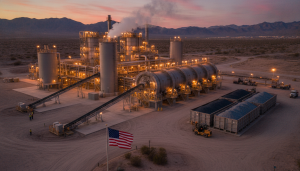
The energy landscape is undergoing a profound transformation, requiring oil and gas investors to expand their analytical lens beyond traditional hydrocarbon cycles. While crude prices and geopolitical shifts rightly dominate immediate attention, strategic capital allocation increasingly flows into technologies underpinning the broader energy transition. The recent move by German startup Tozero to establish a pilot plant for lithium-ion battery recycling at Gendorf Chemical Park in Bavaria serves as a potent reminder of this evolving investment thesis. This facility, set to commence operations later this year, represents more than just a new venture; it’s a foundational step towards building out critical infrastructure for the circular economy of electric vehicles, directly impacting future demand dynamics for energy resources and offering new avenues for long-term growth.
Strategic Infrastructure for a Future-Forward Energy Mix
Tozero’s commitment to building out its demonstration plant at Gendorf Chemical Park is a strategic play in the burgeoning battery recycling sector. This facility is envisioned as the technological cornerstone for commercial production targeted for 2026, marking a tangible investment in Europe’s raw material independence. The company’s focus on recovering high-purity lithium and graphite from “black mass” – the valuable active materials within used batteries – is particularly noteworthy. With an ambitious goal to extract over 80 percent of lithium from end-of-life batteries, Tozero is not just meeting, but exceeding, the stringent EU targets set for 2031. This efficiency, coupled with their asset-light model of outsourcing mechanical dismantling and collection, minimizes logistical complexities and enhances scalability, key factors for attracting further investment in this capital-intensive sector. The “mid-single-digit million euro” investment in Gendorf, though modest compared to major upstream oil and gas projects, signifies a crucial capital deployment into the infrastructure necessary for a sustainable energy future.
Crude Volatility Contrasts with Long-Term Energy Diversification
While the long-term energy transition gains momentum, the immediate reality for oil and gas investors remains firmly rooted in market volatility. As of today, Brent crude trades at $94.72, showing a marginal dip of 0.22% within a daily range of $94.42 to $94.91. Similarly, WTI crude sits at $90.97, down 0.35% for the day. This current stability, however, masks a more significant recent trend: Brent crude has seen a notable decline over the past two weeks, dropping from $108.01 on March 26th to $94.58 on April 15th, representing a 12.4% decrease. This $13.43 contraction highlights the inherent price sensitivity of traditional energy markets to global supply-demand shifts, economic indicators, and geopolitical developments. This short-term volatility in crude markets stands in stark contrast to the steady, strategic investments being made in enabling technologies like battery recycling. For diversified investors, balancing exposure to these immediate, high-liquidity commodity markets with calculated long-term bets on future energy infrastructure is becoming increasingly vital.
Navigating Near-Term Catalysts for Hydrocarbon Prices
Looking ahead, the next two weeks are packed with critical events that will undoubtedly shape the trajectory of oil prices and provide fresh data points for investor models. The industry will closely watch the Baker Hughes Rig Count reports on April 17th and April 24th for insights into North American drilling activity and potential future supply. More critically, the OPEC+ Joint Ministerial Monitoring Committee (JMMC) meeting on April 18th, followed by the full OPEC+ Ministerial Meeting on April 20th, will be paramount. These gatherings will determine the alliance’s production policy, directly influencing global crude supply and market sentiment. Any indication of quota changes or compliance shifts could send ripples through the market. Furthermore, the weekly API Crude Inventory reports on April 21st and April 28th, alongside the EIA Weekly Petroleum Status Reports on April 22nd and April 29th, will offer crucial snapshots of U.S. supply and demand dynamics, including gasoline inventories currently trading around $2.99 per gallon. Investors will be scrutinizing these figures for signs of demand strength or weakness, which could either support or undermine recent price levels.
Investor Focus: Bridging the Immediate and the Strategic
Our proprietary data indicates that a primary concern for investors this week revolves around forecasting future crude prices, with a significant number asking for a base-case Brent price forecast for the next quarter and the consensus 2026 Brent forecast. This immediate focus on traditional market drivers underscores the ongoing importance of hydrocarbon investments. However, the strategic implications of developments like Tozero’s plant cannot be ignored, even by investors primarily focused on oil and gas. The move towards a circular economy for critical battery materials directly impacts the long-term viability and growth trajectory of electric vehicles, which in turn influences future oil demand, particularly for gasoline. While immediate investment decisions are often driven by factors like Chinese teapot refinery runs or Asian LNG spot prices, smart capital is also quietly positioning itself in the enabling technologies of the energy transition. Tozero’s capacity boost at Gendorf is a microcosm of this broader trend: a foundational investment in the infrastructure that will shape the energy landscape for decades to come, demanding that oil and gas investors expand their analytical framework to include these adjacent, yet increasingly interconnected, sectors.