Geopolitical Shocks and Political Rhetoric Drive Market Volatility
The global oil and gas markets are once again navigating a treacherous landscape, marked by significant geopolitical disruptions and influential political rhetoric. A recent drone strike on Russia’s vital Orenburg gas processing plant has injected fresh concerns about energy supply stability, while former US President Donald Trump’s evolving comments on the Ukraine conflict introduce further uncertainty into the geopolitical risk premium. These events are unfolding against a backdrop of already heightened volatility, with crude prices experiencing a notable downturn in recent days. Investors are keenly watching how these intertwined factors will shape both near-term price action and the long-term outlook for global energy markets.
Orenburg Incident: A Direct Hit on Russia’s Gas Infrastructure
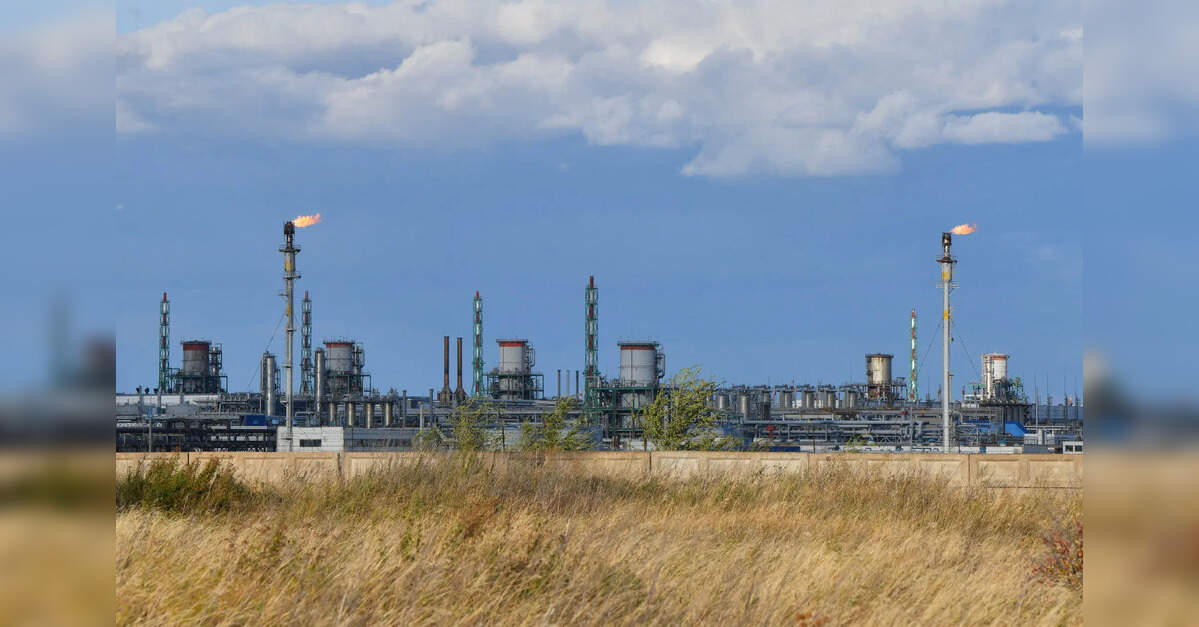
The drone strike on Gazprom’s Orenburg gas processing plant in southern Russia represents a direct and impactful blow to a critical piece of the nation’s energy infrastructure. Located near the Kazakh border, this facility is an integral part of one of the world’s largest production and processing complexes, boasting an annual capacity of 45 billion cubic meters. Its primary function includes handling gas condensate from Kazakhstan’s Karachaganak field, alongside gas from local Orenburg fields. Reports confirm that the attack caused a fire in a workshop and damaged a gas processing and purification unit, forcing the plant to halt gas intake from Kazakhstan temporarily due to the emergency. This incident underscores Kyiv’s escalating strategy of targeting Russian energy assets, which it views as funding Moscow’s ongoing war efforts. For investors, this pattern of attacks highlights persistent supply-side risks that could, under different market conditions, trigger significant price spikes in natural gas, particularly given Europe’s continued, albeit reduced, reliance on Russian flows.
Trump’s Shifting Stance: Unsettling the Geopolitical Calculus
Adding another layer of complexity to the global energy equation are the latest pronouncements from former US President Donald Trump regarding the Ukraine conflict. In a recent interview, Trump suggested that Ukraine might need to cede territory in exchange for an end to Russia’s invasion, stating that Russian President Vladimir Putin “is going to take something” and has “won certain property.” These comments represent a notable shift, diverging from his more recent expressions of impatience with Putin and openness to aiding Ukraine’s victory. While not a direct market mover in the same vein as a supply disruption, such high-profile political statements inject considerable uncertainty into geopolitical risk assessments. For oil and gas investors, this rhetoric creates a difficult scenario to price: does it signal a potential path to de-escalation that could reduce the war premium, or does it merely prolong the conflict by emboldening one side while undermining another? This ambiguity directly impacts the perception of future stability, influencing investment decisions in an already volatile sector.
Market Reaction and Investor Sentiment: Price Declines Amid Uncertainty
The confluence of geopolitical events and political rhetoric has contributed to a noticeable shift in market sentiment, reflected in recent price action. As of today, Brent Crude trades at $90.38, marking a significant decline of 9.07% within the day, with a range spanning $86.08 to $98.97. Similarly, WTI Crude has fallen to $82.59, down 9.41% from its previous close, trading between $78.97 and $90.34. This daily volatility follows a more extended downtrend, with Brent having shed approximately $22.4, or nearly 19.9%, from its high of $112.78 observed just a few weeks ago on March 30th. This steep correction raises pertinent questions for investors, many of whom are asking what the price of oil per barrel will be by the end of 2026. While the Orenburg incident points to potential supply constraints, the broader market decline suggests that other factors, including demand concerns or a reassessment of geopolitical risk, are currently outweighing immediate supply fears. Our proprietary data indicates that investor queries are heavily focused on future price trajectories and the underlying drivers of such dramatic shifts, emphasizing the need for clear analysis in these uncertain times.
Navigating the Near-Term: Upcoming Catalysts and OPEC+ Scrutiny
Looking forward, the immediate horizon is packed with key events that will further shape market direction and provide critical insights for investors. The upcoming OPEC+ Joint Ministerial Monitoring Committee (JMMC) meeting on April 19th, followed by the full OPEC+ Ministerial Meeting on April 20th, will be under intense scrutiny. Investors are particularly focused on current OPEC+ production quotas and whether the alliance will signal any changes amidst the recent price weakness and geopolitical tensions. Any hint of production adjustments could significantly influence market sentiment. Beyond OPEC+, the weekly API and EIA inventory reports on April 21st/22nd and April 28th/29th will offer crucial data on US supply and demand dynamics, providing a pulse check on the world’s largest oil consumer. Additionally, the Baker Hughes Rig Count reports on April 24th and May 1st will indicate North American drilling activity, hinting at future supply trends. These scheduled events, combined with the ongoing geopolitical backdrop, mean that the next two weeks will be pivotal in determining whether the recent price decline stabilizes or deepens, guiding investors grappling with future price predictions and strategic positioning.


