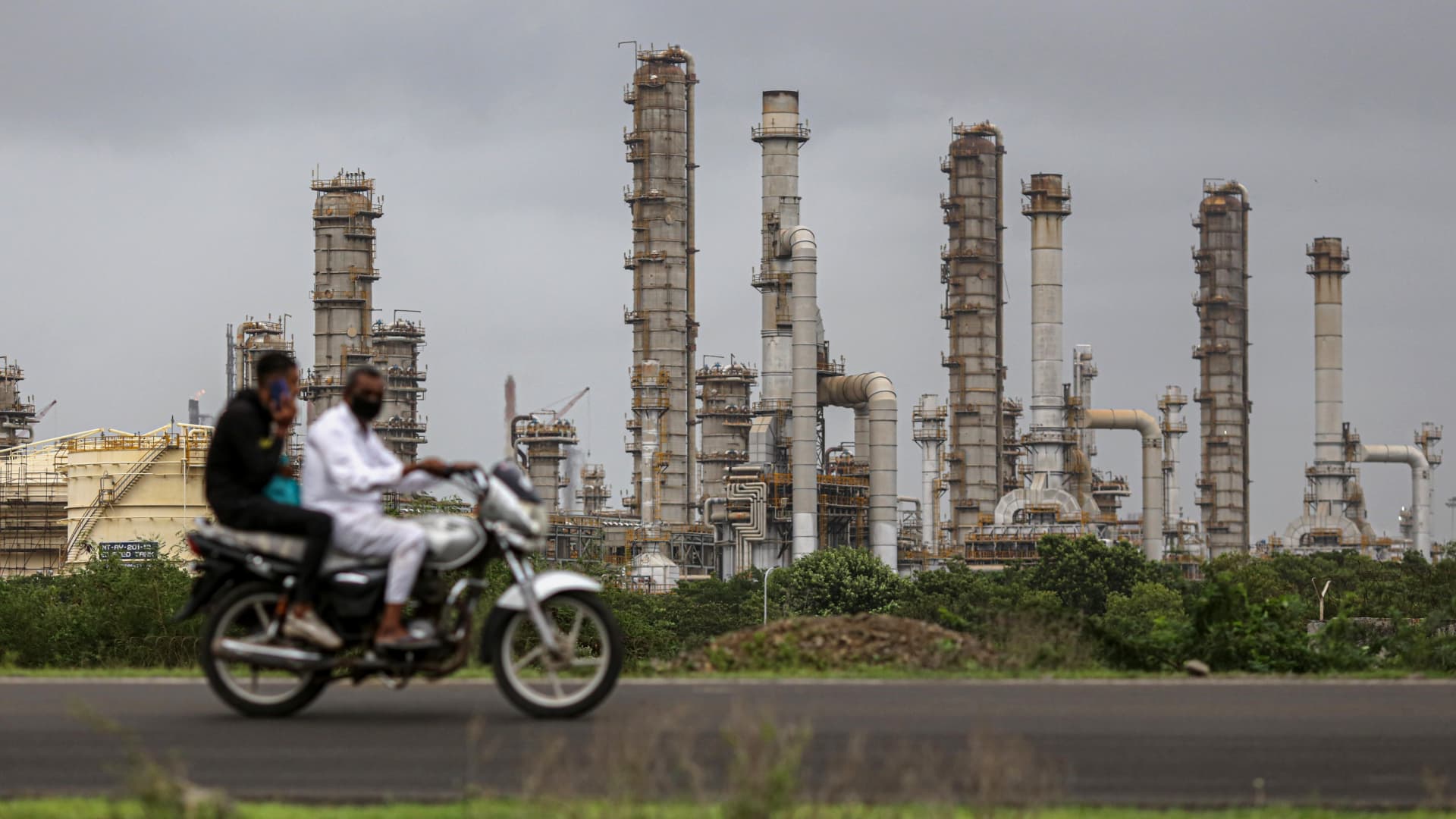
The potential decision by Reliance Industries to halt purchases of Russian crude represents a pivotal moment for India’s refining giant and the broader global oil market. Following recent U.S. sanctions targeting Russia’s two largest oil companies, Rosneft and Lukoil, Reliance faces a significant strategic realignment. This move, if confirmed, will not only test Reliance’s operational flexibility but also recalibrate refining margins and influence crude trade flows, creating a complex investment landscape that demands close scrutiny from oil and gas investors.
Reliance’s Margin Squeeze and Market Volatility
Reliance Industries has rapidly become a cornerstone buyer of Russian crude, a strategy largely driven by the attractive discounts offered on Urals crude. Data from September indicated Reliance purchased approximately 629,590 barrels per day (bpd) from Rosneft and Lukoil alone, a substantial increase from 428,000 bpd the previous year. This volume constituted more than 50% of the company’s crude diet, enabling “opportunistic buying” that significantly bolstered its refining margins. The long-term deal signed last December to import $12 billion-$13 billion worth of crude annually from Rosneft for 10 years, translating to roughly 500,000 bpd, further cemented this reliance.
The immediate consequence of halting these purchases is a direct hit to profitability. Replacing such large volumes, particularly those secured at a reported $5-6 per barrel discount compared to comparable grades, will inevitably pressure Reliance’s refining margins. As of today, the broader market is already experiencing significant downward pressure, with Brent crude trading at $90.38, down a notable 9.07% from its open, and WTI crude similarly declining by 9.41% to $82.59. This recent market volatility follows a broader trend where Brent has fallen from $112.78 on March 30th to its current $90.38, a substantial 19.9% decline in just over two weeks. In this environment of softening crude prices, the loss of competitively priced feedstocks presents a magnified challenge for refiners like Reliance, forcing them to navigate higher input costs relative to product prices.
Strategic Pivot and Investor Outlook Amidst Sanctions
The U.S. Treasury Department’s sanctions against Rosneft and Lukoil aim to diminish Moscow’s capacity to finance its ongoing conflict, signaling a tougher stance that could lead to further measures. For Reliance, this necessitates a swift strategic pivot. While alternative crude sources from regions like West Asia, Brazil, and Guyana are available, the crucial factor for investors is whether Reliance can secure these replacements at prices that maintain its competitive edge. The sheer volume under the Rosneft deal means that securing replacement barrels will likely present “short-term friction” and could erode the margin advantages previously enjoyed.
Investors are keenly observing how this situation will impact Reliance’s financial performance. Our proprietary reader intent data reveals a common question: “What do you predict the price of oil per barrel will be by end of 2026?” Reliance’s ability to navigate this supply disruption effectively will undoubtedly play a role in their profitability outlook and, consequently, their share performance over the coming quarters and years. India’s overall crude import basket has dramatically shifted, with Russian crude growing from less than 3% to one-third of total imports. This strategic reliance, while opportunistic, now introduces a vulnerability that Reliance must address with agility to reassure shareholders about its long-term profitability and India’s energy security.
Upcoming Events and Global Supply Dynamics
Beyond Reliance’s immediate challenges, this development adds another layer of complexity to global oil supply dynamics. India, as the second-largest buyer of Russian crude (accounting for 38% of Russia’s crude exports in September), plays a critical role in absorbing volumes that would otherwise struggle to find a market. Any significant reduction in Indian purchases will impact Russia’s export strategy and potentially reshape global trade routes.
Crucially, the next two weeks are packed with events that will shape the market’s response to these shifts. The OPEC+ Joint Ministerial Monitoring Committee (JMMC) Meeting on April 19th, followed by the full OPEC+ Ministerial Meeting on April 20th, will be under intense scrutiny. Investors are asking, “What are OPEC+ current production quotas?” and these meetings could provide critical insights into future supply decisions. Any adjustments to production quotas by the cartel could either exacerbate or alleviate the availability of alternative crude grades for refiners like Reliance. Furthermore, the weekly API Crude Inventory reports (April 21st and April 28th) and the EIA Weekly Petroleum Status Reports (April 22nd and April 29th) will offer fresh data on U.S. supply-demand balances, which will influence global pricing. The Baker Hughes Rig Count reports on April 24th and May 1st will also provide indicators of future production capacity. These upcoming events, combined with the geopolitical pressures on Russian crude, underscore a period of heightened uncertainty and potential volatility for oil and gas investors.
In conclusion, while Reliance Industries possesses the operational scale to pivot its crude sourcing, the cessation of discounted Russian crude represents a non-trivial challenge to its refining margins. Investors must weigh the company’s short-term earnings pressure against its long-term strategic adaptability and the broader implications for global energy trade. The confluence of geopolitical sanctions, fluid market prices, and upcoming OPEC+ decisions creates a dynamic environment where informed analysis of supply-side responses and refining economics will be paramount for successful investment outcomes.

