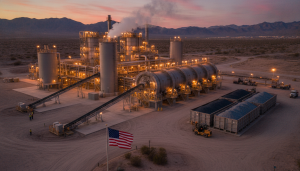
The energy investment landscape is undergoing a profound transformation, with grid-scale storage emerging as a critical component for future stability and efficiency. A significant development in this evolving sector comes from Peak Energy, a U.S.-based innovator, which has just announced the launch and shipment of its pioneering sodium-ion battery energy storage system (ESS). This marks the first deployment of a grid-scale sodium-ion storage solution to the U.S. electric grid, featuring a patent-pending passive cooling design that promises to dramatically reduce lifetime energy costs and enhance safety. For oil and gas investors monitoring the broader energy transition, this milestone represents a tangible step towards a more resilient and domestically supplied energy infrastructure, impacting long-term demand dynamics and creating new avenues for investment within the energy complex.
The Strategic Edge of Sodium-Ion and Passive Cooling
Peak Energy’s new system represents a landmark shift in energy storage technology. At its core is a sodium-ion phosphate pyrophosphate (NFPP) battery chemistry, distinguishing it from incumbent lithium-ion solutions. Critically, this is the first ever fully passive megawatt-hour scale battery storage system, and the largest NFPP battery system globally. The passive cooling design is a game-changer, eliminating all moving parts, including active cooling and ventilation components. This innovation directly addresses the root cause of 89% of reported battery storage system fires in the United States, as documented by the Electric Power Research Institute (EPRI). For investors, this translates into significantly enhanced reliability and substantially lower operating and maintenance costs, making it not only cost-competitive with existing market products but offering massive lifetime savings. The ability of sodium-ion chemistry to operate across a wide range of hot and cold temperatures without auxiliary cooling further strengthens its economic and operational advantages, offering a robust solution for diverse climatic conditions across the U.S. grid.
Investor Focus on Grid Resilience Amidst Market Volatility
Our proprietary reader intent data reveals a consistent theme among investors this week: a deep focus on market stability and future energy pricing. Investors are actively asking about the predicted price of oil per barrel by the end of 2026 and seeking insights into the future performance of major players like Repsol. While these questions traditionally center on hydrocarbon markets, they underscore a broader concern for energy security and cost predictability. Peak Energy’s deployment of a reliable, lower-cost grid storage solution directly addresses these overarching anxieties. By improving grid resilience and reducing energy costs, advanced battery storage mitigates the impact of volatility in traditional energy sources on electricity consumers and industries. The shift towards domestic energy supply chains and manufacturing capabilities, driven by recent federal policies and skyrocketing energy demand in the U.S., further aligns with investor desires for stable, domestically controlled energy resources, positioning sodium-ion as a strategic opportunity for U.S. leadership in battery chemistries.
Navigating Volatile Crude Markets and The Storage Imperative
The current state of the global crude market vividly illustrates the imperative for diversified and resilient energy solutions. As of today, Brent crude trades at $90.38, reflecting a significant 9.07% drop within the day’s range of $86.08 to $98.97. Similarly, WTI crude has seen a sharp decline to $82.59, down 9.41% from its daily high. This volatility is not an isolated event; the Brent crude benchmark has shed $20.91, or 18.5%, since March 30th, moving from $112.78 to $91.87 just yesterday. Such pronounced swings underscore the persistent instability in global oil markets, making reliable and affordable domestic energy solutions increasingly critical. While traditional oil and gas investments remain central to many portfolios, the imperative to diversify and fortify the energy grid against external shocks is undeniable. Peak Energy’s deployment of a cost-effective, reliable grid storage system directly addresses this strategic need, offering a domestic alternative to managing energy supply and demand fluctuations and contributing to overall energy price stability.
Forward Outlook: Policy Tailwinds and Upcoming Catalysts
Looking ahead, the next two weeks present several key events that could influence energy market sentiment and underscore the strategic importance of energy storage. The OPEC+ Joint Ministerial Monitoring Committee (JMMC) meets tomorrow, April 18th, followed by the full Ministerial Meeting on Sunday, April 19th. These gatherings often dictate global crude supply strategies, directly impacting the price stability of hydrocarbon fuels. Against this backdrop of potential supply adjustments, the consistent stream of U.S. inventory data, including the API Weekly Crude Inventory reports on April 21st and 28th, and the EIA Weekly Petroleum Status Reports on April 22nd and 29th, will provide critical insights into domestic supply-demand dynamics. Further, the Baker Hughes Rig Count on April 24th and May 1st will signal future production trends. For investors evaluating the broader energy landscape, Peak Energy’s move to onshore battery manufacturing and its shared pilot deployment with nine leading utility and independent power producer (IPP) customers this summer is a powerful counter-narrative to the volatility in traditional energy. Policy support for domestic manufacturing, coupled with the urgent need for grid resilience highlighted by these market fluctuations, positions innovative storage solutions like Peak Energy’s sodium-ion system as a crucial component of future energy security, offering a stable and domestically sourced option independent of OPEC+ decisions or weekly inventory swings.