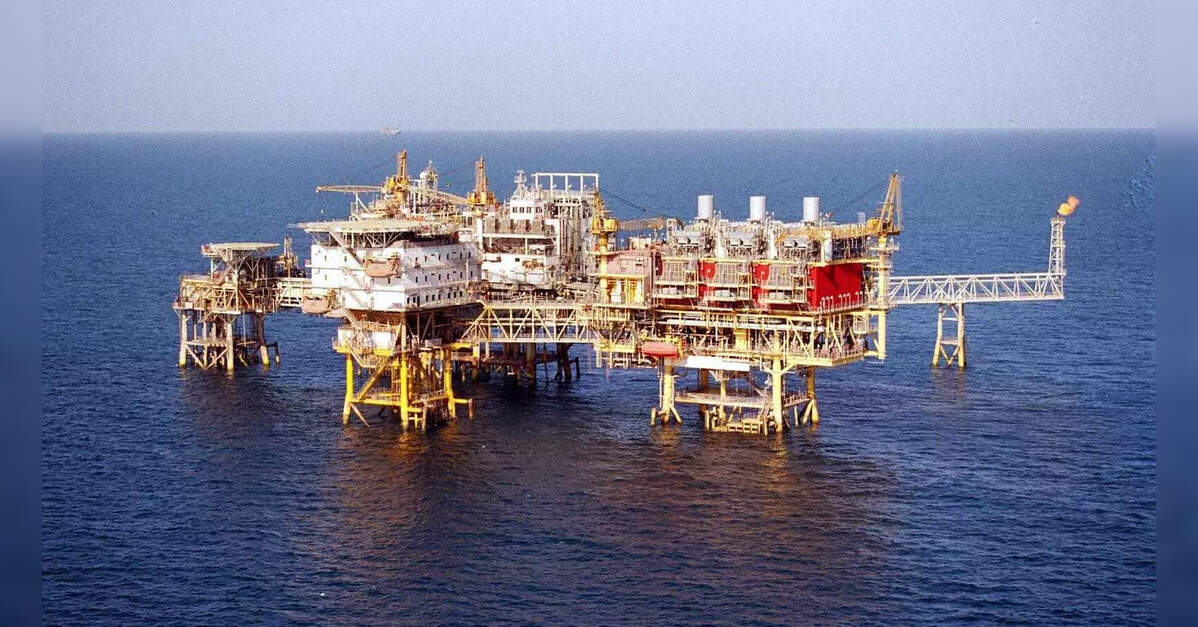
In a significant strategic move, India’s state-owned energy giants, ONGC and Oil India Ltd (OIL), are poised to embark on an ambitious ₹3,200 crore offshore stratigraphic drilling campaign. Slated to commence in early 2026, this multi-year initiative represents a pivotal commitment to uncovering new hydrocarbon reserves across previously untapped deepwater regions. For investors, this isn’t merely another drilling program; it’s a long-term play aimed squarely at bolstering India’s energy security and reducing its substantial reliance on imports, all while global energy markets navigate a complex transition. With global energy major BP providing crucial technical expertise, this exploration drive warrants a closer look at its potential impact, its alignment with current market realities, and the long-term value proposition it offers.
Strategic Vision in a Shifting Energy Landscape
The decision by ONGC and OIL to allocate ₹3,200 crore towards stratigraphic drilling underscores a clear strategic imperative: securing domestic energy supplies. India, a major energy consumer, faces persistent pressure to meet its growing demand while navigating volatile international markets. This campaign, targeting four wells in the deepsea sedimentary basins of Andaman, Mahanadi, Saurashtra, and Bengal, is a direct response to that challenge. Stratigraphic drilling, by its very nature, is a foundational step in hydrocarbon exploration. It involves meticulously studying underground geological formations through continuous coring, petrophysical logging, and seismic data integration. The immediate goal is not to produce oil or gas, but rather to construct a detailed geological profile that can inform future commercial exploration and development decisions, essentially de-risking subsequent, more costly appraisal and production phases. The involvement of BP, a global energy giant, to provide technical expertise in both location identification and drilling operations, further validates the geological prospectivity and adds a layer of technical assurance to this high-stakes, long-term endeavor.
Market Dynamics and Investor Sentiment
This substantial investment in future domestic supply comes at a fascinating juncture for global energy markets. As of today, Brent Crude trades at $98.22 per barrel, reflecting a -1.18% movement within a daily range of $97.92 to $98.67. Similarly, WTI Crude stands at $89.69, down -1.62% from its opening, trading between $89.5 and $90.26. Gasoline prices also saw a slight dip to $3.08, a -0.32% change. These figures, while representing daily fluctuations, are part of a broader trend; our proprietary data reveals that Brent crude has experienced a notable decline of $14, or -12.4%, over the past 14 days, falling from $112.57 on March 27th to $98.57 on April 16th. This recent downward pressure on prices highlights the inherent volatility in the energy sector, prompting investors to scrutinize the financial viability of long-cycle projects. Yet, for a nation like India, the imperative of energy security often transcends short-term price movements, framing such exploration initiatives as essential hedges against future supply shocks and geopolitical risks. Investors are acutely aware that while current prices dictate immediate returns, long-term strategic projects secure future supply and price stability.
The Long Game: Timelines, Risks, and Monetization Paths
The “early 2026” start date for drilling signals that any potential commercial discovery from this campaign is a multi-year proposition, demanding patience from investors. Stratigraphic drilling is a precursor to production, meaning that even if significant hydrocarbon deposits are identified, the path to commercial output will involve further appraisal, development planning, and substantial capital expenditure. A crucial element de-risking this initial phase for ONGC and OIL India is the government’s commitment to compensating them for the ₹3,200 crore drilling costs, including BP’s fees. This government backing effectively shields the state-owned entities from the direct financial burden of exploratory failures, making the investment more palatable. However, the future monetization of any discovery remains firmly in the government’s hands, with options ranging from auctioning the area to awarding it on a nomination basis. The potential for BP to secure a ‘first right of refusal’ on future development, while unconfirmed, adds an interesting dynamic, hinting at possible future partnerships that could further enhance project execution and market access. Meanwhile, the broader market context continues to evolve with key upcoming events. The OPEC+ Joint Ministerial Monitoring Committee (JMMC) meeting on April 17th, followed by the Full Ministerial meeting on April 18th, will be closely watched for any shifts in production quotas that could impact global supply and pricing. Further, the API and EIA weekly crude inventory reports on April 21st, 22nd, 28th, and 29th, alongside the Baker Hughes Rig Count on April 24th and May 1st, will offer vital near-term insights into supply, demand, and drilling activity. While these events don’t directly impact the ongoing drilling campaign, they collectively shape the forward curve and investor confidence in the long-term viability of significant hydrocarbon investments.
Investor Focus: De-risking and Value Creation
Our proprietary reader intent data reveals a keen investor interest in fundamental questions such as “What are OPEC+ current production quotas?” and “What is the current Brent crude price?” These inquiries underscore a pervasive concern about market stability and the long-term price trajectory – factors that directly influence the attractiveness of substantial, long-cycle investments like this offshore campaign. For investors considering ONGC and OIL India, the government’s commitment to fully compensate the drilling costs is a significant de-risking factor, providing a crucial buffer against the inherent uncertainties of frontier exploration. This support mechanism effectively transforms what could be a speculative venture into a strategically backed endeavor. Should these stratigraphic wells confirm substantial hydrocarbon resources in these untapped basins, the value creation for ONGC and OIL India could be transformative. Such discoveries would not only expand their reserve base significantly but also enhance their long-term production profiles, contributing directly to India’s energy independence goals. The government’s eventual decision on monetization – whether through auctions or direct allocation – will be a critical determinant of how this value is realized, and for whom. While the capital outlay is substantial, the strategic imperative, coupled with government financial backing and BP’s technical expertise, positions this offshore drive as a compelling, albeit long-term, value proposition for investors focused on India’s energy future.


