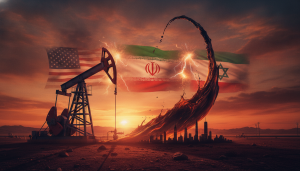
The global oil market is once again gripped by escalating geopolitical tensions, as recent developments concerning Iran’s nuclear program and the United States’ firm stance have sent crude prices surging. This abrupt shift in sentiment follows Vice President JD Vance’s declaration that Iran failed to address critical U.S. “red lines” during nuclear negotiations this week, with President Donald Trump explicitly reserving the right to employ military force. Investors are now re-evaluating risk premiums, leading to a significant rally in energy benchmarks. As of today, Brent Crude is trading at $94.74, marking a substantial 4.77% increase, while WTI Crude has climbed to $91.54, up 4.71%. Gasoline prices have also responded, reaching $3.15, a 3.95% rise, underscoring the market’s immediate concern over potential supply disruptions.
Geopolitical Tensions Reignite Oil Market Volatility
The recent diplomatic engagement in Geneva, involving U.S. envoys Steve Witkoff and Jared Kushner with Iranian Foreign Minister Abbas Araghchi, initially offered a glimmer of hope. Araghchi’s description of the talks as “constructive” and the mention of a “general agreement on guiding principles” had briefly pushed oil prices lower on Tuesday, as traders anticipated a potential de-escalation. However, Vice President Vance’s subsequent clarification swiftly dispelled that optimism. He indicated that while future meetings were agreed upon, Tehran had not conceded on core U.S. demands, thereby failing to acknowledge President Trump’s established red lines. This stark divergence between initial Iranian statements and the U.S. interpretation has underscored the fragility of the diplomatic path. For investors, this re-emerging risk comes after a period of significant price adjustments; our proprietary data shows Brent crude had fallen from $118.35 on March 31st to $94.86 just yesterday, April 20th, representing a nearly 20% decline. The current surge demonstrates how quickly market sentiment can pivot on geopolitical headlines, erasing weeks of downward pressure in a single trading session.
The Strait of Hormuz: A Critical Chokepoint Under Threat
A major driver of the heightened risk premium is the strategic importance of the Strait of Hormuz. This narrow waterway is an indispensable transit point for global energy flows, with approximately one-third of all waterborne crude exports passing through it. Concerns over its security intensified this week as Iran’s Revolutionary Guard conducted war games in the strait, reportedly closing a section of the waterway on Tuesday. This action serves as a potent reminder of Iran’s capacity to disrupt a crucial artery of the global oil trade. Compounding these fears, President Trump has deployed the USS Abraham Lincoln aircraft carrier to the Middle East, with the USS Gerald Ford also en route, explicitly stating their purpose is to provide leverage should negotiations falter. Intelligence reports suggest that any U.S. military campaign against Iran could be extensive, lasting for weeks and resembling a full-fledged conflict rather than a limited strike. Such a scenario would undoubtedly lead to severe and prolonged disruptions in oil supply, making the Strait of Hormuz a focal point of investor anxiety.
Navigating Market Uncertainty: What Investors are Asking Now
The current volatility has ignited a flurry of questions among our investor community, reflecting deep uncertainty about market direction. Our AI assistant, EnerGPT, has seen a spike in queries like “is WTI going up or down” and “what do you predict the price of oil per barrel will be by end of 2026?” These questions highlight a dual concern: immediate trading opportunities or risks, and the long-term impact of geopolitical instability on energy asset valuations. Today’s robust price action, with WTI trading above $91.50, provides a clear short-term answer to the direction question – it’s up significantly. However, the sustainability of this rally is directly tied to the geopolitical narrative. The prospect of prolonged conflict or even heightened tensions could fundamentally re-rate the future value of crude. Investors are also keenly watching the performance of specific energy companies, with questions about firms like Repsol signaling a broader interest in how oil majors will fare under these conditions. The market is clearly anticipating that sustained higher prices, driven by supply concerns, could translate into stronger earnings for producers, provided disruptions are not so severe as to cripple demand or operational capabilities.
Forward Outlook: Key Events Shaping the Next Fortnight
While geopolitical headlines will continue to dominate sentiment, the energy market’s foundational data points will offer crucial insights and potential catalysts in the coming weeks. A pivotal event is the OPEC+ Joint Ministerial Monitoring Committee (JMMC) Meeting scheduled for April 21st. With oil prices surging on supply disruption fears, the JMMC’s discussions will be closely scrutinized for any signals regarding production adjustments. Will the group consider increasing output to stabilize markets, or will they maintain their current strategy, potentially benefiting from higher prices? Following this, the EIA Weekly Petroleum Status Report on April 22nd and April 29th will provide updated data on U.S. crude inventories, refinery activity, and demand indicators. In a market fixated on potential supply shocks from the Middle East, these inventory figures will be more critical than ever, offering a benchmark for current market tightness. Furthermore, the Baker Hughes Rig Count on April 24th and May 1st will shed light on North American production trends, a vital counter-balance to global supply concerns. The EIA’s Short-Term Energy Outlook on May 2nd will offer broader projections, providing investors with a comprehensive view of anticipated supply, demand, and price trajectories under evolving geopolitical scenarios. Investors should monitor these events closely, as they will provide tangible data amidst the speculative fervor driven by international relations.