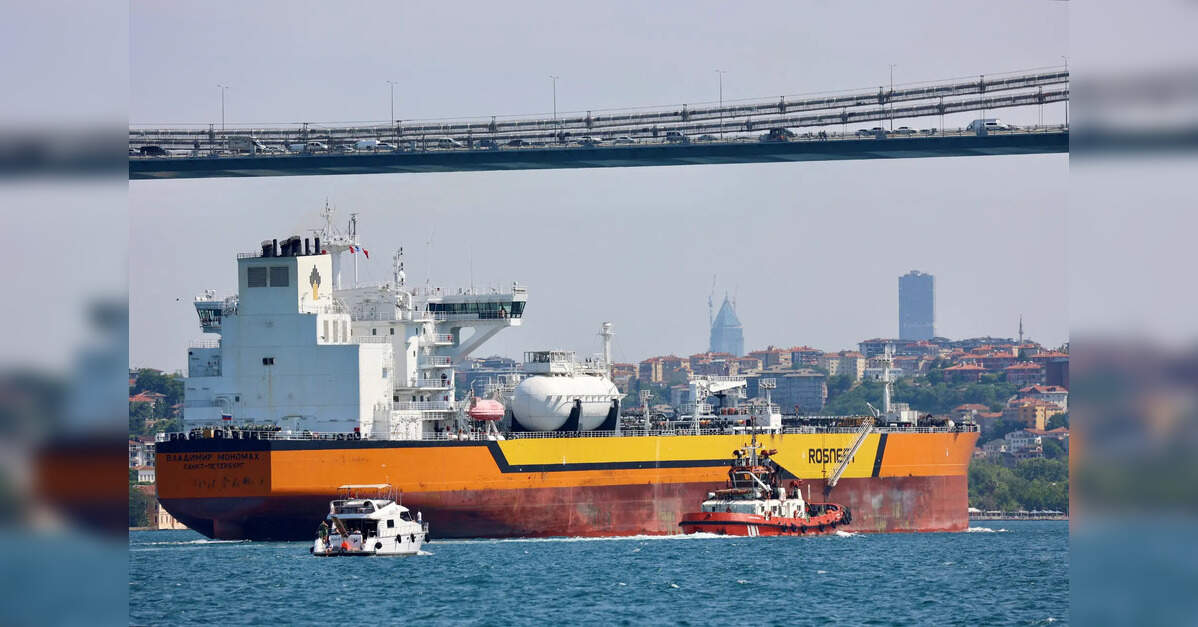
The global oil landscape is once again shifting, driven by a widening policy chasm between key Western powers regarding Russian crude exports. This divergence, particularly between the United States and the European Union, is not merely a diplomatic squabble; it has tangible implications for global supply chains, trade routes, and ultimately, crude pricing. Our analysis indicates an immediate impact on October’s crude flows to India, a critical market for Russian oil, signaling a new layer of complexity for investors navigating the volatile energy sector.
Geopolitical Fault Lines Rattle Russian Oil Trade
A significant policy divergence has emerged between the United States and its European allies regarding Russian oil exports to India. While the EU and G7 nations initially implemented a price cap mechanism designed to limit Russia’s oil revenues while keeping crude flowing globally, the current U.S. administration has adopted a more aggressive stance. Washington is now demanding a complete cessation of Indian purchases of Russian oil, backing this demand with substantial tariffs, reportedly up to 50%, on Indian exports to the U.S. This direct pressure on New Delhi stands in stark contrast to the original price cap’s intent, which effectively encouraged nations like India and China to purchase discounted Russian crude. This policy contradiction has prompted leading geopolitical analysts to observe a breakdown in sanctions coordination among G7 nations, fostering an environment of heightened uncertainty for all participants in the Russian oil trade.
The immediate fallout from this policy friction is being felt by Indian importers. Faced with increased scrutiny from banking institutions and escalating risks associated with the trade, Indian buyers are now pushing for significantly wider discounts from Russian sellers. Traders indicate that discounts of approximately $10 per barrel relative to benchmark Brent prices are now necessary to offset these risks and align with revised price cap considerations, a substantial increase from the $2-3 per barrel seen just last month. In response, some Russian suppliers are reportedly redirecting October spot cargoes to China, where demand for deeper discounts may not be as pronounced, signaling a tangible shift in trade flows away from India.
October Supply Adjustments and Market Realities
The operational impact of this geopolitical friction is already visible in forward-looking trade data. Our proprietary intelligence on loading plans suggests that Russian crude arrivals in India for October are projected to average approximately 1.4 million barrels per day (mbpd). This marks a notable decrease from the 1.6 mbpd observed in September and 1.5 mbpd in August, confirming a slight but significant reduction in volumes directed to India. While some of these barrels may find alternative destinations, the uncertainty surrounding pricing and logistics creates friction in the global supply chain.
The broader market is attempting to price in these evolving dynamics. As of today, Brent crude trades at $98.51 per barrel, reflecting a slight decline of 0.89% within a daily range of $97.92 to $98.67. Similarly, WTI crude is trading at $90.06, down 1.22% with a range of $89.57 to $90.26. This modest intraday dip contributes to a more pronounced trend observed over the past two weeks, where Brent crude has shed over $14 per barrel, a significant 12.4% reduction from its high of $112.57 on March 27th. This sustained downward pressure suggests that while the market is reacting to various factors, the uncertainty surrounding Russian supply logistics and the potential for shifts in global trade patterns are certainly contributing to a cautious sentiment among investors, despite the potential for localized supply tightening.
Investor Focus: Seeking Clarity Amidst Volatility
Our proprietary reader intent data offers a direct window into what matters most to sophisticated oil and gas investors. This week, we’ve seen a consistent surge in inquiries focused on “What are OPEC+ current production quotas?” and “What is the current Brent crude price and what model powers this response?” This clearly indicates that investors are grappling with dual concerns: understanding the foundational elements of global supply management and seeking real-time, reliable data to inform their decisions. The current geopolitical friction surrounding Russian oil exports only amplifies these questions, as the actions of non-OPEC+ producers and major consumers directly influence the supply-demand balance that OPEC+ aims to manage.
The breakdown in U.S.-EU sanctions coordination introduces an additional layer of complexity for OPEC+. Any sustained reduction in Russian exports, or significant shifts in trade routes and pricing structures, could alter the global supply picture, potentially influencing OPEC+’s strategy. Investors are keenly aware that disruptions in Russian supply, even if partially offset by re-routing, can tighten markets and impact benchmark prices. Therefore, the market is closely watching for any signals from major producers regarding their response to these evolving geopolitical risks, highlighting the critical importance of transparent and timely information.
Forward Outlook: OPEC+ and Escalating Sanctions Risk
The coming days will be crucial for the oil markets, particularly with key events on the horizon. The OPEC+ Joint Ministerial Monitoring Committee (JMMC) is scheduled to meet on April 18th, followed by the full OPEC+ Ministerial Meeting on April 20th. These meetings occur against a backdrop of escalating geopolitical tensions and the aforementioned policy divergence on Russian oil. The committee will undoubtedly be weighing the implications of potential shifts in Russian export volumes and destinations, as well as the broader market sentiment, when assessing current production quotas and future output strategies. Any signals regarding supply adjustments from this influential group could significantly impact price trajectories.
Adding to the uncertainty is the European Union’s ongoing internal discussions. The European Commission chief recently indicated that the EU is considering a faster phase-out of Russian fossil fuels as part of new sanctions against Moscow. An EU sanctions envoy and team are currently in Washington for discussions, suggesting potential for further coordinated, or even unilateral, European action. Should the EU indeed accelerate its move away from Russian oil, it would create a significant vacuum in global supply that would be difficult to fill quickly, potentially sending crude prices higher. Investors must remain vigilant, as the interplay between geopolitical strategy, trade policy, and OPEC+ decisions will continue to define oil market volatility in the months ahead.


