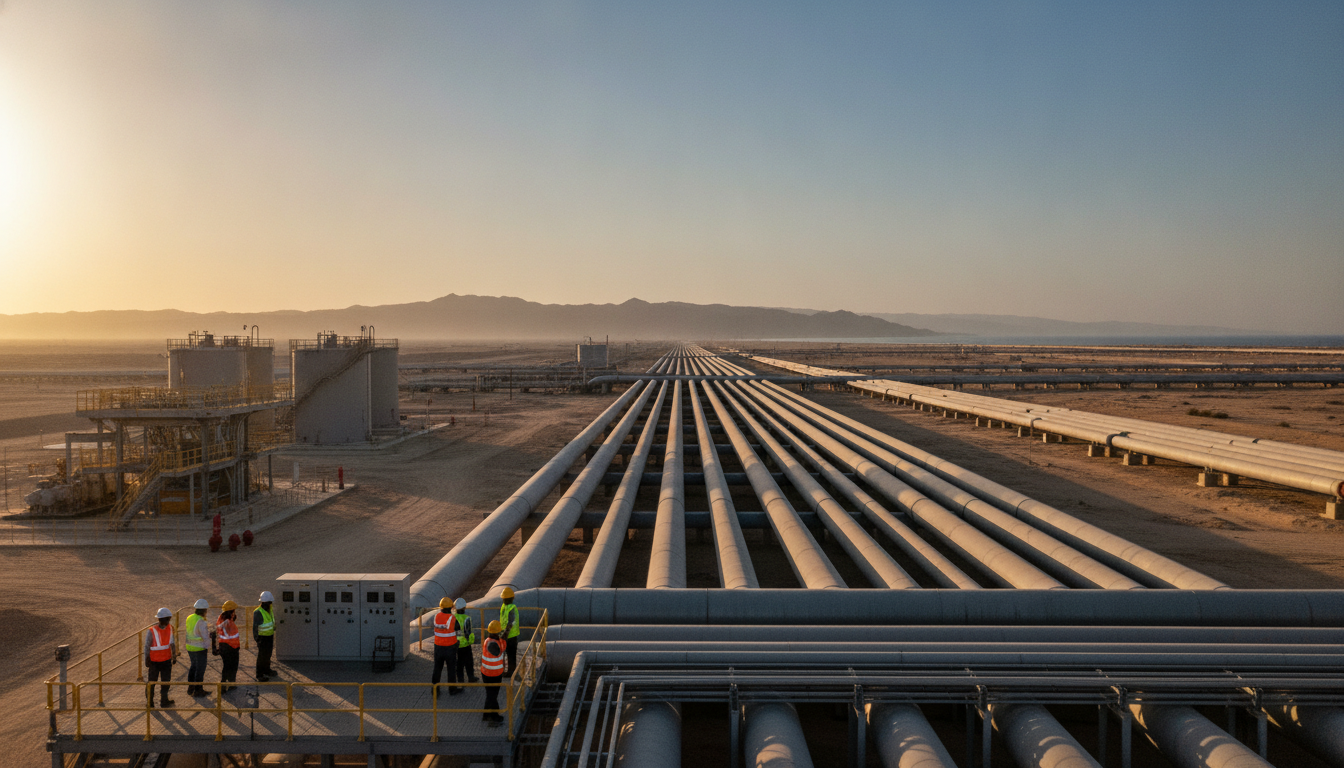
The Great Energy Bypass: Gulf Nations Invest Billions to Reroute Critical Oil Flows
The geopolitical landscape of global energy is undergoing a monumental transformation as Gulf oil producers embark on a multi-billion-dollar infrastructure spree aimed at decoupling their vital crude exports from the volatile Strait of Hormuz. Historically, this narrow waterway has funneled approximately 15 million barrels of Persian Gulf oil to global markets daily. However, with escalating regional instability and its profound impact on oil prices, a strategic imperative has taken hold: reroute these critical supplies to alternative ports along the Red Sea, the Suez Canal, and the Gulf of Oman, fundamentally reshaping global energy trade routes.
This unprecedented wave of investment sees at least seven major pipeline projects either under active construction, in advanced planning stages, or under serious discussion among government entities, leading oil companies, and energy analysts. While even alternative routes face their own set of vulnerabilities – as recent disruptions by Houthi rebels in the Red Sea have demonstrated – the current geopolitical climate has served as an unequivocal wake-up call. Gulf producers are determined to mitigate their heavy reliance on a transit point geographically hugging Iran’s coast, even if it entails longer and potentially more expensive journeys for their crude to reach its final destinations. Victoria Grabenwoger, a senior researcher at the data and analytics firm Kpler, articulates this sentiment precisely: “Relying so heavily on the Strait of Hormuz is no longer a prudent long-term strategy.”
Existing Lifelines: Saudi and UAE’s Early Diversification Efforts
The foresight of past decades has provided some immediate relief amidst the current disruptions. Saudi Arabia’s East-West pipeline, a strategic asset built in the 1980s during the Iran-Iraq war, has proven invaluable. This conduit efficiently transports crude across the desert from the colossal Abqaiq processing facility to the Red Sea port of Yanbu. From Yanbu, tankers can navigate south to the Arabian Sea or north towards the Suez Canal. Similarly, the United Arab Emirates has increasingly leveraged its port of Fujairah, strategically located on the Gulf of Oman, roughly 145 kilometers south of Hormuz.
These two critical bypasses, prior to the most recent geopolitical escalations, possessed a combined spare capacity estimated by the US Energy Information Agency at a significant 3.5 million to 5.5 million barrels per day. Today, these pipelines are operating near their maximum capabilities, underscoring the urgency and strategic value of expanding these and developing new channels.
UAE Accelerates $3 Billion Fujairah Expansion
Highlighting the rapid response to the evolving risk profile, Abu Dhabi’s state-owned oil company is fast-tracking a substantial $3 billion investment into a new 300-kilometer pipeline to Fujairah. This pipeline, designed to run parallel to an existing one, is set to boost oil supplies to Fujairah by over 1.2 million barrels per day. The project, which commenced before the recent regional tensions, is reportedly now halfway to completion, according to Kpler.
While the initial completion target was early 2027, Kpler suggests a mid-2027 timeframe is more realistic, allowing for necessary expansions at the Fujairah port itself. Kpler’s Grabenwoger emphasizes that this ambitious schedule has become “feasible only against the backdrop of the Strait of Hormuz blockade,” illustrating the direct correlation between geopolitical risk and accelerated infrastructure development. This investment underscores the UAE’s commitment to enhancing its energy export resilience and cementing Fujairah’s role as a primary alternative export hub.
Iraq’s Ambitious Western Pivots for Oil Exports
Iraq, a nation profoundly reliant on oil sales for approximately 90% of its national revenue, faces a particularly acute challenge, having been forced to scale back production due to its heavy dependence on Hormuz for southern oil field exports. In response, Baghdad is actively pursuing alternative export avenues, engaging with US companies on several key pipeline initiatives. One significant project aims to route crude from the Basra oil terminal – which previously exported over 3 million barrels daily – westward to the Turkish port of Ceyhan on the Mediterranean Sea.
This pipeline system is also envisioned with a branch extending to the Mediterranean port of Baniyas in Syria, with a potential capacity of up to 2 million barrels per day. The US State Department has previously recognized Baniyas as a “critical energy corridor,” highlighting its strategic significance. Iraqi officials have also held discussions with Jordan to advance long-standing plans for a pipeline connecting Basra to Aqaba, which would facilitate exports via the Red Sea or the Suez Canal to Asian and other international markets.
Assessing the New Energy Corridors: Capacity, Costs, and Persistent Risks
Collectively, these new projects represent a monumental shift in regional energy infrastructure. Analysts at investment bank Goldman Sachs project that these bypass initiatives could collectively carry 3.8 million barrels of oil per day by the close of next year, expanding further to 7.3 million barrels per day by the end of 2028. This would effectively insulate approximately 60% of the Gulf’s total pre-war exports, estimated at 23 million barrels daily, from a potential Hormuz cutoff.
However, investors must also acknowledge the inherent new challenges and vulnerabilities these alternative routes present. Pipelines directing oil from the Persian Gulf to the Mediterranean, while bypassing Hormuz, send crude in the “wrong” direction for many Asian customers, necessitating significantly longer and more expensive voyages around the southern tip of Africa. Furthermore, any additional supplies piped to the Red Sea remain exposed to the threat of Houthi rebel attacks in Yemen, specifically at the critical Bab el-Mandeb Strait, where shipping has been successfully disrupted before. While the Suez Canal offers an alternative for Red Sea exports, it cannot accommodate the industry’s largest and most cost-efficient tankers, which can hold up to 2 million barrels per vessel.
Even pipelines seemingly far removed from direct Iranian influence are not immune. The Saudi East-West pipeline itself experienced a temporary shutdown following a Houthi drone strike in May 2019, demonstrating the pervasive reach of regional threats. This underscores that while new infrastructure offers diversification from Hormuz, it often introduces new, albeit different, sets of geopolitical and operational risks that investors must carefully weigh.
The Unresolved LNG Dilemma
While crude oil infrastructure receives the lion’s share of attention, a significant, and as yet largely unaddressed, challenge pertains to liquefied natural gas (LNG). Before the current regional instability, approximately one-fifth of the world’s LNG supply – much of it originating from Qatar – also transited the Strait of Hormuz. Developing equivalent bypass solutions for LNG, which requires specialized liquefaction, regasification, and shipping infrastructure, presents an even more complex and substantially more expensive problem for the industry to tackle in the coming years.
The Gulf’s strategic pivot away from a singular choke point marks a new era in global energy geopolitics. While the billions in investment promise greater resilience and diversified export capabilities, they also introduce new layers of logistical complexity and inherent vulnerabilities that demand continuous monitoring by energy market participants and investors alike.


