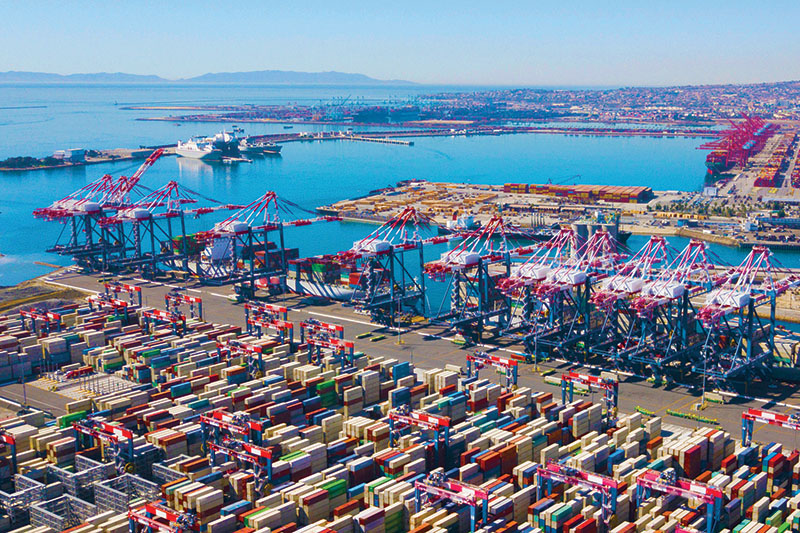
The recent cooperative agreement between the South Coast Air Quality Management District and the Ports of Long Beach and Los Angeles marks a pivotal moment for the energy sector. This isn’t just another environmental headline; it’s a legally binding mandate for the nation’s two busiest ports to transition to zero-emission cargo operations by 2029. For oil and gas investors, this signifies a tangible, accelerated shift in demand profiles within a critical industrial segment, forcing a re-evaluation of long-term investment theses. While the immediate impact on global crude demand may seem marginal, the precedent set by this enforceable agreement in a major economic hub offers a potent glimpse into the future of industrial decarbonization and its inevitable reshaping of energy markets.
Immediate Demand Shifts and Current Market Realities
The agreement outlines a phased approach, setting clear milestones for developing and implementing charging and fueling plans. Penalties ranging from $50,000 to $200,000 per violation underscore the enforceability of this commitment, pushing port operators to rapidly adopt zero-emission equipment, vehicles, and eventually, vessels. This translates to a direct and accelerating reduction in demand for diesel, gasoline, and other traditional bunker fuels used in port logistics. As of today, Brent Crude trades at $90.38 per barrel, reflecting a significant 9.07% drop within a single trading session, with a day range between $86.08 and $98.97. Similarly, WTI Crude has fallen to $82.59, down 9.41%, while gasoline prices have dipped to $2.93, a 5.18% decrease. This current market volatility, which has seen Brent decline by nearly 20% in the last 14 days from $112.78, highlights the broader sensitivities of energy markets. While the port’s transition is a long-term structural shift, these localized demand erosions, when aggregated across future similar initiatives, will contribute to the ongoing rebalancing of global energy consumption, further pressuring demand for conventional refined products.
Investor Questions: Navigating Price Direction and Long-Term Outlook
Our proprietary reader intent data reveals a clear focus among investors on directional price movements and future market forecasts. Questions like “is WTI going up or down?” and “what do you predict the price of oil per barrel will be by end of 2026?” dominate discussions. The LA/LB port agreement offers a concrete example of how demand-side pressures are emerging, even as supply dynamics remain central to short-term price discovery. While broad macroeconomic factors and geopolitical events will continue to dictate near-term crude price swings, these specific, mandated transitions in critical industrial sectors provide a bearish signal for long-term demand for certain petroleum products. Investors need to understand that such initiatives, though localized, contribute to a cumulative effect that will increasingly challenge the traditional growth narrative for fossil fuels. Companies heavily reliant on supplying conventional fuels to sectors undergoing such rapid decarbonization face structural headwinds that must be factored into their valuations, impacting how assets like Repsol might perform against a backdrop of accelerating energy transition.
Strategic Adaptation: New Avenues for Oil & Gas Investment
The push for zero-emission ports by 2029 doesn’t spell the end for all energy players, but rather demands strategic adaptation. While demand for traditional fuels diminishes, new markets emerge for alternative energy solutions and supporting infrastructure. This includes significant opportunities for companies involved in renewable electricity generation, battery storage, hydrogen production (both green and blue), and advanced biofuels. The necessary build-out of charging and fueling infrastructure at the ports represents a multi-billion-dollar investment opportunity. Oil and gas majors with expertise in large-scale project management, energy logistics, and capital deployment are well-positioned to pivot into these new energy segments. Investment in companies developing carbon capture technologies, or those specializing in the transportation and storage of new energy carriers like ammonia or methanol, could see substantial growth as these port initiatives gain traction globally. This is a clear signal that the capital allocation strategies of diversified energy companies must increasingly prioritize these transitional technologies.
Upcoming Events and the Pace of Transition
The broader energy market is currently awaiting several key events that will influence short-term price stability and, by extension, the economic viability and pace of these green transitions. The upcoming OPEC+ Joint Ministerial Monitoring Committee (JMMC) Meeting on April 19th, followed by the full OPEC+ Ministerial Meeting on April 20th, will provide critical insights into global supply management. Any decisions regarding production cuts or increases will immediately impact crude prices. Additionally, the weekly API and EIA inventory reports on April 21st, 22nd, 28th, and 29th, alongside the Baker Hughes Rig Count on April 24th and May 1st, will offer real-time data on U.S. supply and demand dynamics. While these events primarily dictate short-term market sentiment, sustained periods of lower oil prices, potentially exacerbated by robust supply or weak global demand, could make the economic case for transitioning to zero-emission infrastructure even more compelling. Conversely, prolonged high prices might initially slow adoption rates due to the higher upfront costs of new technologies, though the regulatory mandates like those at LA/LB will ultimately override market-driven hesitations. Investors must monitor these short-term market signals while keeping a firm eye on the long-term, legally-mandated shifts driving the energy transition.