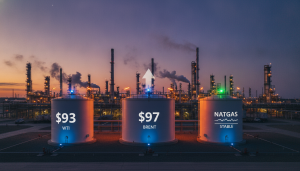
Global energy markets are grappling with a rapidly intensifying geopolitical landscape, pushing crude oil benchmarks significantly higher as investors price in escalating supply disruption risks. Against a backdrop of fragile peace efforts and regional instability, the trajectory for oil prices appears firmly upward, commanding the attention of every serious energy investor.
Geopolitical Volatility Ignites Oil’s Ascent
The Middle East remains a critical flashpoint, with prospects for de-escalation between major powers dimming considerably. Reports indicate that efforts towards a lasting peace arrangement are in a highly precarious state, exacerbated by rejections of proposed truces from key non-state actors. This prevailing uncertainty has dramatically lowered market expectations for a rapid resolution, with some forecasting mechanisms placing the probability of a permanent accord between the US and Iran by mid-June at a mere 6%. Such low odds underscore the deep-seated apprehension within global markets regarding regional stability.
This heightened geopolitical tension has translated directly into a significant risk premium for crude oil. Both Brent and West Texas Intermediate (WTI) futures saw gains of approximately 5% during recent trading, with market participants now eyeing the psychologically important US$100 per barrel threshold. The primary catalyst for this upward momentum is the perceived threat to maritime traffic in the Strait of Hormuz. This vital chokepoint, through which a substantial portion of the world’s seaborne crude oil passes, faces potential closure or severe disruption due to the ongoing escalation, leading to immediate pricing adjustments across the energy complex.
Global Equities Experience Significant Sell-Off
The geopolitical tremors, combined with other economic factors, have sent shockwaves through global equity markets. Overnight, Asia-Pacific bourses bore the brunt of a significant sell-off. Japan’s Nikkei 225 index recorded a substantial decline of over 4%, while South Korea’s KOSPI index experienced an even more severe contraction, tumbling over 7%—marking its most challenging trading session since early March. Major technology players within the KOSPI, Samsung and SK Hynix, collectively representing roughly half of the index’s weight, each saw their share values plummet by more than 10% at the market open, signaling broad investor jitters.
This regional downturn followed a challenging close for major US benchmarks. Stronger-than-expected US jobs data, paradoxically, contributed to a bearish sentiment, particularly within the technology sector. The S&P 500 index shed 200 points, or 2.6%, closing at 7,383, thereby forming a weekly bearish outside pattern and concluding an impressive nine-week winning streak. The Nasdaq 100, heavily weighted towards technology stocks, suffered an even steeper decline, falling 1,450 points, or 4.8%, to 28,957. This marked its largest single-day percentage drop since April 2025, highlighting investor concerns over potential monetary policy shifts in response to a robust economy.
Robust US Jobs Report Sets Stage for Inflation Focus
The latter half of the previous week was dominated by the release of the May US payrolls report, which painted a picture of a remarkably resilient labor market. The economy added a robust 172,000 jobs, comfortably surpassing the most optimistic upper estimate of 125,000 from economists. Furthermore, the two-month net revision added an additional 93,000 payrolls, underscoring underlying strength. The national unemployment rate held steady at 4.3%, while wage growth met expectations, increasing 3.4% year-over-year and 0.3% month-over-month. Notably, the year-over-year wage growth figure registered slightly lower than April’s 3.6% reading, offering a nuanced perspective on inflationary pressures.
While the headline numbers undoubtedly reflect a strong job market, a closer examination reveals that hiring momentum was concentrated within a relatively narrow band of sectors. Indeed, when these specific industries are excluded from the analysis, the broader trend indicates a multi-year decline in job creation. This sector-specific strength suggests that while the overall labor market remains tight, the underlying dynamics might not be as universally robust as the headline figure implies. Nonetheless, the report’s overall strength is now shifting investor and Federal Reserve attention firmly towards this week’s impending US inflation data, which will be crucial in shaping expectations for future interest rate policy and its potential impact on economic growth and energy demand.
Navigating a Complex Investment Landscape for Energy
For oil and gas investors, the confluence of persistent geopolitical instability, volatile equity markets, and evolving economic data presents a complex, yet potentially rewarding, landscape. The immediate surge in crude prices highlights the ongoing sensitivity of energy markets to supply shocks, particularly those emanating from the Middle East. While equity investors contend with sector-specific weaknesses and broader market downturns, the energy sector may find a degree of insulation or even benefit from the flight to commodities as a hedge against inflation and instability. The interplay between a strong US economy, potential Fed actions, and the ever-present geopolitical ‘black swan’ risks will continue to define market narratives. Astute investors will need to carefully monitor these intertwined factors, recognizing that strategic positioning in the energy complex could offer resilience and opportunities amidst a period of elevated global uncertainty.