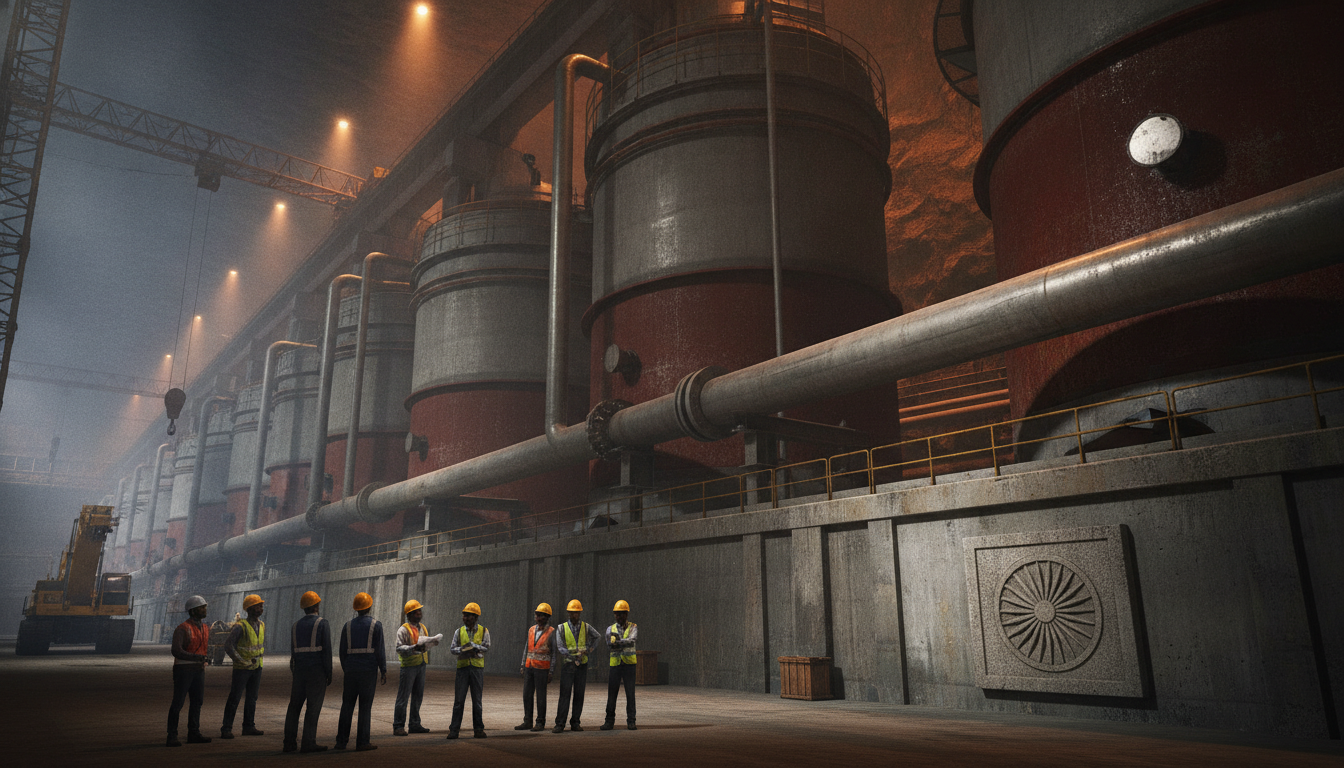
India Accelerates Strategic Oil Reserve Expansion with Major PPP Investment
India is significantly advancing its energy security framework, embarking on the second phase of its strategic petroleum reserve (SPR) program with an estimated investment of ₹14,527 crore. This substantial infrastructure push, designed under a robust public-private partnership (PPP) model, signals the nation’s proactive stance in safeguarding its critical crude oil supplies amidst a volatile global energy landscape. The government has committed to providing viability gap funding (VGF) that will cover up to 60 percent of the total project expenditure, underscoring the strategic importance of this initiative.
The ambitious Phase-II expansion, which received its green light in July 2021, is set to bolster India’s commercial-cum-strategic crude oil storage capacity by an impressive 6.5 million tonnes. These vital new facilities will be strategically located across two key states: Odisha, which will host a 4 million tonne reserve, and Karnataka, earmarked for a 2.5 million tonne capacity. The announcement, confirmed by Minister of State for Petroleum and Natural Gas Suresh Gopi in a parliamentary address, highlights a continuous governmental focus on identifying and developing new sites for further augmenting India’s strategic petroleum reserves.
Building on Foundational Reserves: Phase I Achievements
This upcoming expansion builds upon the foundation laid by Phase-I of India’s SPR program. Under the stewardship of Indian Strategic Petroleum Reserve Ltd (ISPRL), the nation successfully established strategic petroleum reserve facilities with a combined capacity of 5.33 million tonnes. These existing reserves are strategically situated at Visakhapatnam (1.33 million tonnes), Mangaluru (1.5 million tonnes), and Padur (2.5 million tonnes), all of which became operational between 2016 and 2018. It is noteworthy for investors that the volume of crude held within these caverns is dynamically managed, fluctuating in response to prevailing market conditions and geopolitical considerations.
A key distinction for market participants lies in the funding models. While the initial Phase-I SPR facilities were developed and constructed without direct government budgetary support, Phase-II embraces a PPP framework. This shift enables private sector participation, leveraging expertise and capital, with the government’s VGF commitment of up to 60 percent of the ₹14,527 crore total project cost providing a significant de-risking element for potential investors. This hybrid model signals a mature approach to large-scale infrastructure development, blending public strategic necessity with private operational efficiency.
Strategic Partnerships and Diversification for Energy Resilience
India’s strategy extends beyond domestic infrastructure. ISPRL has forged a crucial agreement with the Abu Dhabi National Oil Company (ADNOC), granting the UAE energy giant access to a 750,000 tonne cavern at the Mangaluru facility. This collaboration underscores a growing trend of international partnerships in managing strategic reserves, offering mutual benefits in energy security and operational flexibility. Furthermore, a non-binding memorandum of understanding for broader strategic collaboration has also been signed between the two entities, indicating deeper ties in the energy sector.
The expansion of SPRs is merely one facet of a comprehensive, multi-pronged strategy designed to bolster India’s energy security and mitigate supply risks. The government actively monitors global threats that could lead to disruptions in energy supplies. This vigilance has spurred a remarkable diversification in India’s energy sourcing portfolio. The nation now procures crude oil from 41 countries, a significant expansion from 27 previously, while LNG sourcing has similarly broadened from six to 15 countries. Such extensive diversification substantially reduces reliance on any single nation, region, or transit route, thereby enhancing India’s capacity to navigate market volatility and manage potential supply disruptions effectively.
Broader Policy Initiatives to Reduce Import Dependency
Strategic petroleum reserves are designed to act as a crucial buffer against short-term supply shocks, providing immediate relief during unforeseen events. However, India’s long-term vision encompasses a holistic approach to reducing its overall import dependency on crude oil. This comprehensive strategy includes a variety of demand-side and supply-side initiatives:
- **Demand Substitution:** Aggressively promoting the widespread adoption of natural gas as both fuel and feedstock across various sectors, aiming to increase its share in the national economy and transition towards a gas-based economic model.
- **Alternate Fuels:** Driving the proliferation of alternative fuels such as Compressed Natural Gas (CNG), Piped Natural Gas (PNG), ethanol, compressed biogas, and biodiesel, fostering a more sustainable and diversified energy mix.
- **Refinery Efficiency:** Implementing continuous improvements in refinery processes to optimize resource utilization and reduce waste.
- **Energy Efficiency and Conservation:** Vigorously promoting energy efficiency measures and conservation practices across industrial, commercial, and residential sectors.
- **Boosting Domestic Production:** Introducing and implementing various policy initiatives specifically designed to stimulate and increase the indigenous production of oil and natural gas, thereby reducing the reliance on international markets.
These concerted efforts reflect India’s deep commitment to strengthening its energy independence and resilience. For investors tracking global energy markets and infrastructure opportunities, India’s strategic petroleum reserve expansion, coupled with its broader energy policy landscape, presents a compelling case for growth and stability in one of the world’s most dynamic energy consumption regions. The government’s proactive approach to energy security not only stabilizes domestic markets but also creates significant opportunities for private sector engagement in critical national infrastructure projects.


