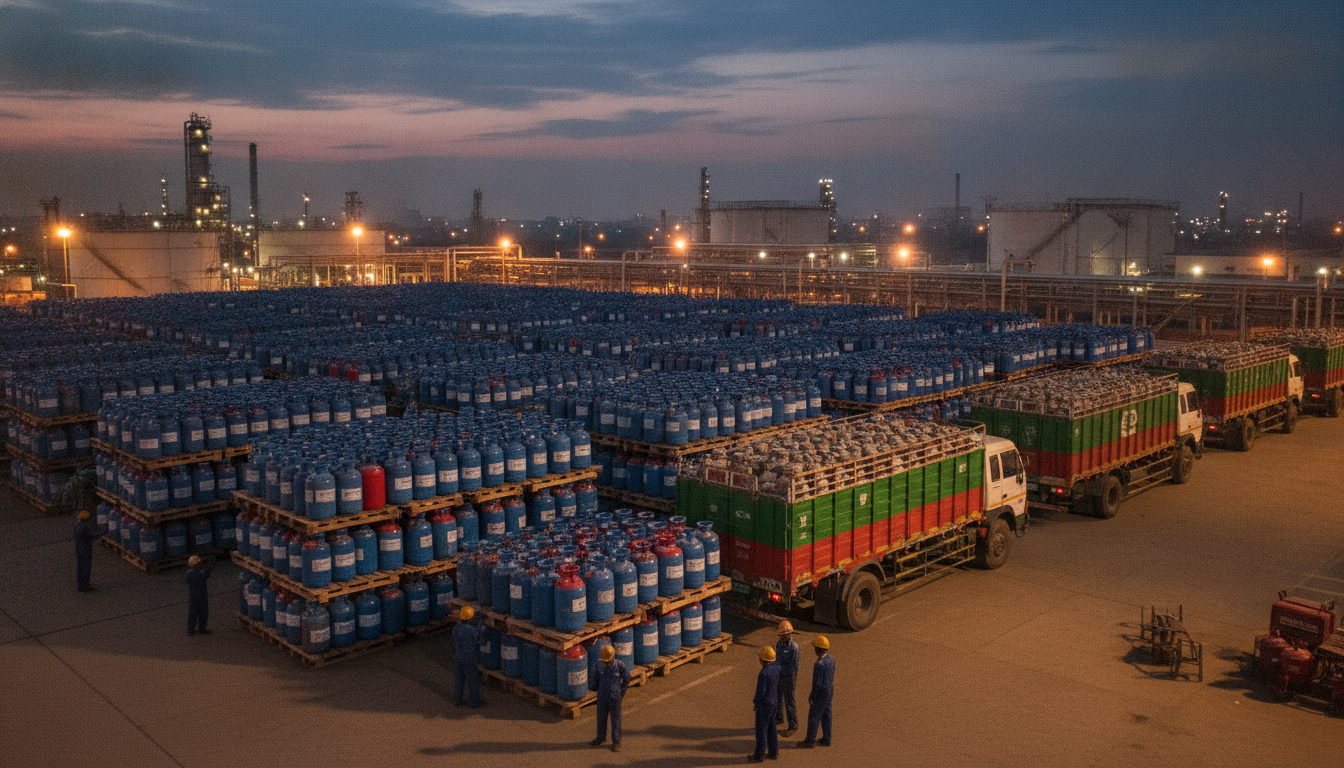
India’s robust intervention in its domestic Liquefied Petroleum Gas (LPG) market continues to shield consumers from soaring international prices, but at a significant financial cost. Recent statements from the government underscore the substantial implicit subsidies embedded in retail LPG cylinder prices, creating both consumer affordability and considerable under-recoveries for state-owned Oil Marketing Companies (OMCs).
The Subsidy Shield: Navigating Global Price Volatility
As global energy markets reel from geopolitical instability, particularly the West Asia crisis, India’s Ministry of Petroleum and Natural Gas confirms a critical support mechanism for domestic LPG. In June 2026, each standard 14.2 kg LPG cylinder carried an implicit subsidy, or “under-recovery,” exceeding ₹700. This crucial intervention kept the retail selling price (RSP) at an affordable ₹942 per cylinder, a stark contrast to the market-determined price of ₹1,695 that consumers would have faced without government support.
The severity of global price movements is evident in key benchmarks. The average Saudi Contract Price (Saudi CP), a widely followed international standard for LPG, surged from USD 780 per metric tonne in April and May 2026 to USD 796 per metric tonne by June 2026. This upward trajectory in international costs directly drives the escalating under-recoveries. Looking ahead, the implicit subsidy, while slightly moderating, remained substantial at over ₹500 per 14.2 kg cylinder for July 2026, indicating sustained government efforts to stabilize consumer costs.
Targeted Support: Empowering Ujjwala Beneficiaries
Beyond the broad implicit subsidy, the government operates a targeted support system for beneficiaries of the Pradhan Mantri Ujjwala Yojana (PMUY) scheme. For over 10.5 crore PMUY consumers, the effective price of an LPG cylinder in Delhi stands at merely ₹642. This highly subsidized rate is achieved through a direct targeted subsidy of ₹300 per cylinder, which is provided in addition to the underlying implicit subsidy of more than ₹500 per cylinder available to all consumers. This multi-layered subsidy architecture highlights the government’s commitment to energy access and affordability for vulnerable households, a key social objective with significant budgetary implications.
Resilience in Supply: Countering Geopolitical Shocks
The recent crisis in West Asia, particularly the potential disruption of the Strait of Hormuz, posed a formidable challenge to India’s energy security. India traditionally imports approximately 60% of its total LPG requirements, with a substantial 90% of these vital imports transiting through the critical Strait of Hormuz waterway. Such a concentrated reliance creates inherent vulnerabilities to geopolitical tensions.
In response to this unprecedented threat, the government implemented a comprehensive strategy to maintain uninterrupted LPG supplies nationwide. Key measures included a significant boost in domestic LPG production, escalating daily output from 34 thousand metric tonnes (TMT) to 54 TMT. Furthermore, the strategy encompassed diversifying import sources to reduce reliance on single trade routes, prioritizing household consumption over industrial uses, dynamically managing existing stock inventories, and strategically reallocating supplies across different regions of the country to ensure equitable distribution.
These proactive steps proved instrumental in averting a supply crisis. Between March and June 2026, a critical period during the peak of the West Asia crisis, the system successfully delivered over 56 crore domestic LPG cylinders, including more than 12 crore cylinders specifically to Ujjwala families. This demonstrates remarkable logistical resilience and strategic foresight in a challenging global environment, ensuring energy availability for millions of households.
OMC Financials: The Balancing Act of Subsidies
While consumers enjoy stable prices, the financial implications for India’s public sector Oil Marketing Companies (OMCs) are substantial. These companies bear the initial burden of selling LPG below market rates, leading to “under-recoveries.” To mitigate this impact, the government has provided financial assistance, including a payment of ₹22,000 crore to OMCs in FY2022-23. Furthermore, the government has committed an additional ₹30,000 crore during the financial years 2025-26 and 2026-27 to support the affordability of domestic LPG.
However, despite these governmental disbursements, the accumulated under-recovery for PSU OMCs on domestic LPG remains a significant concern for investors. As of June 30, 2026, the total accumulated under-recovery surpassed ₹51,000 crore. This substantial figure underscores the ongoing financial strain on these entities, directly impacting their profitability, balance sheets, and capital allocation strategies. Investors closely monitor these under-recovery levels, as they are a crucial factor influencing the financial health and investment attractiveness of OMCs in the Indian energy landscape.
The government’s dual objective of ensuring energy affordability for its vast population and maintaining the operational viability of its OMCs presents a complex financial tightrope walk. The balance between consumer protection and corporate profitability will continue to be a defining characteristic of India’s energy policy, directly shaping the investment environment for key players in the oil and gas sector.


