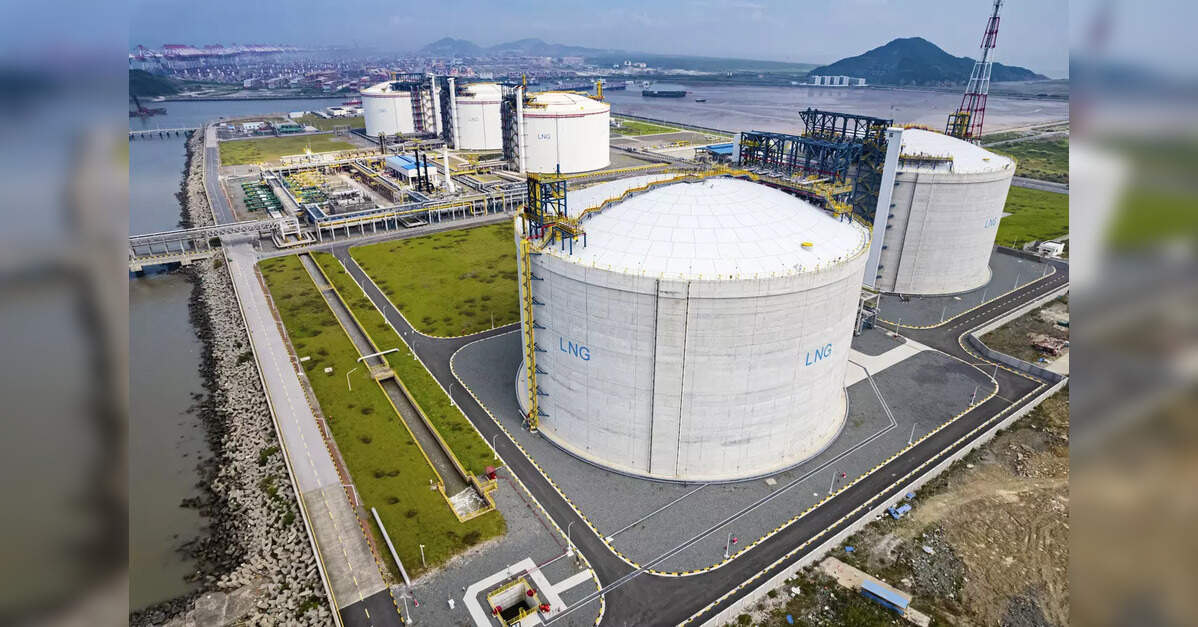
India’s energy landscape is undergoing a profound transformation, marked by a growing reliance on imported liquefied natural gas (LNG) to bridge a persistent domestic supply gap. Recent data from September 2025 highlights a clear trend: national gas production continues to slide, while LNG imports nudge upwards. For investors, this dynamic presents both challenges and lucrative opportunities in the global gas market, particularly as commodity prices navigate a period of significant volatility. Understanding these internal shifts, juxtaposed against broader market movements and anticipated global events, is crucial for positioning portfolios in the evolving energy sector.
India’s Widening Gas Supply-Demand Imbalance
The latest figures from September 2025 paint a stark picture for India’s domestic natural gas supply. Gross production fell by 3.9% year-on-year to 2,860 million standard cubic metres (MMSCM). This decline underscores the continued struggle of local producers, including major players like ONGC (1,518 MMSCM) and OIL (254 MMSCM), to meet the nation’s burgeoning energy needs. Concurrently, LNG imports saw a modest but significant 1.2% increase, reaching 2,819 MMSCM for the month. This rising import dependency is a critical signal for investors, indicating a sustained and potentially growing demand for international LNG cargoes. While total gas available for sale dipped by 1.1% year-on-year to 5,207 MMSCM, the underlying trend points to an increasing reliance on overseas gas supplies to fuel India’s economic expansion and urbanization. This structural deficit positions India as a key demand driver in the global LNG market, offering long-term upside for LNG producers, traders, and infrastructure developers.
Navigating Global Crude Volatility and Its LNG Ripple Effects
While India’s domestic gas dynamics are specific, they operate within a broader, often volatile, global energy market. As of today, Brent crude trades at $90.38 per barrel, a notable 9.07% decline, with the day’s range fluctuating between $86.08 and $98.97. Similarly, WTI crude has experienced a sharp 9.41% drop, settling at $82.59, after trading between $78.97 and $90.34. This significant daily movement follows a broader trend, with Brent having shed a substantial 19.9% from its $112.78 high on March 30, 2026. Even gasoline prices are feeling the pressure, currently at $2.93, down 5.18% today. While these figures pertain to crude oil, the interconnectedness of energy markets means such volatility inevitably sends ripple effects through the natural gas and LNG sectors. Lower crude prices can sometimes dampen enthusiasm for all fossil fuels, yet India’s structural gas deficit means its demand for LNG remains robust, potentially decoupling somewhat from crude’s short-term swings. Investors must balance this underlying demand strength with the prevailing market uncertainty, recognizing that the cost of imported LNG can still be influenced by the broader energy complex and global geopolitical factors.
Sectoral Shifts: Unlocking Niche Investment Opportunities
A deeper dive into India’s natural gas consumption patterns reveals significant sectoral shifts that offer targeted investment opportunities. In September 2025, overall consumption stood at 5,782 MMSCM, marginally higher than the previous month but 2% lower than the same period last year. However, beneath this headline figure, certain sectors are experiencing robust growth. The City Gas Distribution (CGD) segment, for instance, saw an impressive 8.8% year-on-year increase in gas usage, indicative of continued expansion in piped and compressed natural gas networks across urban centers. The petrochemical sector also demonstrated strong growth, with demand surging by 34.8%. These are critical areas for investors focusing on infrastructure and industrial gas supply. Conversely, consumption in the power sector declined by 17.2%, and the refinery sector saw a 17.8% drop, while the crucial fertiliser sector experienced a 4.9% decline. These divergent trends highlight that not all gas demand is created equal; investments aligned with India’s urban expansion and industrial growth, particularly in petrochemicals and CGD, appear to be strategically sound, leveraging the country’s long-term development trajectory.
Forward View: Upcoming Catalysts and Investor Focus
Looking ahead, the next few weeks are packed with events that could shape the near-term trajectory of energy markets, directly impacting investor sentiment and pricing for LNG. Our proprietary data indicates a particularly keen focus among investors on the future price of oil, with questions like “What do you predict the price of oil per barrel will be by end of 2026?” frequently surfacing. This highlights the pervasive uncertainty and the search for clarity amidst market volatility. The upcoming OPEC+ Joint Ministerial Monitoring Committee (JMMC) meeting on April 19, 2026, followed by the full OPEC+ Ministerial Meeting on April 20, will be critical. Decisions on production quotas, a topic our readers are frequently asking about, could significantly influence crude prices and, by extension, the broader energy complex. Further insights into market fundamentals will come from the API and EIA Weekly Crude Inventory reports on April 21, 22, 28, and 29, along with the Baker Hughes Rig Count on April 24 and May 1. For LNG investors, while India’s underlying demand remains strong, these global data points and policy decisions will dictate the cost and availability of alternative fuels, influencing competitive dynamics and overall market sentiment. Monitoring these events closely is essential for understanding the intricate interplay between global supply, demand, and price discovery in the energy sector.


