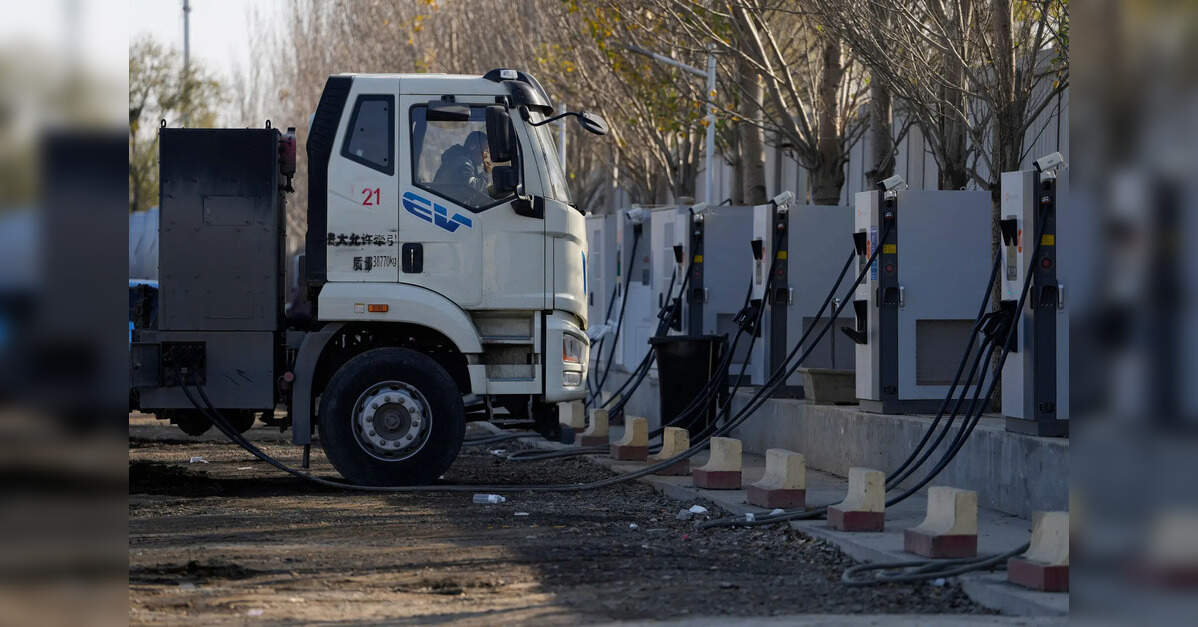
The global energy landscape is constantly evolving, but few shifts carry the long-term implications for crude demand as prominently as China’s accelerating pivot towards electric heavy-duty trucks. What was once considered a challenging segment to electrify due to battery weight and range constraints is now experiencing a profound transformation in the world’s second-largest trucking market. This rapid transition, driven by aggressive policy and compelling economics, is poised to become a significant and persistent headwind for global diesel consumption, demanding a re-evaluation of long-term oil demand forecasts by discerning investors.
China’s Electric Truck Surge Reshapes Transport Fuel Demand
The pace of electric vehicle (EV) adoption in China’s heavy-duty truck sector has far outstripped previous expectations, fundamentally altering the trajectory of transport fuel demand. In a market where virtually all new trucks ran on diesel just six years ago, electric models now command a rapidly expanding share. Proprietary data from Beijing-based trucking analytics shows battery-powered trucks accounted for 22 percent of new heavy truck sales in the first half of 2025, a substantial leap from just 9.2 percent in the same period of 2024. Industry forecasts are even more aggressive: British research firm BMI projects electric trucks will capture nearly 46 percent of new sales this year, surging to 60 percent by next year. This dramatic shift highlights not only China’s commitment to decarbonization but also its unparalleled ability to scale new technologies. Critically, this transition is largely bypassing liquefied natural gas (LNG) as an interim fuel, with electric trucks having outsold LNG models for five consecutive months this year. For oil investors, this means a direct and potent challenge to diesel demand in a nation boasting the world’s second-largest trucking fleet.
Market Implications: A Structural Headwind Amidst Price Volatility
This accelerating shift in China comes at a time when the broader oil market is already navigating a complex interplay of supply dynamics and demand concerns. As of today, Brent crude trades at $94.7, experiencing a modest intraday dip of -0.82%, with a daily range between $93.87 and $95.69. WTI crude similarly saw downward pressure, settling at $86.36, down -1.21% for the day, trading within $85.5 and $86.78. This snapshot reflects a market that has recently undergone significant re-pricing; Brent crude, for instance, has shed nearly 20% in just the past 14 days, plummeting from $118.35 on March 31st to $94.86 yesterday. While immediate price movements are often tied to geopolitical events or inventory data, the structural demand erosion emanating from China’s EV truck adoption is a growing, underlying factor that cannot be overlooked. Gasoline prices, currently at $3.02, also show a slight downtick, indicating broader market sensitivity. The International Energy Agency has already signaled a plateauing in global transport fuel demand, and the speed of China’s transition suggests that diesel use there could decline faster than many expect. This is a crucial development for oil majors and refiners, as it points to a future where a significant growth engine for refined products faces an increasingly formidable headwind.
Economics and Policy: The Dual Engines of China’s EV Truck Revolution
The rapid adoption of electric heavy-duty trucks in China is not merely a top-down mandate; it’s a commercially rational decision for fleet owners, driven by a powerful combination of government incentives and improving economics. While electric trucks initially presented a higher upfront cost – typically two to three times that of a diesel equivalent and about 18 percent more than an LNG truck – the lifetime cost savings are proving irresistible. Research by Chinese scientists estimates these savings can range from 10 percent to 26 percent, primarily due to higher energy efficiency and lower operational costs. As analyst Christopher Doleman succinctly put it, “When it comes to heavy trucks, the fleet owners in China are very bottom-line driven.” This economic advantage is further supercharged by robust government support. A 2024 scheme, for example, offers truck owners up to $19,000 to trade in older, polluting vehicles for newer, often electric, models. Concurrently, massive investments in charging infrastructure at major logistics hubs, such as the Yangtze River Delta, are alleviating range anxiety and streamlining operations, further boosting demand and accelerating the transition.
Navigating the Future: Investor Outlook and Upcoming Catalysts
Our proprietary reader intent data reveals a common thread among investors: a desire to understand the future trajectory of crude prices. Questions like “is WTI going up or down?” and “what do you predict the price of oil per barrel will be by end of 2026?” underscore the prevailing uncertainty. While recent market corrections, like Brent’s almost 20% drop in two weeks, might suggest an immediate bearish sentiment, the long-term structural shifts, exemplified by China’s EV truck pivot, add a persistent layer of demand-side pressure. Investors must consider how these evolving dynamics will interact with upcoming market catalysts. Tomorrow, April 21st, 2026, the OPEC+ JMMC Meeting will be closely watched for any signals on production policy, which could provide near-term volatility. Later this week, the EIA Weekly Petroleum Status Report on April 22nd and the Baker Hughes Rig Count on April 24th will offer crucial insights into current supply and drilling activity. Looking further ahead, the EIA will release its Short-Term Energy Outlook on May 2nd, providing updated global demand and supply forecasts for 2026, which will be vital for recalibrating long-term price expectations. While these events can drive short-term price swings, the accelerating electrification of heavy transport in China represents a fundamental, multi-year shift in demand patterns that astute investors must integrate into their long-term oil and gas investment theses. The headwind on diesel demand is not just a forecast; it’s a rapidly unfolding reality.


