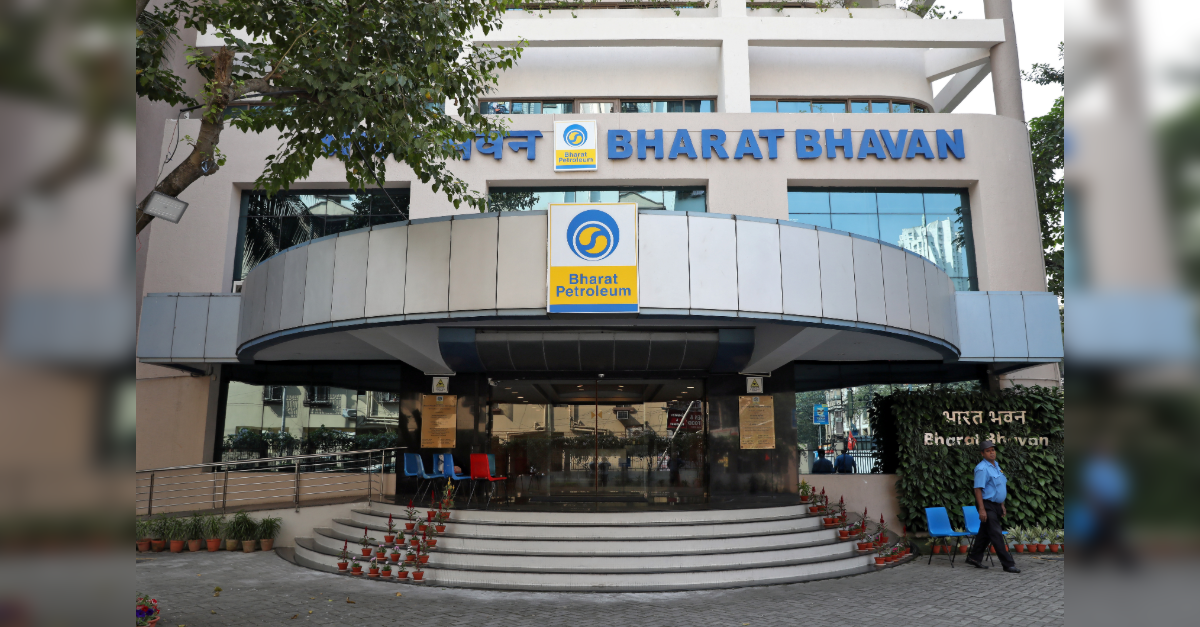
Bharat Petroleum Corporation Ltd (BPCL) has delivered a robust financial performance, reporting a consolidated net profit of ₹6,191 crore for the quarter ended September 30, 2025 (Q2 FY26). This figure represents an impressive 170% surge from the ₹2,297 crore recorded in the prior year period, underscoring significant operational strength in a dynamic market. While sequentially down slightly from Q1 FY26’s ₹6,839 crore, the year-on-year growth trajectory is undeniable. Consolidated revenue from operations for the quarter stood at ₹1,21,605 crore, a 3% increase year-on-year, even as total expenses eased. These results position BPCL as a key player to watch in the refining sector, particularly as the broader energy market grapples with renewed volatility and evolving supply-demand dynamics.
BPCL’s Operational Excellence Drives Record Margins
The stellar Q2 FY26 results for BPCL are largely attributable to strong operational efficiency and favorable product spreads, which are clearly reflected in the company’s Gross Refining Margin (GRM). For the first half of FY26, BPCL reported a GRM of $7.77 per barrel, a notable improvement from $6.12 per barrel in the corresponding period last year. This expansion in margins, despite a marginal sequential dip in profit, highlights the refiner’s ability to capitalize on market conditions. For the entire first half of FY26, the company posted a profit after tax of ₹13,031 crore on a total revenue of ₹2,51,219 crore, significantly outperforming the ₹5,139 crore profit and ₹2,46,055 crore revenue from the same period last year. Such figures confirm that BPCL has effectively navigated the raw material procurement and refined product distribution landscape, translating improved efficiency into substantial shareholder value. The board’s declaration of an interim dividend of ₹7.50 per equity share for FY26, with a record date of November 7, 2025, further signals management’s confidence in the company’s financial health and future prospects.
Navigating Crude Volatility Amidst Investor Scrutiny
While BPCL’s results reflect past performance, the current market environment presents a complex picture for investors. As of today, Brent crude trades at $90.38 per barrel, representing a significant 9.07% decline within a single day, with a range spanning $86.08 to $98.97. Similarly, WTI crude is priced at $82.59, down 9.41% for the day. This swift market correction is particularly striking when considering the 14-day Brent trend, which has plummeted from $112.78 on March 30, 2026, marking a substantial $22.4 or 19.9% reduction. Gasoline prices have followed suit, now at $2.93, down 5.18%. Our proprietary data pipelines reveal that investors are keenly focused on understanding these shifts, with common questions including “what do you predict the price of oil per barrel will be by end of 2026?” and “What are OPEC+ current production quotas?”. For refiners like BPCL, while lower crude input costs can be beneficial, the speed and magnitude of this decline, coupled with the potential implications for demand, introduce considerable uncertainty. Maintaining robust GRMs in such a volatile environment will be a critical test of their operational agility and hedging strategies.
Upcoming Events: Key Catalysts for the Energy Market
The immediate horizon is packed with critical events that could significantly influence the trajectory of crude prices and, by extension, the outlook for refiners. Investors should mark their calendars for the OPEC+ Joint Ministerial Monitoring Committee (JMMC) Meeting on April 19, 2026, swiftly followed by the full OPEC+ Ministerial Meeting on April 20. These gatherings are pivotal, as any decisions regarding production quotas will directly impact global supply levels and crude price stability. Beyond OPEC+, the market will closely monitor the API Weekly Crude Inventory reports on April 21 and April 28, and the EIA Weekly Petroleum Status Reports on April 22 and April 29. These inventory figures provide crucial insights into immediate supply-demand balances within the U.S., a major consumer market. Furthermore, the Baker Hughes Rig Count, scheduled for April 24 and May 1, will offer a glimpse into future production trends by indicating drilling activity. For BPCL and its peers, understanding the outcomes of these events is paramount for strategic planning, inventory management, and anticipating future product spreads, all of which will shape refining profitability in the coming quarters.
Investment Outlook: Balancing Growth with Market Headwinds
BPCL’s Q2 FY26 performance clearly demonstrates its capacity for strong earnings generation and efficient operations, particularly evident in its improved GRMs and significant year-on-year profit growth. The interim dividend reinforces confidence in its financial health. However, the broader macroeconomic landscape, characterized by sharp crude price corrections and persistent investor questions about future oil price stability and OPEC+ policy, necessitates a cautious yet informed approach. The refining sector’s profitability remains intrinsically linked to the delicate balance of crude input costs and refined product prices. While BPCL has shown resilience, the ongoing volatility, as evidenced by recent market movements, means that sustained strong performance will depend on the company’s ability to adapt swiftly to changing market dynamics, manage inventory effectively, and optimize its refining slate. Investors should continue to monitor global demand signals and geopolitical developments, alongside BPCL’s core operational metrics, to gauge its long-term investment appeal in this evolving energy market.


