Alaska’s Economic Headwinds Signal Critical O&G Investment Risks
Alaska’s energy landscape, defined by its vast oil and gas resources since the monumental Prudhoe Bay discovery in 1968, has always presented a fascinating paradox. While crude oil has historically fueled the state’s prosperity—enabling the abolition of state income tax, funding government operations, and providing annual dividends to residents—it has also tethered Alaska’s economic fate almost entirely to the volatile global energy markets. This singular reliance is now manifesting as a significant vulnerability, placing the state at the bottom of a leading national business climate assessment for 2025.
According to a comprehensive study evaluating America’s top states for business, Alaska’s economic performance ranks as the weakest in the nation. This assessment, heavily weighted on economic factors, reflects a challenging environment for investors and underscores the inherent risks associated with such profound resource dependency. Data from the Alaska Department of Revenue reveals that Alaska North Slope (ANS) crude oil prices have declined by double digits over the past year, directly contributing to the state’s economic woes.
Fiscal Strains Emerge from Softening Crude Prices
The numbers paint a stark picture. Alaska’s Gross Domestic Product (GDP) growth currently sits among the lowest ten states nationwide, expanding by a mere 1.5% last year, significantly lagging the national average of 2.8%. More critically for the state’s financial health, the fiscal year 2026 budget is precariously based on a projected crude oil price of $68 per barrel. This forecast faces considerable uncertainty, especially given recent market fluctuations where ANS crude dipped to $63.49 on May 5th before a modest rebound above $70 in recent weeks.
State financial planners are betting heavily on sustained oil revenues, which are expected to constitute approximately 70% of total state income over the next decade, funding nearly half of Alaska’s operational budget. This deep reliance means any sustained drop below the $68 per barrel threshold could trigger severe fiscal shortfalls, impacting public services and potentially unsettling the economic stability that oil has long provided.
Local Economies on the Brink of Extreme Dependency
The state-level dependency on oil is magnified at the local level, particularly in regions directly involved in resource extraction. Josiah Patkotak, Mayor of the North Slope Borough, recently highlighted the profound impact of the sector on his community, stating that oil and gas contributes an astonishing 98% to their local operating budget. This statistic vividly illustrates the extreme concentration of economic risk in these areas, making them exceptionally vulnerable to market shifts and production changes within the oil and gas industry. For investors eyeing Alaskan operations, understanding these localized dependencies is paramount to assessing overall project risk and community relations.
Diversification Efforts Face Uphill Battle
Recognizing the inherent perils of a mono-economy, Alaska has for decades pursued economic diversification. These efforts have explored various avenues, from alternative energy and agriculture to expanding the state’s significant tourism sector, yet tangible success has been limited. A more recent initiative, spearheaded by Governor Mike Dunleavy in 2023, involved legislation to establish a carbon market. This program aims to leverage Alaska’s vast public lands for carbon sequestration, generating carbon offset credits marketable to high-emission industries outside the state.
However, this promising venture remains in its nascent stages. A legislative report in January indicated that revenue generation from this carbon market initiative is not anticipated until 2027 at the earliest. This timeline underscores the long lead times and complexities involved in transitioning away from established resource economies, leaving the state exposed to commodity price volatility for the foreseeable future.
The $40 Billion Natural Gas Pipeline: A Renewed Bet
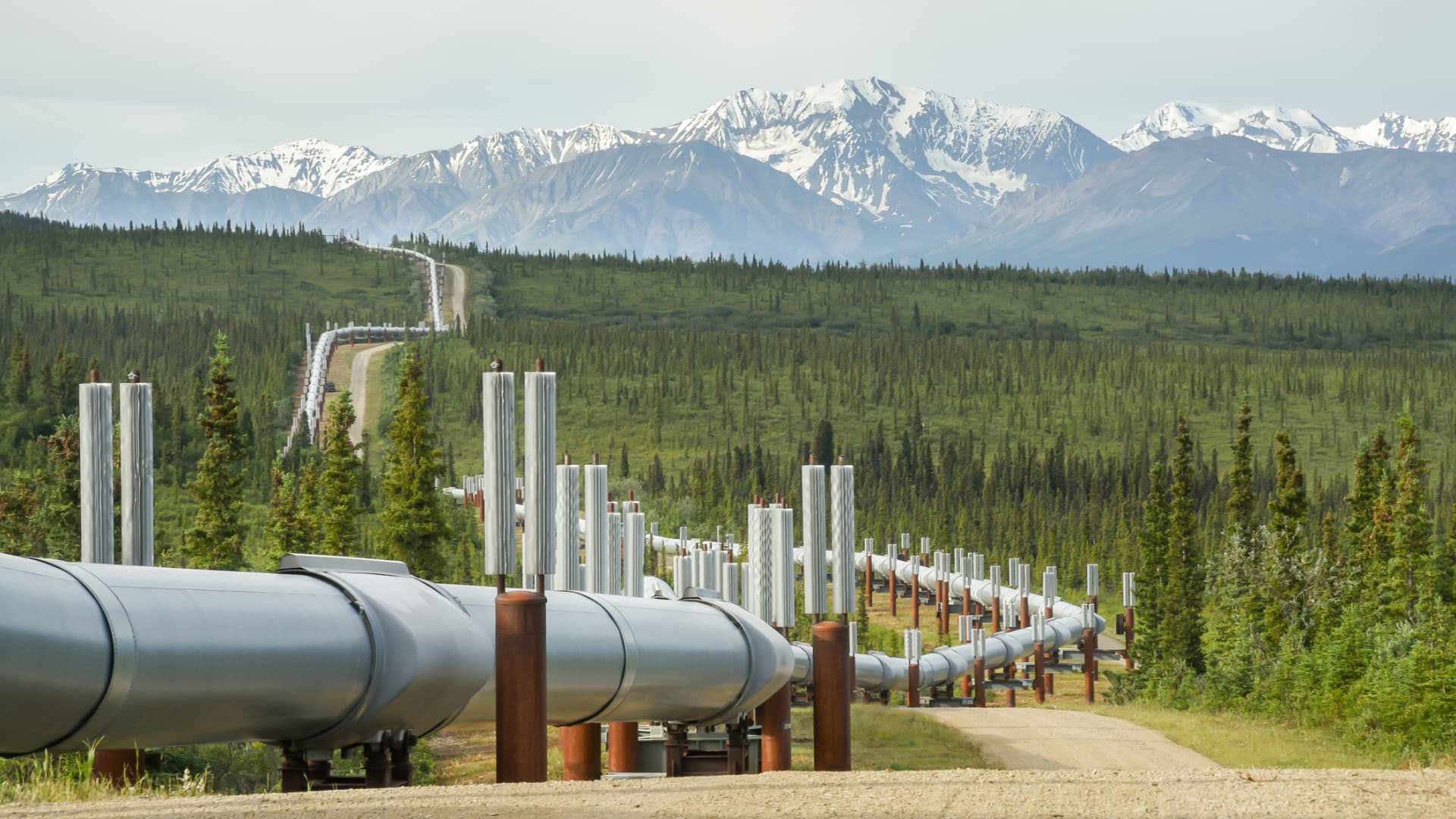
Amidst these challenges, a significant proposal for a natural gas pipeline has re-emerged, gaining federal support. This project envisions a new pipeline running parallel to the existing Trans-Alaska oil conduit, designed to facilitate the export of liquefied natural gas (LNG)—a crucial byproduct of North Slope oil operations—to lucrative Asian markets. The concept has been on the drawing board for years, but its colossal estimated cost, approximately $40 billion, historically rendered it unfeasible for industry investors, even during periods of elevated petroleum prices.
Today, however, a confluence of factors is prompting a fresh look at this ambitious undertaking. Current administration officials suggest that evolving geopolitical dynamics and heightened trade tensions could fundamentally alter the economic viability of such a massive infrastructure project. The prospect of securing a reliable, diverse source of LNG for key Asian economies, coupled with potential strategic advantages, might be shifting the risk-reward calculus for this multi-billion dollar investment. For energy investors, this project represents a potentially transformative opportunity to tap into Alaska’s vast natural gas reserves, though the sheer scale and historical hurdles demand careful scrutiny.
Investment Outlook: Navigating Alaskan Energy Opportunities
For investors focused on the oil and gas sector, Alaska presents a complex risk-reward profile. The state’s foundational reliance on crude oil revenues creates inherent fiscal instability, exacerbated by fluctuating global prices and slow-moving diversification efforts. This economic fragility, highlighted by its poor business climate ranking and sluggish GDP growth, suggests a need for cautious optimism.
However, the potential for significant long-term plays remains. The proposed $40 billion LNG pipeline, if it moves forward, could unlock substantial value from otherwise underutilized natural gas resources, offering a new export avenue and diversifying the region’s energy output. Furthermore, continued exploration and development in established basins could yield further discoveries, maintaining Alaska’s role as a critical domestic energy producer. Successful investments in Alaska will likely hinge on thorough due diligence, a keen understanding of global energy market dynamics, and a clear appreciation for the state’s unique economic and regulatory environment.

