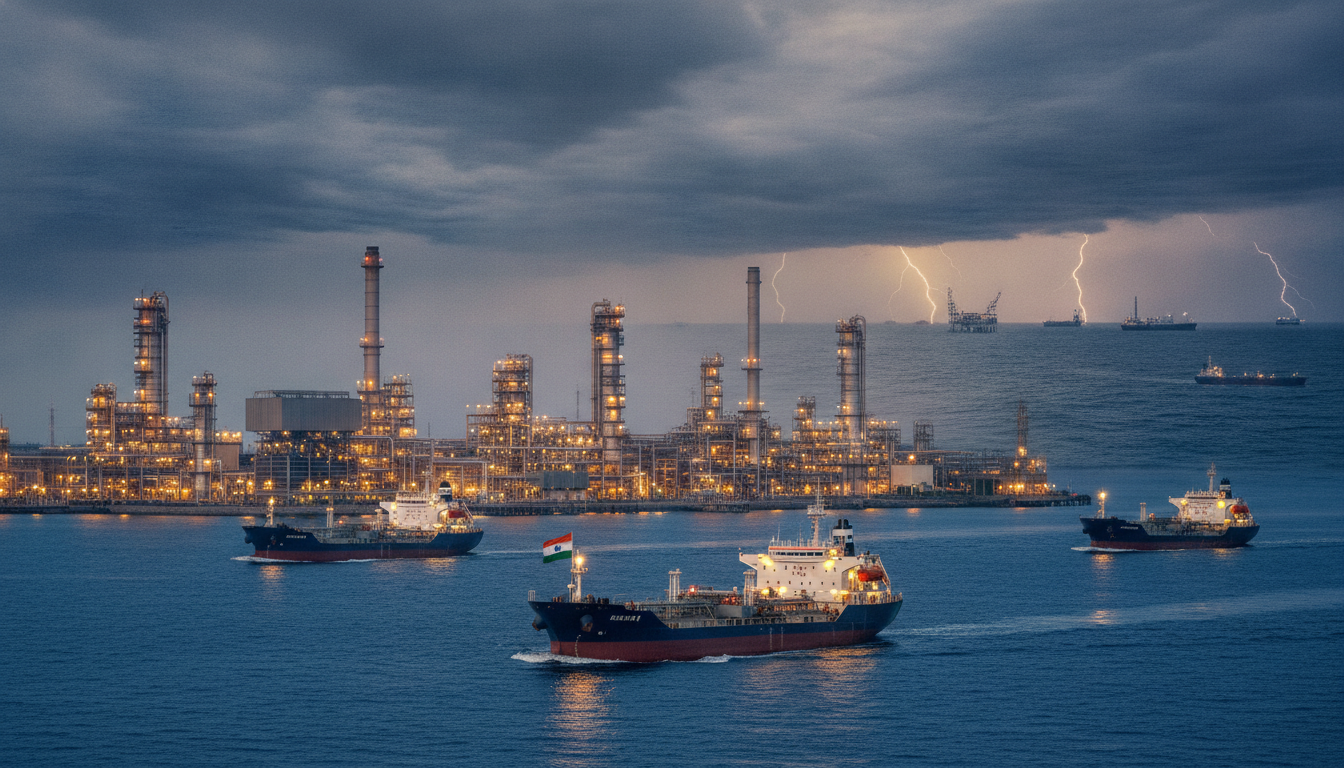
Red Sea Turmoil Ignites Crude Prices, Forces Indian Refiners to Global Supply Scramble
The global oil market finds itself once again grappling with significant geopolitical friction, as escalating hostilities in the Red Sea corridor push benchmark Brent crude prices beyond the critical $100 per barrel threshold. This latest surge, marking a more than 36% rise for the month and hitting levels not seen since late May, is directly attributable to intensified attacks by Yemen’s Houthi militants on vessels in the Bab al-Mandab Strait, a pivotal maritime chokepoint. In response, major Indian refiners are aggressively diversifying their crude procurement strategies and exploring radically altered, extended shipping routes to safeguard their energy security and maintain uninterrupted fuel supplies.
Bab al-Mandab: A Global Oil Chokepoint Under Siege
The Bab al-Mandab Strait, a narrow passage connecting the Red Sea to the Gulf of Aden, is an indispensable artery for global oil trade, facilitating approximately 12% of the world’s total oil shipments. The recent barrages against Saudi vessels by Iranian-backed Houthi forces have transformed this vital waterway into a zone of heightened risk, effectively disrupting established supply chains. This renewed instability has sent shockwaves across energy markets, immediately reflecting in commodity prices and prompting an urgent re-evaluation of maritime transit security for crude cargoes originating from the Gulf region.
Indian Refiners Pivot to New Horizons for Crude Sourcing
India, a major global energy consumer and refiner, finds itself at the forefront of this supply chain re-alignment. State-owned refining giants are actively casting a wider net, exploring non-traditional crude grades from geographically distant producers. For instance, Bharat Petroleum Corp. Ltd. (BPCL) has already begun integrating novel crude streams into its system. Vetsa Ramakrishna Gupta, Finance Director at BPCL, confirmed this strategic shift, stating, “We have substantially diversified our crude sourcing footprint beyond the Strait of Hormuz, evaluating multiple new geographies including securing new crude grades from nations like Venezuela and Angola.” This proactive diversification underscores the industry’s imperative to reduce reliance on vulnerable shipping lanes.
Operational Challenges and Supply Chain Compromises
The ripple effect of the Red Sea disruptions extends deep into refinery operations, compelling companies to make difficult trade-offs. Hindustan Petroleum Corporation Ltd. (HPCL) has reported significant challenges in accessing its preferred crude varieties, many of which are located on the ‘other side’ of the Strait of Hormuz and require transit through the now-risky Red Sea. Vikas Kaushal, Managing Director for HPCL, highlighted the operational realities, remarking, “Our decisions have shifted from optimization-driven choices to availability-driven necessities. Traditionally, we balance term and spot contracts for the year, but in the first quarter, our term contracts, largely situated across the Strait of Hormuz, yielded very little.” This forced processing of non-regular grades risks impacting efficiency and product yields but is deemed essential to maintain refinery throughput and ensure consistent domestic fuel availability.
The Cost of Detour: Lengthened Voyages and Increased Logistical Burden
Beyond sourcing new crude, the industry is also confronting the daunting prospect of drastically altering established shipping routes. Cargoes originally planned for the shorter transit through the Red Sea and Bab al-Mandab Strait to Asia are now being considered for considerably longer detours. As reported, India’s state-run refiners are weighing the option of sending crude initially through the Suez Canal, where it would then be transferred to Very Large Crude Carriers (VLCCs) at a European hub. From there, these massive tankers would undertake the protracted journey around the entire African continent to reach South Asia. Industry traders estimate that such rerouting could extend journey times by as much as a full month. This significant increase in transit duration directly translates to higher freight costs, increased insurance premiums, and a greater strain on tanker availability, ultimately impacting the landed cost of crude and potentially feeding into consumer prices.
A Broader Landscape of Geopolitical Risk for Energy Investors
This latest Red Sea flashpoint amplifies an already precarious global energy landscape for investors. The collapse of the ceasefire between the United States and Iran has ignited a new phase of regional hostilities, further destabilizing the Middle East. Simultaneously, crucial exports from major producer Kazakhstan continue to face jeopardy due to the ongoing Russia-Ukraine conflict. These parallel crises are converging at a time when global oil inventories are already significantly depleted from months of sustained geopolitical tensions and robust demand. For investors in the oil and gas sector, the current environment underscores the heightened importance of supply chain resilience, geopolitical risk assessment, and the potential for persistent price volatility across energy commodities. Navigating these turbulent waters will demand continuous vigilance and a deep understanding of evolving global supply-demand dynamics.


