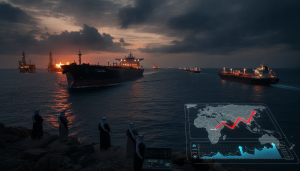
Geopolitical Tensions Push Oil Higher as Ceasefire Hangs by a Thread
Global energy markets are once again grappling with heightened geopolitical uncertainty, following a stark warning from U.S. President Donald Trump regarding the fragile state of the US-Iran ceasefire. His recent comments, delivered from the Oval Office, have sent ripples through crude markets, pushing prices upward as investors recalibrate supply risk premiums. This development underscores the persistent volatility facing oil and gas investors, where diplomatic pronouncements can trigger immediate and significant shifts in commodity valuations, particularly concerning the vital flows from the Middle East.
White House Declares Ceasefire on “Massive Life Support”
President Trump minced no words on Monday, describing the critical truce between the United States and Iran as teetering on “massive life support.” During a live-streamed event focusing on maternal healthcare, the President vividly likened the ceasefire’s condition to a dire medical prognosis, stating, “the doctor walks in and says, ‘sir, your loved one has approximately a one percent chance of living’.” When directly questioned by reporters about the ceasefire’s immediate status, his response offered little comfort, characterizing it as “unbelievably weak” and indeed, “the weakest right now.” This unequivocal assessment from the highest office signals a significant escalation in perceived risk, indicating a potential breakdown in the fragile calm that had temporarily settled over the region. As of this report, the Iranian Ministry of Foreign Affairs has not issued a public response to President Trump’s pointed remarks, leaving investors to weigh the implications of this one-sided commentary.
Market Repercussions: Oil Prices Climb Amid Uncertainty
The immediate market reaction was palpable. Crude oil prices extended their gains on Tuesday, directly attributed to these escalating concerns and President Trump’s rejection of Tehran’s latest counterproposal. Konstantinos Chrysikos, Head of Customer Relationship Management at Kudotrade, highlighted how the President’s “massive life support” declaration amplified market uncertainty. “With diplomatic progress stalling, fears of a re-escalation could keep the market on edge,” Chrysikos cautioned in his market analysis. This translates into increased investor apprehension regarding supply stability and a renewed focus on geopolitical factors driving energy commodity prices. The prospect of renewed hostilities in a crucial oil-producing region invariably prompts a flight to safety in energy assets, elevating their value.
Strait of Hormuz: A Critical Chokepoint and Long-Term Disruptions
Adding to the market’s unease is the ongoing disruption within the critical Strait of Hormuz. This vital waterway continues to impede global crude flows, presenting a significant logistical and economic challenge for the entire oil and gas industry. Chrysikos warned that a prolonged blockade could severely hinder any prospects of normalization, potentially extending disruptions deep into 2027. Such an extended interruption would force a fundamental restructuring of global energy supply chains, with far-reaching consequences for pricing and availability. Consequently, oil importers are already pivotally shifting their strategies, increasingly looking towards alternative sources in the U.S. and other nations to secure supplies. The physical market remains demonstrably tight, exacerbating the impact of any supply shock originating from this crucial maritime route. Investors must closely monitor developments in the Strait, as its status directly correlates with the availability and cost of international oil supplies, influencing profits across the sector.
Global Appeals for De-escalation Highlight Crisis Severity
Amidst the rising tensions, international voices are urgently advocating for a return to diplomacy. UN Secretary General António Guterres, speaking from Nairobi, Kenya, stressed the paramount importance of finding a “diplomatic solution” for the situation in the Gulf. He issued a strong appeal for negotiations to persist, the ceasefire to be meticulously maintained, and crucially, for the Strait of Hormuz to remain “completely open.” Guterres underscored the catastrophic consequences of any renewed conflict, warning that “any restart of the fighting would have terrible consequences” not just for the region, but for global energy security and economic stability. These statements highlight the global community’s profound concern over the potential for regional instability to spiral into a broader energy crisis, impacting economies worldwide and creating immense headwinds for international trade.
The Geopolitical Risk Premium Returns to Oil Valuations
Market dynamics clearly reflect the return of a significant geopolitical risk premium. Naeem Aslam, CIO at Zaye Capital Markets, affirmed that oil prices are experiencing an upward trajectory precisely because traders are re-incorporating this premium into their valuations. Aslam identified the Strait of Hormuz as the “key pressure point for global energy markets,” explaining that any credible threat to shipping flows invariably triggers rapid increases in freight and insurance costs, alongside a pervasive fear of tightened crude supply. He further elucidated the inverse relationship: “When peace talks look stronger, oil usually gives back risk premium because traders expect supply routes to normalize. When talks weaken, prices rise because buyers worry about disrupted barrels, tanker delays, and higher costs across fuel, shipping, airlines, and manufacturing.” This explains the recent upward price movement following Trump’s comments. It also contrasts sharply with an earlier observation from Aslam on April 8th, when oil had “sharply repriced lower into the mid-$90s,” with WTI and Brent experiencing 13-15 percent intraday drops. That previous decline was directly linked to a two-week Strait of Hormuz ceasefire, which had triggered a rapid unwinding of the geopolitical risk premium after prices had spiked above $110, showcasing the immediate and sensitive response of the market to de-escalation signals.
Current Market Snapshot and Investor Outlook: Navigating Volatile Waters
As of writing, the immediate impact on global benchmarks is evident. Brent Crude is now trading at more than $107 per barrel, while West Texas Intermediate (WTI) Crude has surged past the $101 per barrel mark. This represents a substantial increase compared to January 7th, when Brent closed under $60 per barrel and WTI settled under $56 per barrel, illustrating the dramatic shift in market sentiment and supply concerns within a relatively short period. For oil and gas investors, the current outlook remains decidedly skewed to the upside, primarily due to persistent risks of escalation in the Middle East. Supply deficits are poised to maintain elevated price levels, ensuring that volatility remains a constant companion to any emerging diplomatic headlines. While a credible diplomatic resolution could introduce some downward pressure on prices, analysts suggest that structural hurdles to a rapid normalization of supply and geopolitical stability are likely to persist, keeping crude markets on alert for the foreseeable future. Investors should prepare for continued price swings, heavily influenced by geopolitical developments, and strategically position themselves to capitalize on or mitigate against these significant energy market dynamics.