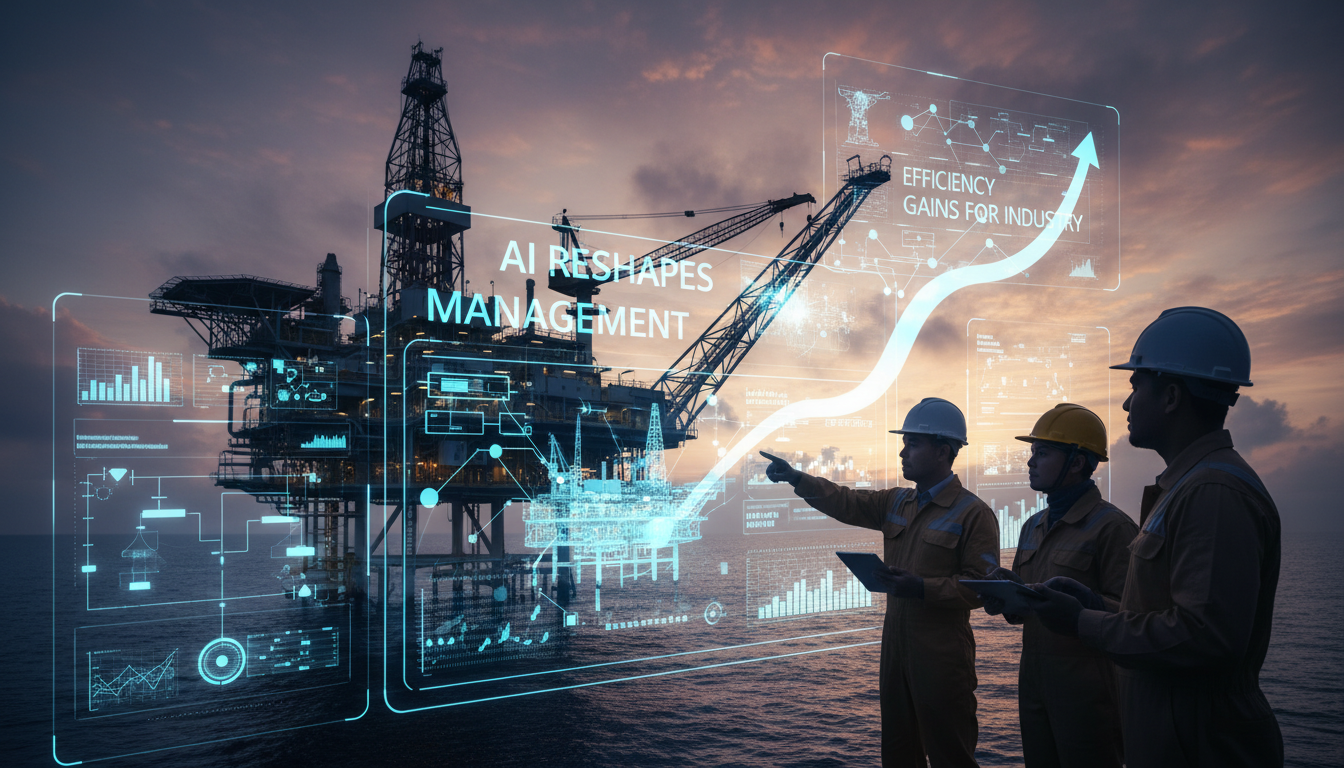
The Autonomous Energy Executive: Navigating the AI-Powered Oilfield of Tomorrow
The energy sector, long a bastion of traditional management hierarchies, stands at the precipice of a radical transformation. A seismic shift in operational philosophy, driven by advancements in artificial intelligence and automation, is poised to redefine roles from the rig floor to the executive suite. This isn’t just about adopting new software; it’s about fundamentally reshaping the very fabric of how oil and gas enterprises operate, echoing revolutionary organizational changes seen in other tech-forward industries.
Consider the recent strategic pivot by a major digital asset firm, which outlined a comprehensive overhaul including significant staff reductions and the complete reimagining of managerial responsibilities, embracing a model where “pure managers” are phased out in favor of executives overseeing vast fleets of AI agents. In this emerging paradigm, individual managers are expected to guide the output of more than fifteen direct reports, many of whom are not human. This forward-looking approach offers a compelling glimpse into the future of operational management within the capital-intensive oil and gas industry, where efficiency gains and real-time decision-making are paramount for investor returns.
To understand the profound implications for energy investors, let’s simulate a day in the life of a modern oil and gas operations manager operating under such an advanced, AI-centric model. This scenario, while hypothetical, illustrates the trajectory for top-tier energy companies leveraging cutting-edge technology to drive unprecedented levels of productivity and cost efficiency.
Morning Analytics: The Autonomous Operational Dashboard
8:41 a.m. I connect to the network. My inbox, surprisingly, is empty. My personalized operational dashboard loads instantly, presenting fifteen active tiles—each representing a critical, AI-driven system under my direct oversight. Not a single one is a human employee. These autonomous agents have already been working tirelessly overnight, monitoring, analyzing, and acting.
For instance, my subsea infrastructure agent flagged an unanticipated pressure fluctuation across a key pipeline segment in the North Sea. Simultaneously, my regulatory compliance agent drafted three potential mitigation strategies, assessing their impact on environmental guidelines and local statutes. My drilling optimization agent, in response, has already pushed a minor adjustment to the real-time drilling parameters of a new well in the Permian Basin, a tweak now live for a preliminary 5% of our ongoing operations. I review the condensed summaries, each concise and actionable. There are no cascading email threads, no scheduled meetings to hash out details, no protracted back-and-forth discussions. I approve two of the AI’s proposed decisions, decline one outright, and request a detailed simulation for the third, focusing on long-term reservoir impact. Total time elapsed: a mere four minutes. The speed of decision-making, in stark contrast to traditional methods, is staggering, directly impacting daily production efficiency and investor confidence.
The Eradication of Coordination Drag
9:10 a.m. In the traditional operational models of just a few years ago—say, 2024—addressing such complex issues would have necessitated extensive cross-departmental coordination, involving dedicated teams from pipeline integrity, regulatory affairs, and drilling engineering. A series of meetings would have been unavoidable. Now, the traditional departmental silos, as distinct teams, are largely dissolved. The intelligent system dynamically routes all pertinent information and proposes integrated solutions.
The notorious “coordination tax,” once a significant drag on productivity, has been virtually eliminated. No longer do we contend with the delays of waiting for replies from disparate teams or the logistical nightmare of scheduling meetings across multiple time zones. However, a new form of friction emerges: the critical decision of when and how much to trust the sophisticated algorithms. Each AI agent transparently displays its confidence levels, data sources, and alternative analytical paths. The process is undeniably rapid, but the underlying complexity can be opaque, often leading me to spend more time validating and second-guessing the AI’s recommendations than anticipated. This human oversight remains crucial for maintaining investor trust and operational integrity.
Hybrid Roles and Accelerated Innovation
10:30 a.m. I conduct a check-in with one of my few remaining human reports. Her role is a fascinating amalgamation: she’s a petroleum engineer, a data scientist, and even contributes directly to production code development. Her “team” comprises solely herself, augmented by a trio of specialized AI agents. She’s been working alongside these agents to rapidly prototype a novel predictive maintenance feature for our offshore platforms, designed to minimize unplanned downtime. She provides a concise, twelve-minute walkthrough of the functioning prototype—no elaborate slide decks, just a demonstration of a fully integrated solution. Under the legacy organizational structure, this would have easily consumed an entire quarter as a dedicated roadmap item. I inquire about her current needs. “Nothing,” she responds, “perhaps just the approval to scale this solution across our global fleet.” This level of individual productivity and rapid deployment capability is a game-changer for capital expenditures and operational expenditure efficiency.
A New Dialogue at Lunch
12:15 p.m. Lunch remains a constant, yet the discourse has fundamentally shifted. Our conversations no longer revolve around project timelines or resource allocations. Instead, we discuss the efficacy of various AI prompts, debate the reliability of specific agents, and share insights on which models perform best under pressure or occasionally “hallucinate” with spurious data. Someone quips that managing human teams was, in some ways, simpler. No one at the table disagrees. This cultural shift underscores the profound psychological and operational adjustments required within the workforce.
High-Stakes Decisions, Instant Execution
2:00 p.m. A critical risk alert flashes on my dashboard—categorized as high priority. My compliance agent recommends an immediate halt on a series of transactions related to a newly detected, highly volatile commodity trading pattern, citing potential market manipulation risks. Simultaneously, my derivatives trading agent argues this is a false positive, warning of significant financial backlash from immediate intervention that could impact our market position. A third legal agent meticulously outlines the potential regulatory exposure scenarios across three different global jurisdictions. The system presents their automated debate transcript. Without any need for a meeting, consensus-building, or an escalation chain, the ultimate decision rests solely with me. I make the call, weighing the financial risks against the reputational and regulatory ones. The decision propagates and executes live across our systems within seconds. The immediacy of this kind of high-impact decision-making, backed by rapid AI analysis, is invaluable for mitigating financial risks and capitalizing on fleeting market opportunities.
Performance Metrics in the Autonomous Era
4:45 p.m. I review my “team performance.” Each AI agent receives a quantifiable score based on its output, accuracy, processing speed, and cost efficiency. My own rating is also heavily influenced by these metrics: how effectively I allocate tasks among the AI fleet, the judiciousness of my overrides, and the accuracy of my critical decisions. It’s a revealing moment as I realize I haven’t provided direct feedback to a single human colleague throughout the entire day. This shift in performance evaluation fundamentally alters the dynamics of management and career progression within the industry.
The Inexorable March of Automation
6:10 p.m. Before logging off for the day, a new prompt appears: “Recommended organizational optimization: reduce human oversight on crude logistics workflows by 12%.” My finger hovers over the approval button. Approve. The continuous optimization suggested by AI, even at the cost of human roles, highlights the relentless pursuit of efficiency that will define the next decade of oil and gas operations. For investors, understanding this profound reorientation towards AI-driven autonomous operations is crucial for identifying the future leaders in energy market capitalization.


