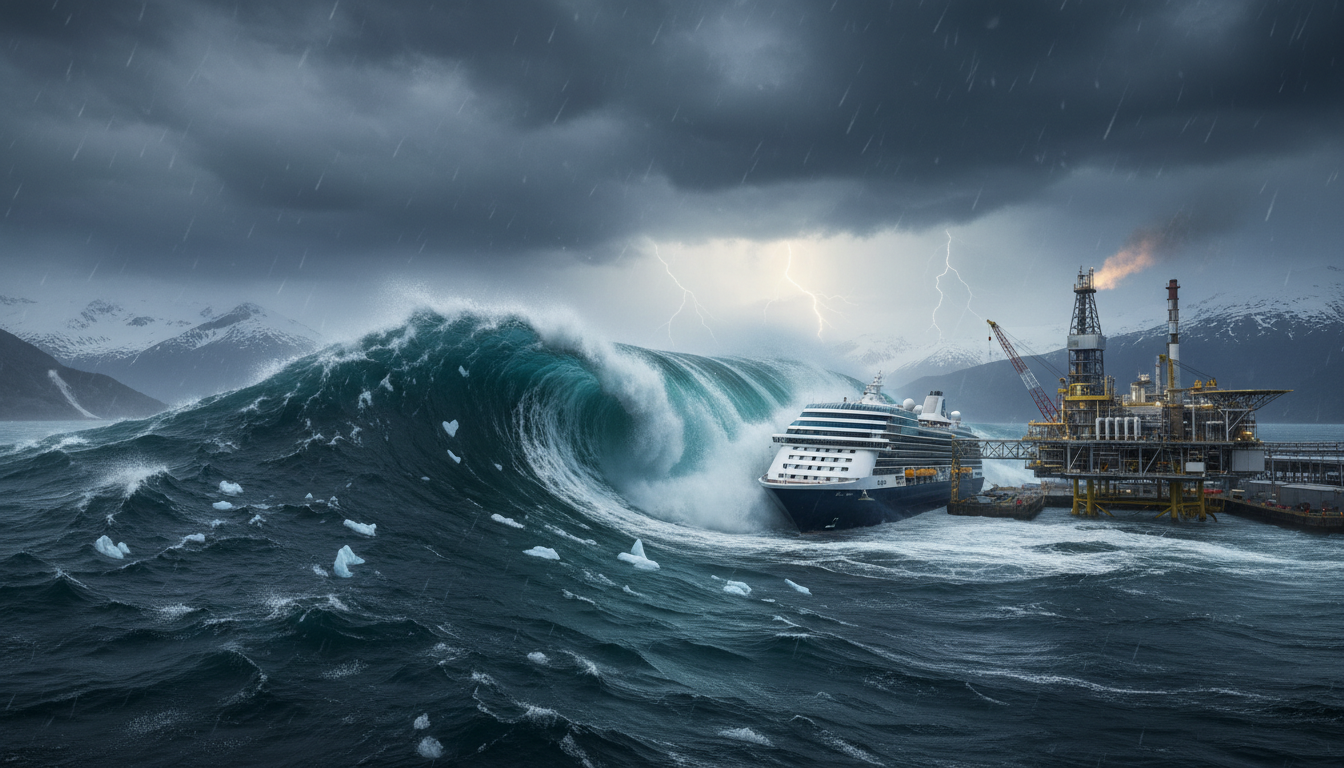
Alaska’s Mega-Tsunami: A Stark Warning for Arctic Energy Investment
A colossal natural event in Southeast Alaska’s Tracy Arm fjord last year delivers a sobering message to energy investors worldwide: the escalating risks of coastal geological instability, driven by rapidly changing environmental conditions. On August 10, 2025, at 5:26 AM local time, a massive rockslide near the terminus of the South Sawyer glacier unleashed the world’s second-tallest recorded tsunami, a phenomenon with significant implications for critical infrastructure and operations in vulnerable coastal and Arctic hydrocarbon regions.
This unprecedented wave, surging to an astounding 481 meters (1,578 feet) in height – dwarfing even the 330-meter (1,082-foot) Eiffel Tower – underscores the amplified dangers inherent in regions undergoing accelerated glacier retreat. While no fatalities occurred due to the early hour, the event’s near-miss potential with commercial shipping and tourism vessels serves as a powerful reminder of the delicate balance between industrial activity and evolving environmental dynamics. For energy companies eyeing the Arctic’s vast resource potential, this incident mandates a fundamental re-evaluation of risk models and long-term investment strategies.
Understanding the Cataclysm: Geological Instability Meets Melting Glaciers
The sequence of events, meticulously detailed in new research published in Science and led by University of Calgary geomorphologist Dan Shugar, began with a significant landslide. A full kilometer of rock vertically collapsed onto the South Sawyer glacier, plunging into the narrow, 48-kilometer fjord below. This direct displacement of water, exacerbated by the confined geography of the fjord, generated the immense tsunami. Geoscientists confirm that such landslide-generated tsunamis often exhibit substantially higher run-ups than those triggered by earthquakes, primarily due to localized variations in water depth and the direct, violent displacement of the water column.
Crucially, the study highlights the direct link between the event’s magnitude and the receding glacier. Researchers concluded that “without the rapid glacier retreat, the landslide would likely not have resulted in such a wave because it would have collapsed entirely onto glacier ice or might not even have occurred at all.” This finding firmly places the event within the broader context of evolving environmental patterns, emphasizing that the reduction of glacial ice cover removes a critical buttress, leaving underlying rock slopes vulnerable and unstable. The incident also generated long-period seismic waves equivalent to a 5.4 magnitude earthquake and triggered a 36-hour seiche – a standing wave oscillating within the fjord.
Near Misses and Broader Implications for Coastal Energy Assets
The Tracy Arm event served as an alarming close call for the maritime industry. The affected area is a busy waterway, routinely traversed by approximately three cruise ships daily, in addition to numerous smaller vessels. Just hours after the tsunami struck, a sightseeing vessel from Juneau and a National Geographic tour boat, each with capacities exceeding 100 passengers, were scheduled to enter the fjord. The previous day, two large cruise ships carrying thousands of passengers had already visited the site, with another slated for arrival the following day. Dennis Staley of the U.S. Geological Survey aptly summarized the situation, stating, “I feel like we dodged a bullet.”
This “bullet dodged” resonates profoundly with energy investors. While this particular event targeted a tourist area, the parallels for coastal energy infrastructure are undeniable. Offshore platforms, coastal liquefaction natural gas (LNG) terminals, oil refineries, and critical shipping lanes in similar high-latitude environments face identical, if not greater, exposure. Eyewitness accounts illustrate the tsunami’s expansive reach: kayakers camping on Harbor Island, approximately 55 kilometers away, reported water surging past their tent, sweeping away equipment. An observer 50 kilometers from the landslide in No Name Bay described initial waves of 2 to 2.5 meters, followed by a 1-meter wave. Such far-reaching impacts underscore the potential for disruption to energy supply chains, posing risks to personnel safety, operational continuity, and the integrity of vital assets.
Arctic Energy Frontier: Compounding Risks and Investment Imperatives
The incident in Tracy Arm is not an isolated phenomenon but rather a potent indicator of an accelerating trend across the Arctic. As tidewater glaciers continue their rapid retreat and permafrost degradation intensifies, the risk of large-scale landslide-generated tsunamis is increasing dramatically throughout the region. This has direct and significant implications for the hydrocarbon sector, which views the Arctic as a frontier for future energy development and resource extraction.
The economic stakes are substantial. For companies engaged in Arctic oil and gas exploration, development, and transportation, understanding and mitigating these evolving geophysical risks becomes paramount. The cost of damage to drilling rigs, pipelines, production facilities, or coastal support infrastructure from such events could run into billions of dollars, not to mention the potential for catastrophic environmental harm and associated regulatory and reputational repercussions. This necessitates a proactive approach to risk management, moving beyond historical averages to embrace dynamic modeling that accounts for these new environmental realities.
Charting a Resilient Course: Mitigation and Strategic Investment
The researchers involved in the Tracy Arm study issued a clear call to action: stronger risk mitigation measures are urgently needed. This includes systematic monitoring of unstable slopes in vulnerable areas, the development of more realistic tsunami-modeling scenarios that account for evolving geological conditions, and enhanced protective strategies for local communities, tourists, and, critically, industrial infrastructure. For energy investors, this translates into several key imperatives.
Firstly, robust due diligence must incorporate cutting-edge geophysical assessments when evaluating projects in high-risk coastal and Arctic zones. Secondly, capital allocation must prioritize resilience, investing in infrastructure designed to withstand extreme events and adapting operational protocols to evolving hazard landscapes. This includes advanced sensor deployment, real-time data analysis, and predictive modeling capabilities to enhance early warning systems.
Alaska has already experienced several significant tsunami events in the last decade, reinforcing the emergent pattern. In 2024, a large landslide in Kenai Fjords National Park generated an 18-to-55-meter wave. Earlier, in 2015, a landslide near a receding glacier in Taan Fjord, Southeast Alaska, caused a 193-meter tsunami. These precedents, culminating in the Tracy Arm mega-tsunami, highlight a clear trajectory of increasing geological instability. As global energy demand continues to drive interest in Arctic resources, investors must recognize that the financial success and long-term viability of these ventures will depend heavily on their ability to accurately assess, predict, and mitigate the profound and accelerating risks presented by these dynamic environmental shifts.


