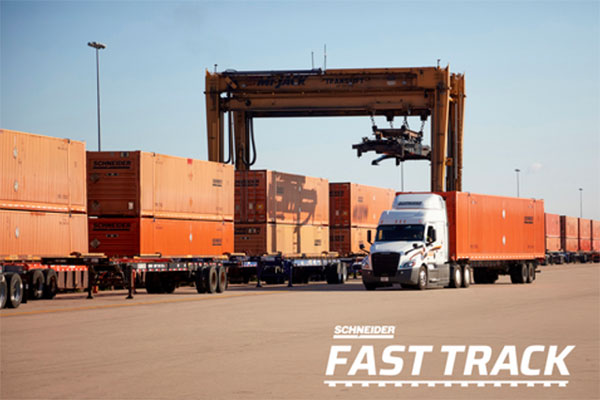
The energy sector, perpetually navigating the currents of global supply and demand, is increasingly scrutinizing every avenue for efficiency gains. In this environment, logistics and supply chain optimization are not mere operational footnotes; they are critical drivers of profitability and resilience. Schneider National’s introduction of its Fast Track intermodal service represents a significant development for energy companies seeking to streamline their operations, reduce costs, and enhance reliability across their extensive supply chains. This new offering, combining robust truckload and intermodal assets with strategic rail partnerships, promises truck-like speed and consistency, a paradigm shift that demands close attention from investors keen on identifying companies poised for operational excellence.
Intermodal Efficiency Becomes Critical Amidst Market Volatility
In a period marked by significant price swings, the imperative for energy companies to control costs and optimize their logistics has never been clearer. As of today, Brent Crude trades at $90.38, a notable decline of 9.07% within the day, having ranged from $86.08 to $98.97. Similarly, WTI Crude stands at $82.59, down 9.41% from its open, fluctuating between $78.97 and $90.34. This sharp daily downturn follows a more protracted slide, with Brent having fallen from $112.78 just two weeks ago to its current level. These figures underscore a volatile market where every dollar saved on operational expenditure directly impacts the bottom line. Fast Track, with its reported capability to deliver transit up to two days faster than competitors while maintaining a 95% or higher on-time rate, offers a tangible solution to mitigate these pressures. For an industry reliant on the timely delivery of specialized equipment, spare parts, and finished products, such as refined gasoline currently trading at $2.93 (down 5.18%), these efficiencies translate directly into reduced inventory holding costs, minimized downtime, and improved capital allocation.
Strategic Advantages for Energy Supply Chains: Speed, Security, and Savings
The benefits of Schneider’s Fast Track extend across the diverse segments of the energy sector. For upstream exploration and production companies, the expedited delivery of drilling components, fracking equipment, or maintenance supplies to remote sites can significantly reduce non-productive time, a major cost factor. Midstream operators, managing vast networks of pipelines and processing facilities, can leverage Fast Track for the timely transport of critical infrastructure components, ensuring project timelines are met and operational disruptions are minimized. Downstream refiners and distributors stand to gain from the service’s precision, enabling just-in-time inventory management for crude inputs and refined product outputs, thereby optimizing storage costs and enhancing market responsiveness. The service’s proven reliability, already demonstrating a 99.99% theft-free record across U.S. and Mexico operations in 2024, adds another layer of security, crucial for safeguarding high-value energy commodities and specialized equipment during transit. This blend of speed, cost efficiency, and enhanced cargo security creates a compelling value proposition for energy sector participants aiming to fortify their supply chains against both market volatility and operational risks.
Navigating Future Uncertainty: Fast Track as a Resilience Tool
Investors frequently inquire about the future trajectory of oil prices and the impact of supply-side decisions. Our first-party intent data shows a clear preoccupation with questions like “what do you predict the price of oil per barrel will be by end of 2026?” and “What are OPEC+ current production quotas?”. These concerns highlight the pervasive uncertainty surrounding future market dynamics. In this context, initiatives like Fast Track take on greater significance. Energy companies that can achieve superior logistical efficiency are better positioned to absorb potential price shocks, adapt to changing market conditions, and maintain profitability regardless of external price volatility. Looking ahead, the energy market faces several critical junctures. The upcoming OPEC+ Joint Ministerial Monitoring Committee (JMMC) Meeting on April 19th, followed by the full OPEC+ Ministerial Meeting on April 20th, could introduce significant shifts in production quotas. Furthermore, the API Weekly Crude Inventory reports on April 21st and 28th, along with the EIA Weekly Petroleum Status Reports on April 22nd and 29th, will provide crucial insights into supply and demand balances. Against this backdrop of potential policy changes and inventory fluctuations, the ability to rapidly and cost-effectively move goods and materials, as offered by Fast Track, becomes a strategic advantage, enabling energy firms to react swiftly to market signals and maintain competitive edge.
Investment Implications: Boosting Energy Sector Competitiveness
The expansion of highly efficient intermodal services like Fast Track is not merely an operational improvement; it has direct implications for investment theses within the energy sector. Companies that effectively integrate such advanced logistics into their business models can expect to see tangible improvements in their operating margins, capital efficiency, and overall financial performance. This improved efficiency can lead to stronger balance sheets, increased free cash flow, and a more robust competitive position, making them more attractive to investors seeking stability and growth in a dynamic market. The program’s successful implementation for automotive freight from Mexico to key U.S. hubs, with plans for rapid expansion into additional lanes, signals its proven scalability and potential to impact a broader spectrum of industries, including energy. For investors, identifying energy companies that proactively adopt and leverage such innovative logistical solutions will be key to distinguishing leaders from laggards in the coming years. In essence, Fast Track is more than just a faster way to move freight; it’s a catalyst for enhanced operational resilience and a key indicator of forward-thinking management within the energy investment landscape.