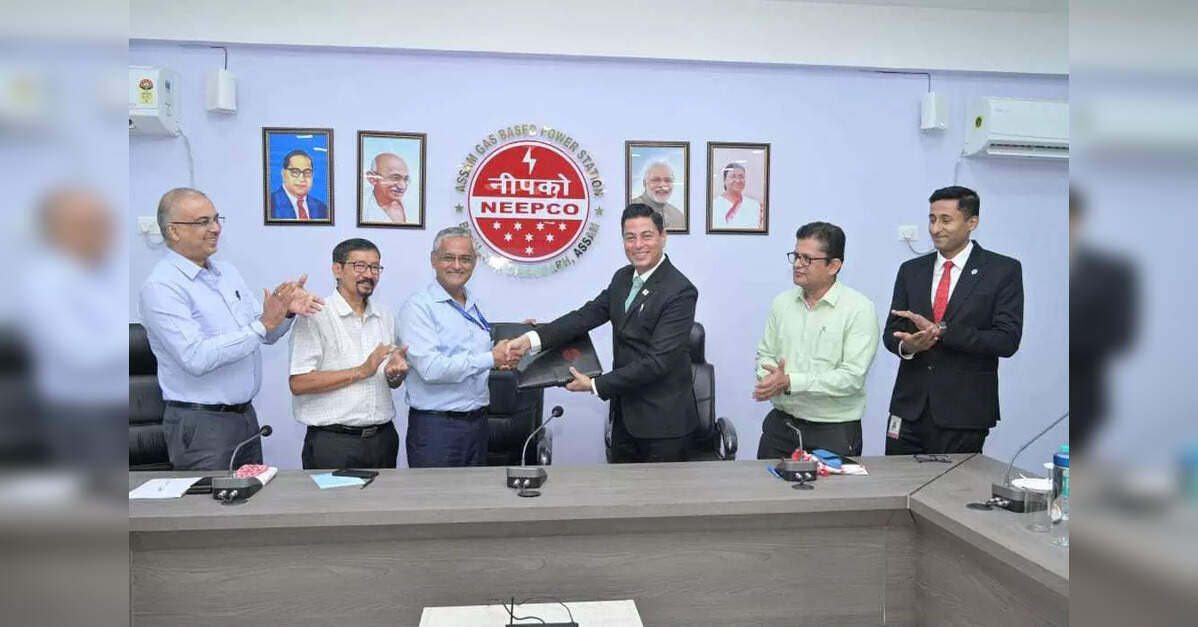
In a global energy landscape defined by volatility and strategic shifts, long-term supply agreements represent a critical pillar of stability for energy producers and consumers alike. The recent 15-year Gas Sale and Purchase Agreement (GSPA) between Oil India Limited (OIL) and North Eastern Electric Power Corporation Limited (NEEPCO) stands out as a prime example, solidifying a significant revenue stream for OIL while bolstering regional energy security. This agreement, which extends a successful decade-long partnership, ensures the sustained supply of 1.4 million metric standard cubic metres per day (MMSCMD) of natural gas to NEEPCO’s Assam Gas-Based Power Station (AGBPS) at Bokuloni, Dibrugarh. For investors, this deal provides valuable insight into a company’s ability to lock in predictable cash flows amidst an otherwise unpredictable market, validating its upstream capabilities and strategic positioning within India’s evolving energy matrix.
Anchoring Revenue Streams with Long-Term Gas Contracts
The extension of the gas supply agreement for another 15 years is a powerful signal of confidence in OIL’s robust reserve base and its operational prowess. This GSPA, succeeding a previous 10-year arrangement, guarantees a substantial and consistent demand for OIL’s natural gas output, translating directly into predictable revenue for nearly two decades. In a commodity market where prices can swing wildly, such long-term contracts offer a crucial hedge, insulating a portion of a company’s earnings from short-term market fluctuations. For a major energy player like OIL, securing demand for 1.4 MMSCMD to a critical power generation asset like AGBPS, the largest gas-based power station in Assam, is not merely a transaction; it’s a strategic move that underpins future investment decisions in its upstream portfolio and provides a stable foundation for growth. This commitment ensures continuous fuel supply to a plant vital for meeting the Northeastern region’s electricity demand, reinforcing the partnership’s role in regional energy stability.
Navigating Market Volatility: A Strategic Imperative
The importance of revenue stability underscored by this GSPA becomes even more apparent when examining the current market snapshot. As of today, Brent crude trades at $90.38 per barrel, marking a significant 9.07% decline from its daily open and experiencing a broader downturn of nearly 20% over the past two weeks, falling from $112.78 on March 30th. WTI crude mirrors this sentiment, currently at $82.59, down 9.41% today. While natural gas markets have their own dynamics, they are not entirely immune to the broader sentiment impacting crude. However, a fixed-volume, long-term contract like the OIL-NEEPCO GSPA provides a crucial buffer. It assures a baseline of demand and revenue, allowing OIL to better manage its operational costs and capital expenditure plans, even when benchmark crude prices are under pressure. This strategic foresight highlights a key differentiator for companies capable of securing such commitments, offering a degree of resilience that pure spot market exposure cannot match.
Investor Focus: Unpacking Stability and Future Prospects
Our proprietary reader intent data reveals a clear investor preoccupation with market stability and future price trajectories. Questions like “what do you predict the price of oil per barrel will be by end of 2026?” and “What are OPEC+ current production quotas?” frequently top the list. This GSPA directly addresses the underlying desire for stability by demonstrating a company’s ability to de-risk a portion of its future earnings. For investors evaluating OIL, this agreement signifies a predictable income stream that helps to cushion against the uncertainties driving crude price speculation. Looking forward, the next two weeks present several key events that could influence the broader energy market. The OPEC+ JMMC and Ministerial Meetings on April 19th and 20th, respectively, will set the tone for global crude supply. Subsequent API and EIA Weekly Petroleum Status Reports on April 21st, 22nd, 28th, and 29th will offer critical insights into inventory levels, while the Baker Hughes Rig Count on April 24th and May 1st will indicate North American production activity. While these events primarily impact crude, the stability offered by long-term gas contracts like OIL’s can help anchor valuations, providing a degree of insulation from the immediate volatility these macro announcements might trigger in the broader energy sector.
Driving India’s Energy Transition and Regional Security
This 15-year GSPA is more than just a commercial deal; it’s a foundational step in India’s journey towards a gas-based economy and strengthens regional energy security in the Northeast. As an anchor energy company in the region, OIL’s commitment to sustained gas supply directly supports the vision of affordable and clean energy. Natural gas, with its lower carbon footprint compared to coal and liquid fuels, is a critical transition fuel. By ensuring a reliable supply to AGBPS, OIL directly contributes to stable power generation, which is essential for economic development and industrialization in Assam and the wider Northeastern region. This partnership, formalized by key executives Ranjan Goswami from OIL and Bijit Kumar Goswami from NEEPCO, showcases how public sector enterprises can collaborate effectively to meet national energy objectives. For investors, this alignment with national strategic priorities, coupled with the expansion of OIL’s upstream portfolio, suggests a growth trajectory supported by both commercial viability and governmental impetus, making it a compelling case for long-term investment in India’s energy future.


