India’s Refining Growth: Analyzing the Investment Implications of HPCL’s Balotra Project
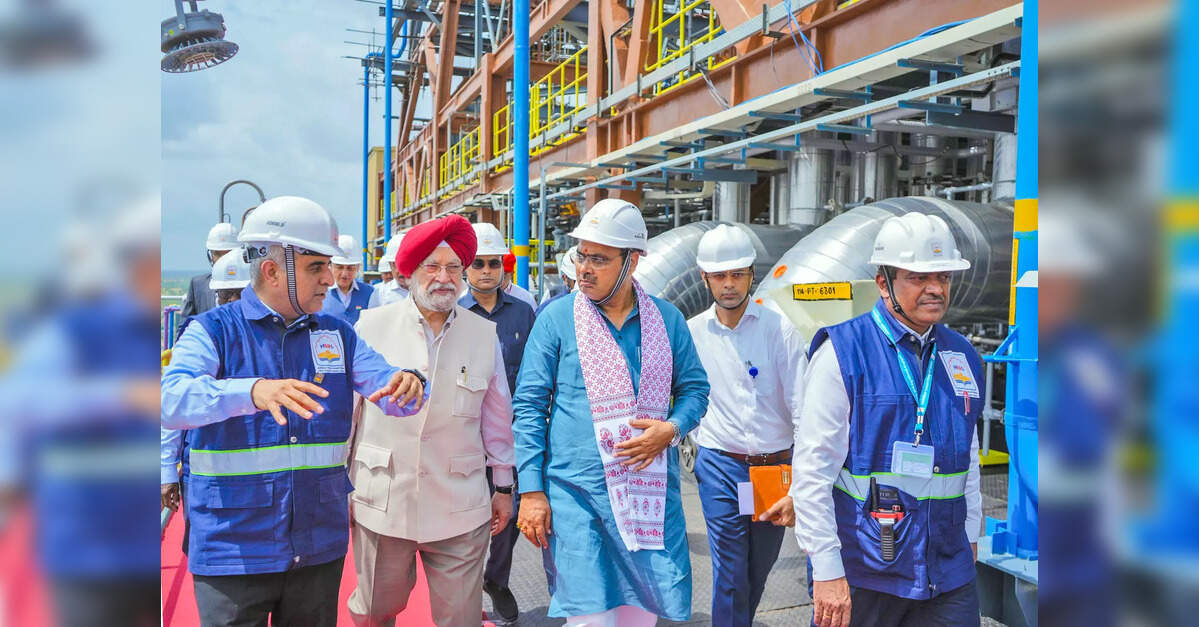
The recent high-level inspection of the HPCL Rajasthan Refinery Limited in Balotra district by key ministers signals the imminent commissioning of a strategically vital asset for India’s energy landscape. With operations “expected to commence soon,” according to official statements made during the August 2025 review, this massive integrated refinery and petrochemical complex is poised to significantly bolster India’s domestic refining capacity and contribute to the nation’s energy security objectives. For oil and gas investors, understanding the operational readiness of facilities like Balotra, alongside evolving market dynamics, is crucial for assessing future product supply, regional demand shifts, and potential impacts on refining margins.
Strategic Capacity Addition Amidst Evolving Global Supply Chains
The HPCL Balotra refinery is not just another facility; it represents a substantial investment in India’s refining prowess, designed to process diverse crude grades and produce a wide array of petroleum products and petrochemicals. The detailed review of critical units such as the Crude Distillation Unit (CDU), Vacuum Distillation Unit (VDU), and Delayed Coker Unit (DCU), coupled with the inauguration of the Refinery Main Control Room (RMCR) and an operator training simulator, underscores the advanced stage of readiness. This new capacity, emerging from six months of accelerated work, will play a pivotal role in meeting India’s surging energy demand, reducing reliance on imported refined products, and fostering regional economic growth through local employment and skill development initiatives. Investors should view this as a long-term strategic play, enhancing India’s self-sufficiency and positioning it as a key player in the global refined products market.
Navigating Volatile Crude Markets and Their Impact on Refining Economics
The timing of Balotra’s commissioning comes at a period of pronounced volatility in global crude markets, a critical factor for refinery economics. As of today, Brent crude trades at $90.38 per barrel, experiencing a notable 9.07% decline within the day, with its range fluctuating between $86.08 and $98.97. Similarly, WTI crude stands at $82.59, down 9.41% today, trading within a range of $78.97 to $90.34. This daily price action is part of a broader trend; Brent has shed over 18% in recent weeks, falling from $112.78 on March 30th to $91.87 yesterday, before today’s further dip. These significant price swings directly influence feedstock costs for refiners. While lower crude prices can initially boost crack spreads if refined product demand remains robust, the current decline, alongside a 5.18% drop in gasoline prices to $2.93 today, suggests potential softening in demand or an oversupply of products. For a new refinery like Balotra, managing these input costs and maximizing product yield will be paramount to achieving optimal profitability in a dynamic pricing environment.
Forward Outlook: Key Events and Commissioning Catalysts
With the Balotra refinery on the cusp of full operation, investors must keenly observe upcoming market catalysts that will shape its economic performance. The immediate horizon includes critical OPEC+ meetings, with the Joint Ministerial Monitoring Committee (JMMC) convening on April 18th and the full Ministerial Meeting on April 19th. Decisions regarding production quotas from these gatherings will directly impact global crude supply and pricing, dictating the feedstock costs for new and existing refineries. Furthermore, weekly inventory data from the API (April 21st, April 28th) and EIA (April 22nd, April 29th) will provide crucial insights into demand-supply balances for crude and refined products, offering a real-time pulse on market health. The Baker Hughes Rig Count (April 24th, May 1st) will signal future upstream activity. These data points, combined with the successful ramp-up of Balotra’s CDU, VDU, and DCU units, will determine the refinery’s initial profitability and its contribution to regional product supply, which includes a planned sales strategy for its output.
Addressing Investor Queries: Market Trajectory and Strategic Positioning
OilMarketCap’s proprietary reader intent data reveals a strong focus among investors on forward-looking crude price predictions and the impact of OPEC+ policy. Many are actively asking about the potential price trajectory of oil per barrel by the end of 2026 and the specifics of current OPEC+ production quotas. The commissioning of the Balotra refinery directly ties into these concerns. As new refining capacity comes online globally, it increases the supply of refined products, potentially impacting crack spreads if demand growth does not keep pace. Therefore, OPEC+’s ability to manage crude supply will be critical in supporting a stable pricing environment, which in turn influences refinery margins. Furthermore, the directive for HPCL officials to explore solar energy production, battery storage projects, and increase green cover within the refinery premises speaks to a growing investor interest in Environmental, Social, and Governance (ESG) factors. Integrating renewable energy and sustainability initiatives into new oil and gas projects can enhance long-term viability and appeal to a broader investor base, even within traditional energy sectors.


