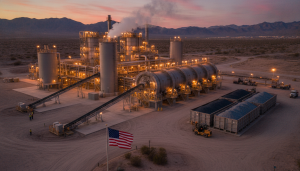
The recent announcement of NorcSi, a German technology startup, successfully securing €10.7 million in a new financing round for its silicon anode technology marks more than just a win for the European battery industry; it signals a significant accelerant for the broader energy transition. As investments target the establishment of an automated production line for pure silicon anodes, the implications for future electric vehicle (EV) performance and, by extension, global oil demand, are substantial. For oil and gas investors, this development underscores the relentless pace of innovation in alternative energy, compelling a deeper look at long-term market shifts versus short-term volatility in crude prices.
The Disruptive Potential of Silicon Anodes
NorcSi’s €10.7 million funding round, with contributions from existing investors Millennium Venture Capital AG and IBG-Risikokapitalfonds IV, alongside new entrant European Battery Research Institute GmbH, is earmarked for industrializing a technology that promises to redefine battery capabilities. The company boldly claims to be the first globally to move from pre-series to automated, industrial roll-to-roll production of pure silicon anodes. This move is crucial because silicon, unlike the currently dominant graphite, can absorb up to ten times more lithium ions due to its atomic structure. The practical benefits are profound: significantly higher energy density, translating into greater range for electric vehicles with the same battery size, and dramatically faster charging times. NorcSi provides compelling figures, suggesting a ‘medium-sized electric vehicle’ with an 80 kWh battery currently achieving 560 kilometers and charging from 20% to 80% in 26 minutes could, with their silicon anode technology, see capacity jump to 145 kWh, range extend to 1,016 kilometers, and charging times plummet to just six minutes for the same 20-80% charge. Furthermore, the global availability of silicon contrasts sharply with China’s dominance in graphite supply chains, offering potential for cost reduction and enhanced resource efficiency. The key challenge NorcSi claims to have solved is silicon’s inherent volume expansion and contraction during charging and discharging, a factor that has historically impaired durability. If their industrial process indeed delivers on these promises, it represents a pivotal step towards mainstreaming ultra-high-performance EVs, accelerating the displacement of internal combustion engine vehicles and, consequently, impacting future gasoline demand.
Navigating Current Market Volatility Amidst Structural Shifts
While the long-term horizon is increasingly shaped by advancements in battery technology, the immediate landscape for oil and gas investors remains characterized by pronounced volatility. As of today, Brent crude trades at $90.38 per barrel, marking a significant 9.07% decline in a single day, within a range of $86.08 to $98.97. WTI follows a similar trajectory, priced at $82.59, down 9.41% from its open, fluctuating between $78.97 and $90.34. This sharp daily correction contrasts with a broader 14-day trend that saw Brent crude drop from $112.78 on March 30th to $91.87 just yesterday, representing an 18.5% erosion. Concurrently, gasoline prices reflect this bearish sentiment, standing at $2.93 per gallon, down 5.18% today. This immediate market turbulence, often driven by geopolitical developments, inventory adjustments, or macroeconomic data, underscores the complex environment investors must navigate. However, it’s crucial to view these short-term fluctuations through the lens of a looming structural shift. Breakthroughs like NorcSi’s, by enhancing EV performance and affordability, contribute to a long-term bearish demand outlook for crude oil, particularly for gasoline. Investors must reconcile the immediate need to manage price swings with the strategic imperative to position portfolios for an energy sector increasingly defined by electrification and decarbonization.
Investor Focus: Beyond the Barrel Price
Our proprietary reader intent data reveals a consistent theme this week: investors are intensely focused on predicting future oil prices, with questions like “What do you predict the price of oil per barrel will be by end of 2026?” dominating inquiries. There’s also keen interest in specific company outlooks, such as “How well do you think Repsol will end in April 2026?”, reflecting a desire to understand individual company resilience within a volatile commodity market. This acute focus on price and corporate performance highlights the immediate concerns stemming from market uncertainty. However, the emergence of advanced battery technologies like silicon anodes adds another layer to investment analysis. While traditional oil & gas companies like Repsol face immediate market pressures and strategic decisions regarding their energy transition pathways, the long-term investment thesis for the broader energy sector is increasingly influenced by these disruptive innovations. Investors are also seeking robust analytical tools, evidenced by questions such as “What data sources does EnerGPT use? What APIs or feeds power your your market data?”, indicating a demand for sophisticated insights to decipher complex market signals. Understanding how a company like NorcSi’s progress impacts the total addressable market for EVs – and thus the demand for fossil fuels – becomes paramount for long-term strategic positioning, moving beyond mere barrel price predictions to fundamental shifts in energy consumption patterns.
Upcoming Catalysts and Strategic Repositioning
Looking ahead, the next two weeks present several key market catalysts that will undoubtedly influence short-term price movements, even as the strategic implications of battery advancements like NorcSi’s continue to unfold. The upcoming OPEC+ Joint Ministerial Monitoring Committee (JMMC) and full Ministerial Meetings on April 18th and 19th, respectively, will be critical for understanding immediate supply-side discipline and potential production adjustments. Following this, the regular API and EIA Weekly Crude Inventory reports on April 21st, 22nd, 28th, and 29th will provide crucial insights into demand dynamics and storage levels, offering critical data points for short-term trading strategies. These are complemented by the Baker Hughes Rig Count on April 24th and May 1st, offering a glimpse into upstream activity and future supply trends. These events demand investor attention for tactical market navigation. However, the funding of NorcSi serves as a potent reminder that while OPEC+ decisions and inventory data drive immediate sentiment, a more profound, albeit slower, force is reshaping the energy landscape. The structural shift towards higher-density, faster-charging, and cheaper batteries is a powerful current that will increasingly dictate long-term investment strategies. Savvy investors must balance reactions to immediate market events with strategic positioning for an accelerating energy transition, recognizing that every advancement in battery technology nudges the world closer to a future of reduced fossil fuel reliance.