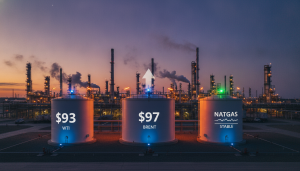
Geopolitical Tensions Fueling a Tight Physical Crude Market
The global crude oil market finds itself in a precarious state, characterized by an underlying tightness in physical supply that precedes any significant new geopolitical disruptions. Investors are keenly observing escalating tensions in the Middle East, a region pivotal to global energy flows. The delicate balance of supply and demand suggests that crude oil prices are poised to remain elevated unless a definitive diplomatic resolution emerges, particularly concerning trade through the critical Strait of Hormuz. A failure to achieve a lasting de-escalation could easily trigger another substantial rally in both Brent and West Texas Intermediate (WTI) benchmarks, presenting both significant risks and potential opportunities for energy investors.
The Strait of Hormuz, a narrow maritime choke point between the Persian Gulf and the Gulf of Oman, is an indispensable conduit for roughly one-third of the world’s seaborne oil trade. Any prolonged or significant impediment to transit through this waterway would inevitably lead to immediate and severe supply shocks, sending ripple effects across the global economy. This vulnerability underscores why geopolitical instability in the region is consistently priced into oil futures, demanding close attention from market participants. The current market structure reflects an anticipation of these potential supply shocks, maintaining a bullish bias that rewards long positions in times of heightened risk.
Beyond the immediate geopolitical flashpoints, the broader crude market has been grappling with persistent underinvestment in upstream exploration and production capacity over recent years. This structural issue, coupled with recovering global energy demand as economies rebound, forms the bedrock of the current tight physical market. OPEC+ production policies, while aiming to stabilize the market, also play a crucial role in managing spare capacity. Consequently, any unforeseen supply interruption from a major producer, or a widespread disruption due to regional conflicts, would exacerbate an already constrained supply environment, pushing prices well beyond current levels. The lack of decisive diplomatic progress in hot zones thus amplifies the potential for an already tight market to become critically undersupplied, propelling energy prices higher.
WTI Crude Technical Analysis: Bulls Maintain Control Following Key Rebound
From a technical standpoint, the short-term price action for West Texas Intermediate (WTI) crude oil signals a resilient bullish sentiment among traders. Recent trading patterns reveal a notable rebound from the robust support level at $89.60 per barrel, with prices subsequently pushing higher towards the $102 area. This decisive bounce indicates that the $89.60 mark served as a strong psychological and technical floor, successfully warding off bearish attempts to drive prices lower. The failure of WTI to break definitively below this key support has reinvigorated buyers, confirming the underlying strength of the market and reinforcing the control held by the bulls in the immediate term.
This technical resilience is critical for investors analyzing future price trajectories. The ability of WTI to hold above such a significant support level, particularly in a volatile global climate, suggests that market participants are eager to buy on dips. Such a pattern often precedes further upward momentum, provided no major fundamental shifts negate this technical strength. The move back towards the $102 level represents a significant recovery, indicating that market sentiment remains focused on the potential for higher prices, particularly given the backdrop of tight supply and geopolitical uncertainty that characterizes the current energy landscape.
Navigating the $80-$120 Consolidation Range: Key Levels for Oil Investors
WTI crude oil has largely consolidated within a substantial price range between $80 and $120 per barrel, a range established following the initial surge observed during past US-Iran geopolitical tensions. This extensive consolidation period has created a crucial battleground for market forces, with both the $80 floor and the $120 ceiling representing pivotal junctures for future price direction. For investors, understanding the implications of a definitive break from this established range is paramount, as it will likely dictate the next significant move in global energy markets and the broader economic outlook.
A definitive breach above the $120 resistance level would be a profoundly bullish signal, indicating that WTI crude prices are likely to surge significantly higher. Such a breakout would almost certainly be driven by severe and persistent supply issues, whether stemming from escalating geopolitical conflicts, unforeseen production outages from key regions, or a dramatic increase in global demand that outpaces available supply capacity. In such a scenario, the market would likely enter a new phase of elevated prices, potentially reminiscent of historical supercycles, challenging the cost structures of industries reliant on crude and impacting global inflation. Energy companies, particularly exploration and production (E&P) firms, would stand to benefit substantially from such an environment.
Conversely, while WTI holding above the $100 threshold signals a robust market, it also positions crude as an “expensive” commodity from a broader economic perspective. High oil prices impose significant costs on consumers and businesses, potentially acting as a drag on economic growth by reducing discretionary spending and increasing operational expenses. Investors must weigh the upside potential against the inherent risks associated with such elevated valuations. Maintaining prices above $100 for an extended period could invite demand destruction, albeit typically a slow process, or prompt strategic reserve releases from major consuming nations looking to temper price inflation and support economic stability.
The current environment therefore demands a nuanced investment strategy. While the technical indicators show immediate strength and geopolitical risks point towards continued upside potential, the existing consolidation range provides clear boundaries for trading strategies. A sustained move beyond $120 would confirm a new, higher price regime driven by supply scarcity and intensified market speculation. Conversely, a failure to advance meaningfully from current levels, or a dip below key support, could see the market retesting the lower end of its established trading channel, particularly if diplomatic breakthroughs or a significant demand slowdown materializes. Active management and careful monitoring of both fundamental supply-demand dynamics and geopolitical developments remain essential for navigating this complex and high-stakes energy market.