

The Australian government was hit with sharp criticism in May when – despite its promise that it would take serious action – the country’s greenhouse gas emissions were revealed to have slightly increased last year.
New data for the year to March suggest this has now changed. According to a climate department quarterly inventory, heat-trapping pollution dropped by 1.4%.
It was down 6.5m tonnes to 440.2m tonnes of carbon dioxide. This is 28% less than in 2005.
Unless it picks up, that rate of decline is not fast enough to meet the Albanese government’s legislated emissions reduction target for 2030 (a 43% cut compared with 2005). To get there, emissions needs to drop by about 15m tonnes a year on average.
Sign up: AU Breaking News email
Much deeper cuts again will be needed by 2035. The government is expected to announce its delayed 2035 target next month after receiving advice from the Climate Change Authority, led by Matt Kean.
Pollution from electricity is down
The good news in the latest data is the reduction in pollution coming from fossil fuel plants.
Last year, emissions from power generation increased for the first time in a decade. Australians used more electricity and there was less hydro and wind energy available. Solar was up, but the gap was otherwise met by burning more coal and gas.
In the year to March, emissions from electricity fell 0.8m tonnes – just a 0.5% drop, but a reversal on where things had been. It was driven by increases in wind and rooftop solar generation in the national grid. There was also a bit more hydro power. Coal and gas generation were down.
Electricity generation is Australia’s biggest source of emissions, responsible for about a third of the national total. Until last year, pollution from power plants had been coming down – 23.8% since 2005 – due to an influx of solar and wind.
The government is relying on that decline accelerating fast to hit its emissions target. It has promised 82% of all electricity will come from renewable sources by 2030.
That is more than double the proportion now. In the year to March, 54.9% of electricity still came from coal, 39.9% from renewables and 5.2% from gas-fired power. The industry and experts have warned that investment in new large-scale renewable energy is not happening at the pace needed to make up that gap. It has slowed this year.
There is a ray of light in a preliminary snapshot of emissions data for the year to June, also included in the latest inventory. It suggests emissions from electricity fell 3.2% over that period, indicating April-June this year was great for clean energy.
Emissions also down from industry, farms
In the year to March, there was a 2.7% drop in pollution from stationary energy, which includes fossil fuel burning in manufacturing, mining, and commercial and residential buildings. This was due to less coal being burned in metal manufacturing and households using less gas for heating and cooking.
Fugitive emissions – mostly leaks – from fossil fuel mining and transportation were down 2.2%. Pollution from industrial processes – mostly production of chemicals, metals and minerals – dropped 4.7%, in part due to steel production being lower.
In agriculture, pollution fell 1.3%, mainly due to fewer grazing cattle and sheep.
Sign up to Breaking News Australia
Get the most important news as it breaks
Privacy Notice: Newsletters may contain info about charities, online ads, and content funded by outside parties. For more information see our Privacy Policy. We use Google reCaptcha to protect our website and the Google Privacy Policy and Terms of Service apply.
after newsletter promotion
But transport pollution keeps rising
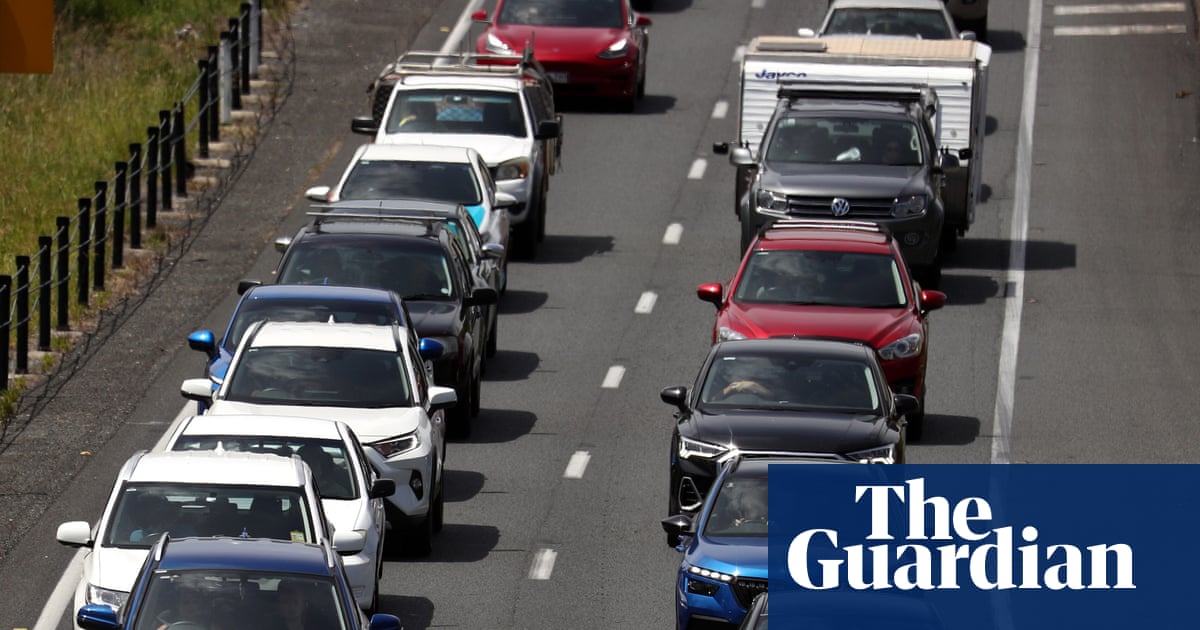
Pollution from transport – road, rail and domestic aviation and shipping – continues to head in the wrong direction. It was up 0.5m tonnes, or 0.5%.
This was a smaller rise than in recent years, but continues a long-term trend that was briefly interrupted by Covid-19 shutdowns. Transport is Australia’s second-biggest sectoral source of emissions after electricity generation, and has increased 22.4% higher over the past 20 years.
The most recent increase was due to a jump in use of jet fuel and diesel. The increase was partly offset by a small drop in petrol use. Australia’s diesel vehicle fleet – including SUVs, freight vehicles and buses – has increased 93% since 2014.
What is driving change?
According to the climate change minister, Chris Bowen, the data shows the government’s policies are having an impact. They include a large-scale electricity underwriting scheme and a revamped safeguard mechanism, which requires the country’s biggest polluting sites to cut emissions intensity year-on-year or buy contentious carbon offsets.
The redesigned safeguard mechanism has been criticised for not requiring enough of polluters, including financially rewarding some companies that increase emissions. Data for the first year suggested the total cut in direct emissions across the 219 big emitting facilities covered by the scheme was 2.7m tonnes, or nearly 2%.
Bowen said a new vehicle efficiency standard was projected to eventually cut emissions from cars and, despite the criticisms, maintained the government was “on track” to meet its emissions reduction targets “if we stay the course and continue to lift our efforts”.
What about forests and the land?
But the bulk of Australia’s emissions reductions are not due to changes in fossil fuel use, or climate change policy. The overwhelming majority of the claimed 28% cut since 2005 is based on estimates of the change how much CO2 has been sucked from the atmosphere and stored in forests and the land.
Critics say nature-based carbon absorption is important, but its measurement is far from perfect and it cannot be assumed to be permanent, given the rising risk of drought, fire and flood. There is a case that land and forest emissions should be counted separately to the rest of the economy to give a truer picture of what is happening with fossil fuel use.
If the land is excluded from the latest data, national emissions were only 3.7% lower in the year to March than in 2005.
That’s an improvement from a year ago, when they were down only 2.5%. But it shows how far there is to go.
