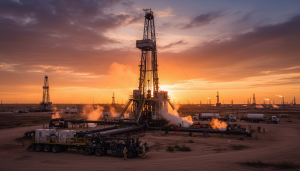
The global energy landscape has been abruptly reshaped by recent geopolitical escalations, culminating in a significant disruption to liquefied natural gas (LNG) production from Qatar. The reported shutdown of QatarEnergy’s Ras Laffan plant, a facility responsible for approximately one-fifth of the world’s LNG supply, following an Iranian drone attack, has sent shockwaves through energy markets. This unprecedented halt immediately triggered a dramatic surge in European natural gas prices, reminiscent of the volatility seen during the 2022 energy crisis. For investors, this event underscores the fragile balance of global energy security and demands a meticulous reassessment of risk and opportunity in the oil and gas sector.
Immediate Market Reaction and Geopolitical Tensions
The confirmed suspension of operations at the Ras Laffan plant, a critical hub for global LNG exports, has had an immediate and profound impact on natural gas markets. European benchmark gas futures witnessed an intraday jump of over 50%, marking their most significant surge since Russia’s invasion of Ukraine four years ago. This spike pushes benchmark prices to a one-year high, reflecting the market’s acute sensitivity to supply shocks. Concurrently, the vital Strait of Hormuz, through which roughly 20% of the world’s LNG transits, has experienced a dramatic slowdown in traffic. This bottleneck has potentially led to fuller storage tanks for QatarEnergy, prompting the company to declare force majeure on its contractual LNG delivery obligations. While no damage to the facility has been reported, the implications for global energy security are here and now, as noted by analysts like Simone Tagliapietra from Bruegel.
This disruption unfolds against a backdrop of intensifying conflict across the Middle East. Blasts have been reported across Israel, Saudi Arabia, Qatar, and the United Arab Emirates as states intercepted Iranian missiles. Adding to the regional supply concerns, Israel recently ordered the temporary closure of some gas-producing capacities, including its largest Leviathan gas field, leading major importer Egypt to seek additional LNG cargoes. These escalating tensions introduce significant uncertainty, with US President Donald Trump indicating that bombing campaigns against Iran could extend for weeks, further prolonging market anxiety.
Crude’s Resilience Amidst Gas Volatility and Investor Concerns
While natural gas markets bear the brunt of the immediate shock, the broader energy complex, including crude oil, is also reacting to the heightened geopolitical risk. As of today, Brent crude trades at $93.93 per barrel, marking a 0.74% increase within a day range of $93.52 to $94.21. Similarly, WTI crude stands at $90.35 per barrel, up 0.76% for the day, trading between $89.71 and $90.70. Gasoline prices remain stable at $3.13. This upward movement in crude prices comes after a notable 14-day Brent trend, where prices saw a significant decline from $118.35 on March 31st to $94.86 by April 20th, representing a nearly 20% drop. The current geopolitical flare-up, however, is providing a counter-narrative to that recent downward trend, suggesting potential for renewed upward price volatility.
Our proprietary reader intent data reveals a clear focus among investors on crude oil’s trajectory, with frequent questions like “Is WTI going up or down?” and broader inquiries about the “price of oil per barrel by end of 2026.” The current events highlight that while fundamental supply-demand dynamics are always at play, geopolitical instability can rapidly override them, injecting considerable upside risk into pricing models. The direct impact on LNG, combined with the indirect implications for crude through shipping disruptions and regional instability, means investors must factor in a higher geopolitical risk premium across their energy portfolios.
Forward Outlook: Supply Shortfalls and Strategic Adjustments
The critical question for traders and investors alike revolves around the duration of this disruption. Analysts at Goldman Sachs Group Inc. have projected that European gas prices could more than double if shipping through the Strait of Hormuz were halted for a full month, a stark reminder of the potential economic fallout. Europe, with its unusually low storage inventories, faces an urgent need to import substantial volumes of LNG this summer to replenish reserves ahead of the next winter, intensifying global competition for available supplies.
While the United States is poised to boost its LNG production, notably with QatarEnergy’s Golden Pass expansion project scheduled to commence in the coming weeks, it is unlikely to fully offset the immediate supply gap created by the Ras Laffan shutdown. The Golden Pass facility is not expected to reach full capacity until next year, underscoring the near-term vulnerability. Investors should closely monitor upcoming energy events for further insights. The OPEC+ JMMC Meeting on April 21st will be crucial for any signals regarding crude production policy, potentially influencing global oil supply in response to regional instability. Subsequent EIA Weekly Petroleum Status Reports on April 22nd and April 29th, along with API Weekly Crude Inventory data on April 28th and May 5th, will provide vital updates on U.S. inventory levels, offering a snapshot of market balance. Furthermore, the EIA Short-Term Energy Outlook on May 2nd will offer a refreshed perspective on market fundamentals in light of these developing geopolitical risks.
Investment Implications and Long-Term Strategy
The current situation unequivocally elevates the risk profile for investments in the oil and gas sector, particularly within the LNG value chain. The immediate surge in natural gas prices, driven by supply fears, presents both challenges and opportunities. While the direct hit to Qatari exports creates significant volatility, it also highlights the strategic importance of diversified LNG sources and robust import infrastructure. Companies with flexible contracting portfolios or access to alternative supply hubs may prove more resilient.
For investors asking about the long-term price trajectory of oil and gas, especially “what do you predict the price of oil per barrel will be by end of 2026?”, the current events add a layer of geopolitical uncertainty that cannot be ignored. The interplay between sustained geopolitical risk, the pace of energy transition, and the fundamental supply-demand balance will dictate price movements. This environment favors companies with strong balance sheets, diversified asset bases, and agile operational capabilities. Monitoring the frequency and severity of such geopolitical incidents will be paramount in assessing the sustained risk premium. Strategic investments in energy security, including storage solutions, regasification terminals, and new liquefaction capacity in stable regions, are likely to gain renewed focus and potentially attract increased capital. The current market dynamics emphasize that a robust, adaptable investment strategy is essential for navigating the complexities of the modern energy market.