As the calendar shifts deeper into Q2 2026, a significant re-evaluation of energy sector exposure is underway across Wall Street. Following a period of market volatility and a notable correction in crude prices, institutional investors are increasingly turning their attention back to oil and gas, recognizing its enduring strategic value amid evolving macroeconomics and geopolitical landscapes. This isn’t merely a tactical play; it’s a structural re-allocation driven by a confluence of factors, from shifting regulatory perspectives on capital efficiency to persistent inflationary pressures and tightening physical market conditions. OilMarketCap’s proprietary data reveals a compelling narrative supporting this quiet, yet powerful, rotation into energy assets.
Current Market Dynamics Signal Opportunity Amidst Volatility
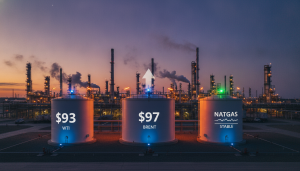
The recent trajectory of crude prices provides a crucial backdrop for institutional re-engagement. As of today, Brent Crude trades at $93.81, showing a modest daily gain of 0.61% within a range of $93.52 to $94.21. Similarly, WTI Crude stands at $90.27, up 0.67% on the day, trading between $89.71 and $90.70. While these daily movements appear stable, they mask a dramatic shift over the past two weeks. OilMarketCap’s 14-day trend data shows Brent Crude plummeting from $118.35 on March 31st to $94.86 by April 20th, representing a substantial 19.8% decline. This sharp correction, nearly $23.49 per barrel, has created an attractive entry point for capital that was previously on the sidelines. Institutions are now reassessing energy exposure, viewing the recent dip not as a weakness, but as a discount on assets with strong fundamental underpinnings. The conversation has quietly shifted from divestment to strategic re-allocation, driven by a recognition that energy security and reliable supply are paramount, influencing how financial institutions model capital efficiency and asset stability.
Physical Market Tightness and Investor Intent
Beyond price fluctuations, the underlying physical market for crude and refined products shows signs of persistent tightness, a key indicator for savvy investors. While precise inventory figures for the current moment await official releases, our internal models suggest a compressed inventory-to-consumption ratio globally. This mirrors what we’ve seen in other foundational commodities: when above-ground inventories thin relative to industrial usage, the market becomes highly sensitive to supply disruptions and demand surges. This dynamic is fueling institutional interest, as sustained physical demand against limited spare capacity can lead to non-linear price appreciation. Our reader intent data underscores this focus, with investors frequently asking, “Is WTI going up or down?” and “What do you predict the price of oil per barrel will be by end of 2026?” These questions directly reflect a deep concern over supply-demand fundamentals and the potential for significant price movements as physical market realities assert themselves over financial sentiment. The expectation is that if physical demand accelerates into key delivery windows, the repricing of crude assets could be swift and substantial.
Inflationary Headwinds and Upcoming Catalysts
The broader macroeconomic environment also strongly supports a rotation into hard assets like oil. Recent U.S. producer price index data has surprised to the upside, indicating that inflationary pressures remain embedded across industrial supply chains and wholesale costs. In such an environment, hard assets historically regain strategic relevance, acting as both an inflation hedge and a direct beneficiary of robust industrial activity. Oil, with its dual role as a foundational industrial input and a geopolitically sensitive commodity, is uniquely positioned to amplify returns during periods of monetary uncertainty and fiscal expansion. Looking ahead, the next two weeks are packed with crucial energy events that will shape market sentiment and positioning. The OPEC+ JMMC Meeting today (April 21st) will provide immediate clarity on supply policy. This will be swiftly followed by the EIA Weekly Petroleum Status Reports on April 22nd and 29th, offering vital insights into U.S. crude and product inventories. The Baker Hughes Rig Count on April 24th and May 1st will signal future supply trends, while the EIA Short-Term Energy Outlook on May 2nd will provide official forecasts. These upcoming calendar events are not merely data points; they are critical catalysts that will confirm or challenge current market narratives, providing institutional desks with the specific data needed to refine their price forecasts, including questions like “How well do you think Repsol will end in April 2026?” and their broader “end of 2026” oil price predictions. This period is shaping up to be one where strategic positioning, informed by these key data releases, could matter disproportionately for portfolio performance.
Strategic Re-evaluation: Oil as an Amplifying Asset
The institutional shift into oil and gas is more than just a bet on higher prices; it’s a strategic re-evaluation of energy as a core portfolio component. Large quantitative trading firms and institutional desks have been observed expanding their exposure to energy-linked instruments in recent weeks, indicating a broader trend beyond speculative plays. Unlike some commodities that merely preserve capital, oil possesses an amplifying quality, particularly in times of inflationary acceleration and global economic re-alignment. Its indispensability to industrial growth and its critical role in national energy security make it uniquely sensitive to macro shifts. In an environment where energy transition narratives sometimes overshadow the immediate need for reliable, affordable hydrocarbons, institutional capital is recognizing the pragmatic necessity and the potential for significant returns from an undervalued sector. This isn’t just about chasing short-term gains; it’s about positioning for a multi-year cycle where robust energy fundamentals, underpinned by sustained global demand and constrained supply growth, will drive value.