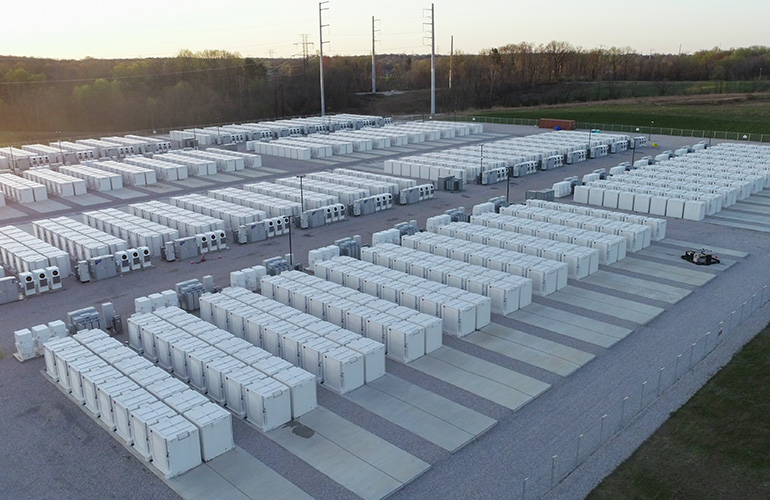
The U.S. energy landscape is undergoing a profound transformation, with energy storage emerging as a critical component for grid resilience and decarbonization. In a testament to this accelerating shift, the second quarter of 2025 set an unprecedented benchmark, witnessing the installation of 5.6 gigawatts (GW) of energy storage capacity across the nation. This record-breaking deployment, primarily driven by utility-scale projects, underscores a clear investment thesis: energy storage is no longer a niche technology but a foundational element in addressing escalating electricity demand and volatile energy prices. For investors tracking the broader energy sector, this rapid expansion signals robust opportunities well beyond traditional fossil fuel plays, demanding a closer look at the infrastructure and technology powering the future grid.
Utility-Scale Storage Leads the Charge Towards Grid Modernization
The monumental growth in Q2 2025 was overwhelmingly propelled by the utility-scale segment, which alone accounted for 4.9 GW of new installations. This capacity is sufficient to power approximately 3.7 million American homes during peak demand, highlighting the immediate and significant impact of these projects on grid stability and reliability. Major states like Texas, California, and Arizona were at the forefront, each adding over 1 GW of capacity, demonstrating a strong regional commitment to large-scale energy solutions. Notably, the Southwest Power Pool (SPP) region, including Oklahoma, saw a resurgence of activity with three new projects coming online, marking the first such deployments in three years. Furthermore, Florida and Georgia have significantly upgraded their future storage forecasts, spurred by aggressive procurement strategies from vertically integrated utilities. This concentrated development in key markets reflects a strategic response to rising electricity costs and the imperative to strengthen grid infrastructure against increasing demand pressures.
Decentralized Storage Gains Traction Amidst Diverse Investor Focus
While utility-scale projects dominated the headlines, the residential and commercial & industrial (CCI) storage markets also demonstrated compelling growth, signaling broadening investment avenues. Residential storage expanded by a robust 608 megawatts (MW) in Q2, representing an impressive 132% year-over-year increase and an 8% quarter-over-quarter bump. This segment’s strength was primarily concentrated in California, Arizona, and Illinois, where higher attachment rates and the deployment of larger-capacity systems are becoming standard. The CCI segment, though expanding more modestly at 38 MW (an 11% year-over-year increase), saw significant activity in California and New York, which together constituted over 70% of new capacity, with Illinois also gaining traction. Our proprietary data indicates that many investors are currently fixated on the near-term trajectory of crude oil prices, with questions surrounding specific producers and the broader 2026 oil price outlook dominating recent inquiries. This intense focus on traditional fossil fuels, including detailed questions about OPEC+ production quotas, underscores the need for diversification. The consistent growth in residential and commercial storage presents a compelling, albeit often overlooked, opportunity to invest in a sector with fundamental demand drivers independent of immediate crude price volatility.
Navigating Policy Headwinds and Commodity Price Swings
Despite the bullish growth figures, the U.S. energy storage market is not without its challenges. The industry faces persistent regulatory uncertainty, particularly concerning the forthcoming Foreign Entity of Concern (FEOC) regulations on battery cell sourcing, which could potentially temper utility-scale installations, possibly leading to a 10% year-over-year decline in 2027. High costs and policy constraints continue to limit the widespread deployment of community storage. However, the overall outlook remains strong, with projections indicating the U.S. storage market will reach 87.8 GW by 2029, predominantly driven by the residential and utility-scale segments. This resilience is particularly noteworthy when contrasted with the inherent volatility in the broader energy commodities market. As of today, Brent crude trades at $90.38, reflecting a significant 9.07% decline in a single trading session, while WTI crude sits at $82.59, down 9.41%. The gasoline market has also seen a sharp drop to $2.93, a 5.18% decrease. This steep, recent correction, following an 18.5% drop in Brent over the past two weeks from $112.78 on March 30th to $91.87 on April 17th, underscores the dynamic and often unpredictable nature of the traditional oil market. While the energy storage sector faces its own policy-related uncertainties, its fundamental demand drivers, tied to grid modernization and decarbonization, offer a distinct risk profile compared to the dramatic commodity price swings we are currently observing.
Upcoming Catalysts and Strategic Investment Implications
The trajectory of the energy storage market, while robust, is influenced by the broader energy ecosystem. For investors, understanding the interplay between traditional energy markets and emerging sectors is crucial. The coming weeks will offer critical insights into crude supply and demand dynamics, which can shape overall investment sentiment. The OPEC+ Joint Ministerial Monitoring Committee (JMMC) meeting on April 18th, followed by the full Ministerial meeting on April 19th, will be closely watched for any shifts in production policy that could further impact crude prices. Weekly API and EIA inventory reports on April 21st, 22nd, 28th, and 29th, alongside the Baker Hughes Rig Count on April 24th and May 1st, will provide real-time data on supply-demand balances and drilling activity. These events, while not directly related to battery storage, create the macro environment in which all energy investment decisions are made. A volatile oil market, for instance, might push more capital into stable, growth-oriented sectors like energy storage infrastructure, especially given the industry’s stated goal of achieving 100% domestic battery supply. The consistent expansion of energy storage capacity, coupled with aggressive utility procurement and resilient residential demand, positions this sector as a compelling long-term play for investors seeking to diversify their energy portfolios and capitalize on the foundational shifts occurring within the global energy transition.