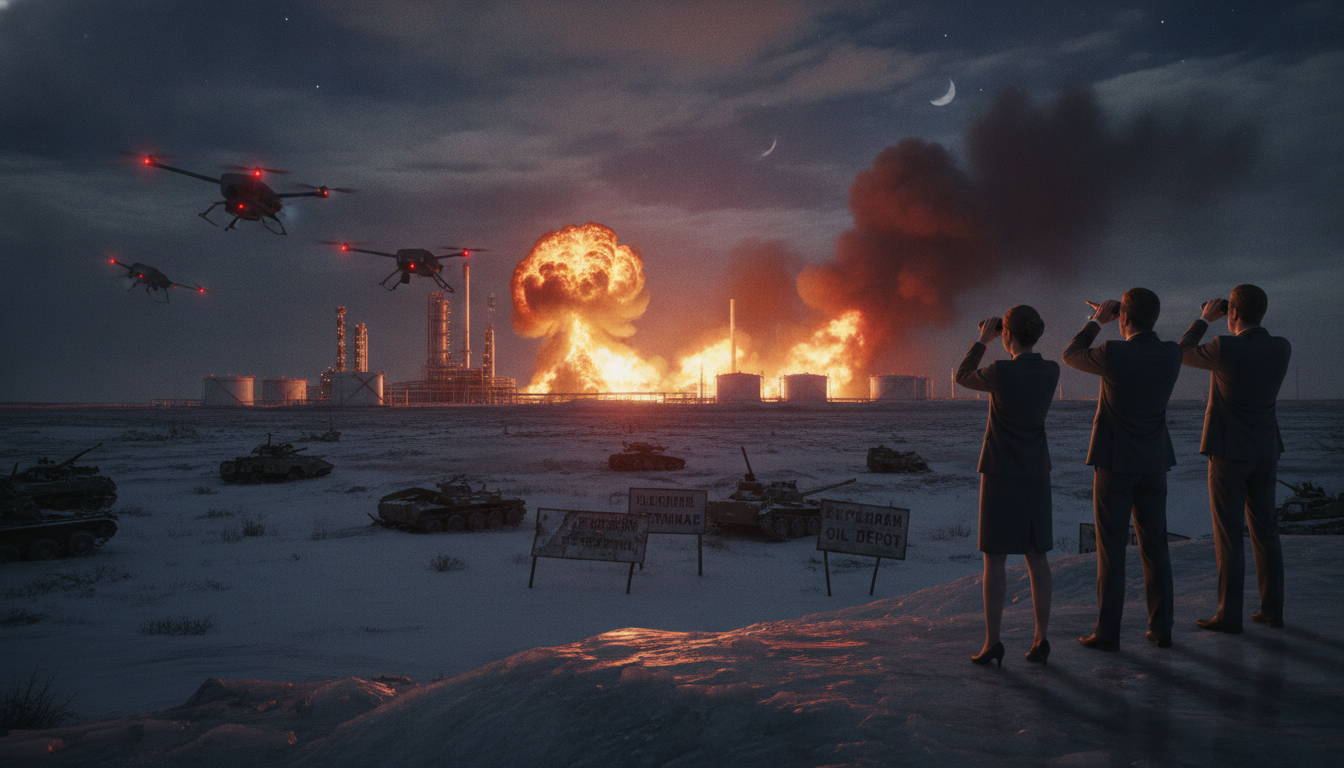
In a dramatic escalation of drone warfare, critical commercial infrastructure deep within Russia has become a primary target, delivering a significant blow to the nation’s economic stability and highlighting profound geopolitical risks for global investors. This past week alone, an extensive series of Ukrainian drone strikes has systematically crippled the operations of Wildberries, Russia’s dominant e-commerce platform, leading to the destruction of seven of its largest distribution centers. The scale of these attacks, culminating in the complete obliteration of massive warehouses in strategic locations, underscores a shifting paradigm in modern conflict with far-reaching implications for global supply chains and investor confidence across all sectors, including energy markets.
The latest barrage saw multiple kamikaze drones strike two substantial Wildberries facilities in St. Petersburg on Friday. These incidents follow a week of intense aerial assaults that commenced in central Russia, quickly extending to Elektrostal on the outskirts of Moscow, and later to Krasnodar and Stavropol, regions close to the disputed Crimean peninsula. Reports indicate these devastating infernos have tragically claimed the lives of at least eight civilians and left dozens more injured, a grim reminder of the human cost inherent in these strategic disruptions. The cumulative impact means over half of Wildberries’ key logistics hubs have now been reduced to ash, severely disrupting supply chains and inflicting substantial economic damage across Russia.
The Target: Russia’s E-commerce Powerhouse Under Siege
At the heart of this unfolding crisis stands Tatyana Kim, the 50-year-old founder and CEO of Wildberries, widely recognized as Russia’s wealthiest woman with a pre-attack net worth estimated at $8.1 billion. Her e-commerce empire, often likened to Amazon’s Russian counterpart, is a commercial behemoth, employing 48,000 individuals and reporting an impressive $9 billion (840 billion rubles) in revenues for 2024. Unconfirmed projections for 2025 sales reportedly aimed for an ambitious $15 billion, a trajectory now severely imperiled by the ongoing destruction of its core assets and the resultant market instability.
In the immediate aftermath of the St. Petersburg strikes, Ms. Kim communicated via her Telegram channel, stating thankfully there were no casualties in these specific incidents. Earlier in the week, expressing profound sorrow and frustration, she lamented, “I have no words to describe all the feelings and emotions caused by the attacks on ordinary people, on our employees, on us, who are simply doing our jobs.” Demonstrating resolve amidst adversity, she affirmed the company’s commitment to “continue to do what we do for the benefit of people,” announcing a substantial compensation package: 2 million rubles ($25,500) for the families of each employee killed and half that amount for those severely injured. This gesture highlights the immense personal and corporate challenge Wildberries faces in maintaining its operational integrity and employee morale under hostile conditions.
Geopolitical Motivations and Broader Market Implications
Ukrainian President Volodymyr Zelensky openly endorsed these attacks, framing the warehouses as legitimate military targets. Kyiv asserts that Wildberries, despite its civilian appearance, plays a crucial role in enabling the sale and distribution of a myriad of tactical military items, including drones, advanced navigation systems, protective flak jackets, and even commemorative flags and patches celebrating Russia’s “special military operation” in Ukraine. This narrative positions the e-commerce giant as an integral component of Russia’s broader wartime logistics and propaganda efforts, justifying the strikes as a means to disrupt the aggressor state’s operational capacity.
The strikes also carry a clear retaliatory dimension, coming after a series of Russian assaults on Ukrainian distribution terminals belonging to Nova Poshta in vital port cities like Odessa and Mykolaiv. A recent analysis from the Kiev School of Economics reported that Russia has systematically destroyed 92 factories and warehouses across Ukraine, underlining a pattern of targeting commercial logistics infrastructure by both sides. Robert Brovdi, a prominent Ukrainian drone commander, articulated the psychological warfare inherent in these operations. Writing on Telegram, Brovdi declared the strikes aim to shatter “the illusion of a comfortable peacetime existence for the obedient population of the aggressor state,” seeking to dismantle not just physical infrastructure but also public complacency and morale. Such actions create broad market volatility, impacting investor sentiment even in seemingly unrelated sectors like oil and gas, as geopolitical tension directly affects energy supply security and pricing.
Economic Fallout and Supply Chain Vulnerabilities
The financial impact of these coordinated attacks is staggering. Prior to the latest St. Petersburg incidents, initial estimates by the Moscow Times placed the damage to Wildberries’ infrastructure at over $1.3 billion. This immense loss has sent shockwaves through the Russian e-commerce sector, prompting competitors like Ozon and Yandex to swiftly amend their contractual terms with sellers. These modifications now explicitly exempt them from liability for inventories destroyed in potential future attacks, a stark indication of the heightened risk environment and the urgent need for reassessing supply chain resilience across all industries. For energy investors, this incident underscores the critical importance of evaluating the security and redundancy of logistics networks that support upstream, midstream, and downstream operations, particularly in politically volatile regions.
The vulnerability of mega-warehouses to such devastating events is not unique to this conflict. A report from insurance giant Zurich North America had previously raised concerns about the inherent risks of modern logistics facilities. These colossal structures, often spanning the size of 30 football fields with roof heights reaching 45 feet and featuring narrow aisles optimized for automated picking, present significant challenges for effective firefighting. Compounding this, contemporary inventories frequently include highly flammable materials like plastics, aerosols, and lithium-ion batteries, dramatically increasing fire intensity and spread. Professor Susan Phillips of Pitzer College further noted that these design and inventory trends have exacerbated the severity of major warehouse fires globally, referencing incidents such as the recent Doyle Heights blaze near Los Angeles. The critical takeaway for investors in any sector, including oil and gas, is the urgent need to factor in supply chain robustness, physical asset security, and disaster preparedness when evaluating long-term operational risks and capital allocation.
Wildberries’ Journey and Future Uncertainty
Tatyana Kim’s entrepreneurial journey began humbly in 2004. A former English teacher, she launched Wildberries at 28 while on maternity leave, initially reselling bulk clothing sourced from Germany’s e-commerce site, Otto, from her apartment. The company evolved rapidly, establishing physical pick-up points for shoppers by 2011 and adopting an Amazon-like marketplace model by 2014, now serving over 88,000 merchants. The path to dominance was not without its internal battles; in 2024, Kim faced a dramatic attempted takeover by her now ex-husband, Vladislav Bakalchuk, a violent incident that resulted in two security guards being killed.
That same year, in a strategic move supported by President Vladimir Putin, Kim merged Wildberries with advertising firm Russ Outdoor. This deal, aimed at creating a formidable Russian rival to global giants like Amazon, Alibaba, and Softbank, saw Kim divest approximately a third of her 99% stake in the company. With operations spanning eight countries and ambitious plans announced in 2025 for expansion into Africa, Wildberries was poised for continued international growth. However, the current systematic destruction of its domestic distribution network may force a significant re-evaluation and potential delay of these global ambitions, redirecting critical resources towards rebuilding and securing its core operations. This highlights how geopolitical events can abruptly alter corporate strategies and investment horizons, a lesson equally pertinent for companies operating within or supplying the energy sector.
A crucial financial detail emerging from the Kommersant report reveals that while Wildberries’ warehouses were insured, these policies explicitly exclude coverage for drone strikes and “terrorist” attacks. This exclusion presents a formidable financial burden for the company, forcing it to shoulder the rebuilding costs directly. Despite the immense challenges, Kim remains resolute. In a recent Telegram update, she confirmed Wildberries is actively redistributing goods to its remaining operational warehouses, striving to fulfill its staggering 7 million daily customer orders. “We will all overcome this,” she declared, a testament to her determination. However, the sustained campaign by Ukraine’s drone forces indicates their plans for Wildberries, and indeed Russia’s economic infrastructure, may extend far beyond a single week of attacks, compelling investors to critically assess the evolving landscape of geopolitical risk and its profound impact on market stability, energy supply chain resilience, and asset protection in volatile regions globally.