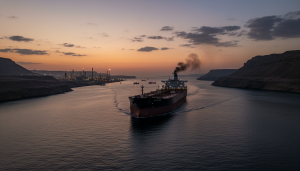
Energy markets faced extreme volatility this past week as geopolitical tensions in the Middle East escalated, with conflicting reports regarding the status of the critical Strait of Hormuz and the future of U.S.-Iran peace talks. Investors watched nervously as crude prices plummeted amid a backdrop of diplomatic uncertainty, military posturing, and accusations of breached agreements.
On Friday, April 17, 2026, President Donald Trump expressed a degree of optimism about ongoing negotiations with Iran, indicating that discussions would continue through the weekend. Speaking to reporters en route to Washington aboard Air Force One, President Trump suggested positive developments, stating, “We had some pretty good news 20 minutes ago, but it seems to be going very well in the Middle East with Iran.” However, this optimism was juxtaposed against stark warnings regarding the persistent naval blockade on Iranian ports and the potential for renewed military action.
Navigating the Diplomatic Minefield
The core of the U.S.-Iran negotiations revolves around Tehran’s nuclear program. President Trump outlined a plan for the recovery of nuclear material, asserting that the U.S. would “go in with Iran and we will take it together, and we will bring it back, 100% of it back to the United States.” He clarified that this reclamation would occur subsequent to a signed agreement. Earlier attempts at resolution proved unsuccessful, with talks in Islamabad last weekend between a U.S. delegation led by Vice President JD Vance and Iranian negotiators headed by parliamentary speaker Mohammad Bagher Ghalibaf failing to yield a breakthrough.
A precarious two-week ceasefire, initiated on April 7, is slated to conclude on Wednesday. President Trump signaled that an extension is improbable, reinforcing the ongoing naval blockade against Iranian ports. “Maybe I won’t extend it,” President Trump stated, adding a stark warning: “you have a blockade, and unfortunately, we’ll have to start dropping bombs again.” This threat follows a U.S. and Israeli aerial campaign against Iranian targets, which commenced on February 28, further underscoring the region’s precarious stability.
The Hormuz Conundrum: A Choke Point in Contention
The most immediate and impactful flashpoint for global energy markets remains the Strait of Hormuz. On Friday, amid a separate 10-day ceasefire between Israel and Lebanon, Iran initially declared the vital shipping lane open for commercial traffic. However, this clarity proved fleeting. By Saturday, Iranian state media reported that the Strait had once again been closed to shipping, alleging that the U.S. had failed to uphold its commitments.
The Islamic Republic of Iran Broadcasting (IRIB) service posted on X, explaining, “Iran agreed to allow a limited number of ships to pass through the Strait of Hormuz according to agreements. But U.S. did not fulfill their obligations. So, the Strait of Hormuz is now closed again and passage requires IRAN approval.” This contradicted an earlier statement from Iranian Foreign Minister Seyed Abbas Araghchi on Friday, who had announced on social media that “In line with the ceasefire in Lebanon, the passage for all commercial vessels through Strait of Hormuz is declared completely open for the remaining period of ceasefire.” Araghchi had, however, stipulated that vessels must transit through a “coordinated route” as designated by Iranian maritime authorities, leaving open the question of potential transit fees.
The Israel-Lebanon ceasefire, which began Thursday at 5 p.m. ET, aimed to pause Israel’s military operations against Hezbollah, a group closely allied with Iran. President Trump had initially acknowledged Iran’s move to open the waterway in a social media post on Friday, even while reiterating that the U.S. naval blockade on Iranian ports would persist until a comprehensive agreement was reached. During a speech in Phoenix, President Trump further asserted that Iran had “just announced that the Strait of Hormuz is fully open and ready for business and full passage.”
However, Tehran quickly challenged this assertion. Mohammad Bagher Ghalibaf, Iran’s parliamentary speaker, countered via an X post, “With the continuation of the blockade, the Strait of Hormuz will not remain open.” Adding to the confusion, real-time ship tracking data from Kpler visually confirmed the operational reality: multiple tankers and cargo ships attempting to exit the waterway on Friday were forced to turn back. Matt Smith, director of commodity research at Kpler, confirmed these vessels “clearly not been given approval to pass through.”
Reports from Iranian media outlets affiliated with the Revolutionary Guard shed further light on a restricted reopening, noting that commercial ships must coordinate with Iranian forces. A source close to Iran’s Supreme National Security Council told Tasnim News that passage would be denied to ships or cargoes linked to “hostile nations,” and warned that the Strait would be fully closed if the U.S. naval blockade persisted.
Market Reaction and Investment Outlook
The profound uncertainty surrounding the Strait of Hormuz, a strategic choke point through which approximately one-fifth of the world’s crude supplies traversed before recent hostilities, triggered a significant market reaction. Oil prices saw a sharp decline exceeding 10% on Friday, pushing crude futures below the $90 per barrel mark. The potential closure of this vital artery, connecting the Persian Gulf to global energy markets, represents an unprecedented disruption to global oil supply, impacting both spot prices and forward curves.
President Trump’s agreement to the two-week ceasefire on April 7 was reportedly contingent on Iran completely opening the Strait. However, Ghalibaf has accused the U.S. of breaching this understanding by allowing Israel’s continued military campaign in Lebanon. This accusation further complicates an already fragile diplomatic landscape, leaving energy investors to grapple with a rapidly evolving and unpredictable supply environment.
As the geopolitical chess game continues, investors must remain vigilant. The interplay of ongoing peace talks, the status of the Iranian nuclear program, the enforceability of blockades, and the operational freedom of the Strait of Hormuz will continue to dictate the trajectory of global oil prices. The Middle East remains a critical area of focus, with any sudden shift capable of triggering substantial market volatility and presenting both risks and opportunities for those engaged in the oil and gas sector.