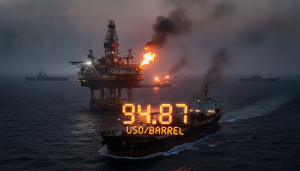
The global energy landscape is once again shifting dramatically, with the US administration actively pushing domestic oil and gas producers to significantly ramp up output. This urgent call stems from escalating geopolitical tensions in the Middle East, particularly disruptions impacting the critical Strait of Hormuz, which have rapidly tightened global crude supplies and sent prices soaring. For energy investors, this scenario presents both profound risks and compelling opportunities, highlighting the indispensable role US upstream operators play in global energy stability amidst a highly volatile market.
Geopolitical Shockwaves and Immediate Market Response
The renewed emphasis on increasing domestic output is a direct response to profound concerns regarding a potential supply shock. Mounting conflict in the region, particularly the effective closure of the Strait of Hormuz, represents a formidable challenge to global energy flows. This narrow chokepoint is not merely a strategic waterway; it serves as the indispensable transit route for approximately one-fifth of the world’s total crude oil and liquefied natural gas (LNG) supplies. The profound impact of its disruption cannot be overstated, with combined damage to vital regional energy infrastructure effectively removing an estimated 16 million barrels per day (MMbpd) from the global market.
Such a substantial and sudden supply contraction inevitably triggers a sharp upward trajectory in crude oil prices, creating significant volatility. As of today, Brent Crude trades at $95.09, reflecting a robust 5.21% gain within the day, with its range spanning $92.77-$97.81. Similarly, WTI Crude has climbed to $86.96, up 5.29%, after trading between $85.45 and $89.6. These immediate price surges are a stark reminder of the market’s sensitivity to supply disruptions. This recent spike follows a period of significant fluctuation; Brent, for example, trended from $112.78 on March 30th down to $90.38 just last Friday, before today’s sharp rebound. This whipsaw action underscores the extreme uncertainty currently dominating the energy investment landscape, with gasoline prices also reflecting the pressure, currently at $3.03, up 3.41%.
US Producers Under Pressure: Capacity and Investor Focus
Washington’s message to the US oil and gas sector is clear: robust price signals are currently incentivizing investment, and an expanded domestic supply is crucial for stabilizing highly volatile global markets. Interior Secretary Doug Burgum and Energy Secretary Chris Wright recently conveyed this message directly to a consortium of top oil executives, including senior leadership from major integrated players like ExxonMobil and Chevron, alongside prominent independent producers such as Continental Resources, Diamondback Energy, Devon Energy, and Occidental Petroleum. This unified front from the administration underscores the severity of the current supply landscape and the perceived opportunity for US production to mitigate the crisis.
While US oil production has already achieved record-setting volumes, administration officials unequivocally stressed the potential for further near-term output increases. This perspective frames the current crisis as a unique window of opportunity for energy companies. Secretary Burgum encapsulated this sentiment, stating, “They’re all leaning in because they’re getting a price signal that this is a time to invest.” This direct engagement addresses a core concern we’ve observed among our readers: “is WTI going up or down?” The administration’s push, combined with current geopolitical events, strongly suggests an upward bias for the near term, provided US producers can respond effectively. Investors are also keenly asking “what do you predict the price of oil per barrel will be by end of 2026?” The answer to this depends heavily on how quickly and substantially US producers can unlock new capacity, balancing immediate supply needs with long-term investment strategies.
Navigating the Near-Term: Upcoming Events to Watch
For investors charting their course in this dynamic environment, the next few weeks are critical, packed with events that could significantly influence market direction and crude oil prices. The immediate focus will be on OPEC+ decisions. The **OPEC+ JMMC Meeting on Monday, April 20th**, followed by the crucial **OPEC+ Ministerial Meeting on Saturday, April 25th**, will be closely scrutinized. Given the current 16 MMbpd supply disruption from the Middle East, any indication of an OPEC+ output adjustment – or lack thereof – could send powerful signals to the market, potentially exacerbating or easing the current supply crunch. A decision to maintain current cuts could amplify price pressures, while an unexpected increase could temper them.
Domestically, US production response and inventory levels will be paramount. The **API Weekly Crude Inventory report on Tuesday, April 21st**, and the **EIA Weekly Petroleum Status Report on Wednesday, April 22nd**, will offer critical insights into US crude stockpiles and production trends. These reports will provide the first real-time data points on whether US producers are indeed “leaning in” to the administration’s call for increased output. Subsequent reports on April 28th and 29th will offer further clarity. Additionally, the **Baker Hughes Rig Count on Friday, April 24th**, and again on May 1st, will serve as a vital barometer for drilling activity and future production growth. An increase in active rigs would signal a clear commitment from producers to expand capacity, influencing investor sentiment regarding the long-term supply outlook and potential for price moderation.
Strategic Implications for Energy Investors
The current confluence of geopolitical risk and governmental pressure creates a complex but potentially lucrative environment for energy investors. Companies with existing, readily scalable production capacity, particularly in US shale plays, are best positioned to capitalize on the robust price signals and the administration’s urgings. Integrated majors with diversified portfolios may weather volatility better, while pure-play upstream independents could see significant upside from sustained higher prices, assuming they can manage operational costs and capital expenditure efficiently.
However, the rapid nature of the supply shock and the inherent unpredictability of geopolitical events demand a cautious yet agile investment approach. The question isn’t just whether US producers *can* increase output, but *how quickly* and *sustainably* they can do so in an environment still grappling with long-term energy transition goals. Investors should closely monitor not only the upcoming data releases and OPEC+ decisions but also the ongoing dialogue between Washington and the energy sector. The current high prices, driven by a severe supply shock, offer a compelling incentive for investment, but the durability of these prices will ultimately depend on the global supply response and the de-escalation of geopolitical tensions.