Crude Prices Surge Amid Heightened Geopolitical Risks and Tight Supply Outlook
The global crude market has witnessed a significant rebound today, with prices climbing sharply as geopolitical tensions re-emerge as a dominant force. After a period of notable decline in recent weeks, investors are once again grappling with the potential for supply disruptions, pushing benchmarks higher. This analysis delves into the immediate market dynamics, critical upcoming catalysts, and the core concerns of investors, leveraging OilMarketCap’s proprietary data to provide a forward-looking perspective.
Market Snapshot: A Strong Rebound After Recent Declines
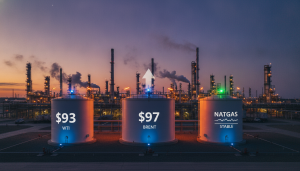
Today’s trading session has seen a robust recovery in crude benchmarks, signaling a shift in market sentiment driven by renewed concerns over global supply stability. As of today, Brent Crude is trading at $94.74 per barrel, marking a substantial increase of +4.77% within the day’s range of $89.11 to $95.18. Similarly, WTI Crude has surged to $91.54 per barrel, up +4.71%, navigating a daily span from $85.5 to $91.97. This strong upward movement contrasts sharply with the recent past; our proprietary data indicates Brent had dropped from $118.35 on March 31st to $94.86 just yesterday, representing a significant decline of nearly 20% in just over two weeks. The sudden reversal underscores the market’s sensitivity to headline risks, particularly those originating from geopolitically sensitive regions. This immediate surge also translates to downstream products, with Gasoline prices climbing to $3.15, an increase of +3.95% today, reflecting the broader inflationary pressures stemming from crude.
Navigating Key Catalysts: OPEC+ and Critical Inventory Data
The coming days and weeks are packed with events that will undoubtedly shape crude oil’s trajectory, demanding close attention from discerning investors. A pivotal moment arrives tomorrow, April 21st, with the OPEC+ JMMC Meeting. This gathering is crucial for assessing the alliance’s commitment to current production quotas and its appetite for market intervention, especially in light of recent price volatility and geopolitical developments. Any indication of further supply tightening or even a sustained hold on current policies could provide a floor for prices, particularly given the present geopolitical premium.
Beyond OPEC+, market participants will keenly await a series of crucial inventory reports. The EIA Weekly Petroleum Status Report on April 22nd and again on April 29th will offer vital insights into U.S. crude stockpiles, refinery activity, and demand indicators. These reports often serve as short-term price movers, with unexpected builds or draws capable of swinging market sentiment. Complementing these are the API Weekly Crude Inventory reports on April 28th and May 5th, which provide an early look at U.S. inventory trends. Furthermore, the Baker Hughes Rig Count on April 24th and May 1st will shed light on North American production intentions, a key factor in the global supply picture. Looking slightly further out, the EIA Short-Term Energy Outlook on May 2nd will offer broader forecasts, providing a macro lens for investors attempting to position for the medium term. Collectively, these events form a critical data mosaic for making informed investment decisions.
Investor Sentiment: Seeking Clarity Amidst Uncertainty
Our proprietary reader intent data from the past week reveals a clear underlying anxiety among investors: a fundamental question of direction. Queries like “is wti going up or down” underscore the prevailing uncertainty and the urgent need for clarity on market trends. Many are also looking beyond the immediate horizon, asking “what do you predict the price of oil per barrel will be by end of 2026?” While precise predictions are inherently challenging, our analysis suggests that the interplay of global economic growth, OPEC+ policy, U.S. shale responsiveness, and persistent geopolitical flashpoints will dictate the long-term trajectory. Factors like potential sanctions, regional conflicts, and evolving energy transition policies will exert continuous pressure on price discovery throughout the year.
Furthermore, investors are keenly interested in the analytical tools and data that inform market outlooks, as evidenced by questions such as “What data sources does EnerGPT use? What APIs or feeds power your market data?” This highlights a sophisticated investor base that values transparency and the robustness of the underlying information. At OilMarketCap, our reliance on real-time, first-party data pipelines allows us to provide timely, granular analysis that addresses these complex questions, offering a distinct edge in understanding the nuanced drivers behind current and future market movements.
Geopolitical Premium: The Enduring Driver of Volatility
The current price rebound is a stark reminder that geopolitical risk remains an indispensable component of crude oil valuations. Beyond the fundamental supply-demand balance, a “geopolitical premium” is now clearly being priced into every barrel. Ongoing tensions in critical oil-producing and transit regions, even without direct supply interruptions, foster an environment of uncertainty that prompts traders to demand higher prices for future supply. This premium is not static; it ebbs and flows with the intensity of global events, creating rapid price swings as demonstrated by Brent’s nearly 5% jump today. Investors must account for this persistent factor, understanding that even robust inventory levels or stable demand forecasts can be quickly overshadowed by external geopolitical shocks. The implication for portfolio managers is clear: hedging strategies and dynamic allocation are paramount in an environment where non-economic factors can dictate market direction.