Sable Offshore Corp.’s ambitious plan to unlock hundreds of millions of barrels of crude off the Santa Barbara coast presents a compelling, albeit high-risk, case study for energy investors. Stymied by California state regulatory opposition to reopening critical pipeline infrastructure, the Houston-based company is now actively seeking intervention from the Trump administration, while simultaneously preparing a contingency plan to bypass state oversight via tanker shipments. This saga highlights the complex interplay of energy security, environmental policy, and political will, set against a backdrop of fluctuating global crude prices and an increasingly scrutinized domestic supply landscape. For investors, Sable’s journey underscores the significant regulatory and political risks inherent in certain U.S. onshore and offshore projects, even as the federal government signals a push for energy dominance.
Regulatory Roadblocks and the Drive for Domestic Supply
Sable Offshore’s acquisition of the Santa Ynez Unit from ExxonMobil last year marked a strategic move to revive production from a cluster of offshore oil fields that had been in suspended animation since a Plains All American pipeline rupture in 2015. Despite restarting oil production in May, Sable faces an ongoing deadlock with California state regulators, who have thus far prevented the reopening of the onshore pipeline network essential for transporting crude to local refineries. This impasse forces Sable’s hand, prompting CEO Jim Flores to seek federal assistance, noting the project is “absolutely on Trump’s agenda.” The National Energy Dominance Council, led by Interior Secretary Doug Burgum and Energy Secretary Chris Wright, is reportedly engaged in discussions with the company, signaling a potential federal push to circumvent state-level resistance.
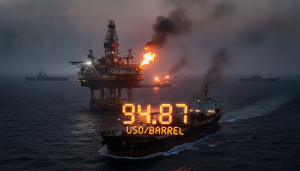
This regulatory entanglement plays out in a volatile global market. As of today, Brent crude trades at $90.38 per barrel, marking a significant 9.07% decline for the day, with its range fluctuating between $86.08 and $98.97. Similarly, WTI crude stands at $82.59, down 9.41%, having traded between $78.97 and $90.34. This sharp daily drop extends a broader trend, with Brent prices having fallen by nearly 20% over the last 14 days, from $112.78 to current levels. Gasoline prices have also adjusted, now at $2.93, down 5.18% for the day. Such market volatility amplifies the strategic importance of domestic supply stability. While California regulators prioritize environmental concerns, the federal perspective, particularly under an administration focused on energy dominance, often emphasizes supply security and consumer price impact, making Sable’s project a key focal point in the ongoing debate over U.S. energy policy.
The Tanker Alternative: Economic Trade-offs and Strategic Maneuvers
Facing unyielding state opposition, Sable Offshore is prepared to fully commit to a plan to transport crude via tanker ships to other markets. This alternative, while potentially unlocking production, carries significant implications. Environmental groups, such as the Center for Biological Diversity, view the tanker proposal as a “deliberate attempt to evade state oversight,” raising concerns about increased shipping traffic and associated risks. From an economic standpoint, shipping crude overseas would mean California loses out on potential jobs and tax revenue that would otherwise be generated if the oil were processed locally. Porter Collins, co-founder of Seawolf Capital and a long-position holder in Sable, highlights this dichotomy, asserting that “the oil is coming out of the ground one way or another,” implying the economic benefits could be captured elsewhere if California remains resistant.
For investors, the tanker option introduces new layers of operational complexity and cost. While it offers a pathway to monetize the assets, the economics of marine transport, especially for hundreds of millions of barrels, will undoubtedly impact profit margins compared to efficient pipeline distribution. The strategic decision to pivot to tankers is a direct response to regulatory gridlock, showcasing management’s determination to realize value from the acquired assets. However, it also underscores the deep-seated conflict between California’s environmental priorities and the federal government’s stated goal of energy independence and lower consumer prices.
Investor Sentiment and the Price of Uncertainty
The highly publicized challenges facing Sable Offshore have not gone unnoticed by the investment community. Proprietary data on investor intent reveals a strong focus on the broader market outlook, with many of our readers asking “what do you predict the price of oil per barrel will be by end of 2026?” and “What are OPEC+ current production quotas?” This illustrates a market grappling with global supply-demand dynamics, which in turn influences the perceived value and risk of individual projects like Sable’s. The uncertainty surrounding Sable’s project is reflected in its share performance; short interest as a share of free-floating shares peaked at 21% in early May, indicating significant skepticism, before dropping to approximately 4% in June. However, as of recent data, that figure has climbed back to almost 15%, suggesting renewed investor apprehension regarding the project’s ability to navigate regulatory hurdles effectively and efficiently.
This volatility in short interest signals a deeply divided market view on Sable’s prospects. Investors are weighing the potential for substantial resource recovery against the very real risks of prolonged legal battles, increased operational costs from alternative transport methods, and the unpredictable nature of political intervention. The climb in short interest suggests that despite the federal government’s interest, a significant portion of the market remains unconvinced that Sable can overcome state-level opposition without incurring substantial delays or compromises that erode shareholder value. The outcome of Sable’s efforts will be a bellwether for how similar projects, balancing energy needs with environmental mandates, are viewed by the broader investment community.
Navigating Future Headwinds and Tailwinds for Energy Investment
Looking ahead, the investment landscape for companies like Sable Offshore will be shaped by a confluence of global and domestic factors. Upcoming energy events, closely watched by our readers, will provide critical context. The OPEC+ Joint Ministerial Monitoring Committee (JMMC) meeting on April 19th, followed by the full OPEC+ Ministerial Meeting on April 20th, are pivotal. Any decisions regarding production quotas will directly impact global crude supply and, consequently, price stability, influencing the economic viability of new and restarted projects. Additionally, the API Weekly Crude Inventory reports on April 21st and April 28th, along with the EIA Weekly Petroleum Status Reports on April 22nd and April 29th, will offer near-term insights into U.S. supply-demand balances and inventory levels, which could either bolster or diminish the argument for increased domestic production.
For Sable, the forward path remains fraught with both opportunity and considerable risk. The company’s reliance on specific political administrations for support introduces an additional layer of election-cycle risk. While the current federal administration may champion “energy dominance,” a change in leadership could shift policy priorities and reduce the impetus for federal intervention in state-level disputes. Investors should closely monitor not only the progress of Sable’s regulatory efforts and its implementation of the tanker strategy but also the broader political climate and global energy market trends. The interplay of these forces will ultimately determine whether Sable Offshore can successfully unlock its Californian crude reserves and deliver sustained value to its shareholders.