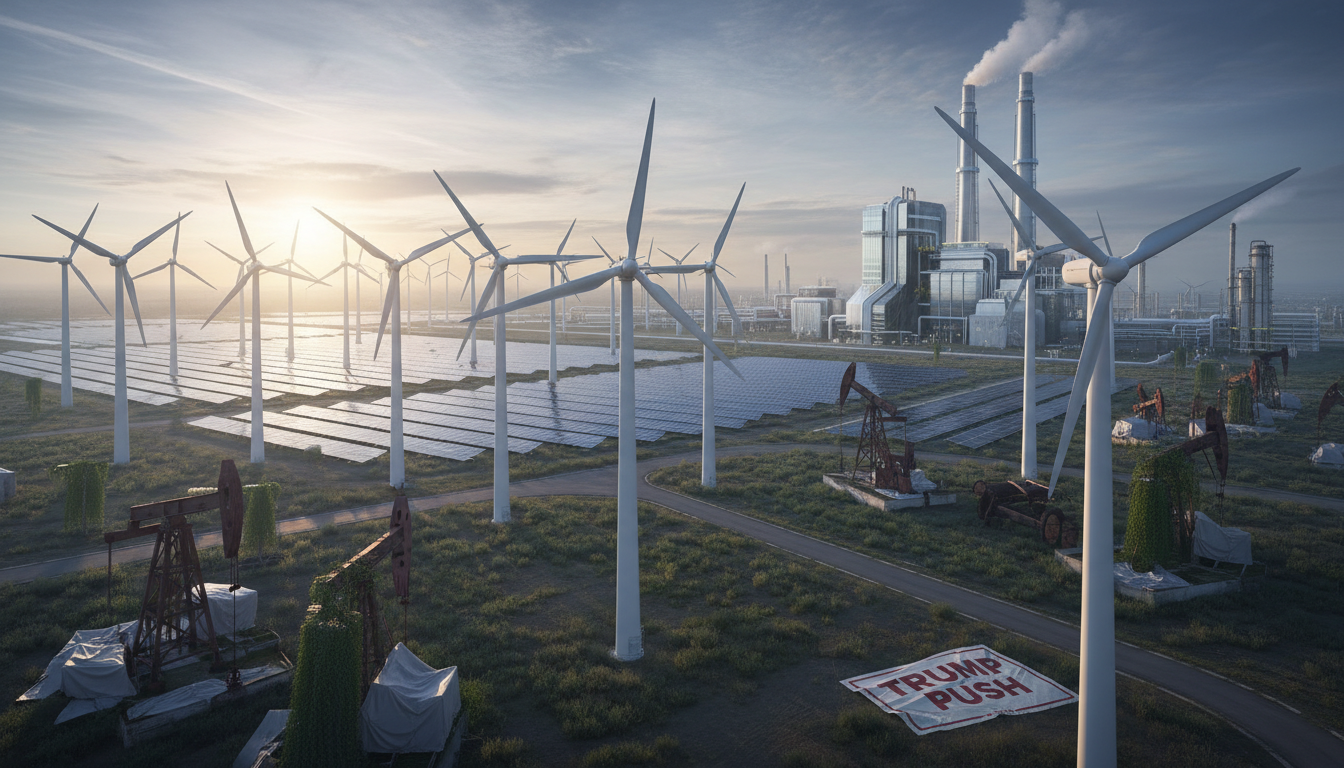
The current U.S. administration has consistently championed the fossil fuel industry, often characterizing clean energy initiatives as economically unsound or impractical. Yet, a nuanced analysis of recent market data and legal developments reveals that the momentum behind renewable energy sources in the United States continues unabated, presenting an evolving landscape for oil and gas investors to navigate.
Far from being stifled, the clean energy sector achieved a significant milestone in March, when U.S. electricity generation from renewable sources, including solar and wind, surpassed that from natural gas for the first time in a full calendar month. This singular event follows a record-breaking year for renewables in 2024, signaling a accelerating trajectory. Looking ahead, an overwhelming 93% of all new electricity generating capacity slated to come online in the U.S. in 2026 is projected to derive from solar, wind, and battery storage technologies. Traditional fossil fuels are expected to contribute a mere 7% to this new capacity pipeline, a stark indicator of shifting investment priorities and market dynamics.
Judicial Rulings Bolster Renewables Against Policy Headwinds
The resilience of the renewable energy sector is not merely a function of market forces; it has also been reinforced by recent legal challenges. The administration’s efforts to impede clean energy projects have frequently encountered resistance in the courts. Last week, a federal court in Massachusetts intervened to block several anti-renewable energy directives issued by the current White House, including prohibitions on solar and wind developments on federal lands. This judicial action closely followed the reversal of previous administrative orders that had halted five major offshore wind farm projects, a technology the president has publicly derided as aesthetically unpleasing.
These legal victories have injected renewed confidence into the clean energy investment community, which has felt under considerable pressure during the current presidential term. Peter Davidson, CEO of Aligned Climate Capital, an active clean energy investor, unequivocally states, “There is no truth to the death of the clean energy industry in the United States – in fact, just the opposite.” He points to a range of metrics, from escalating electric vehicle sales to the rapid deployment of renewable generation, as evidence of this robust growth.
The Irreversible Economic Tipping Point
According to Davidson, the fundamental economics of energy generation have reached a “tipping point” that current political machinations cannot reverse. He asserts that wind, solar, and battery storage solutions are now demonstrably cheaper and faster to construct and bring online compared to new natural gas or coal-fired power plants. “They cannot change the trajectory,” Davidson emphasizes. “They can try and delay it. But the battle for the generation of electricity is over and renewables and storage have won.” This perspective highlights a critical factor for oil and gas investors: the economic competitiveness of renewables is becoming increasingly formidable, irrespective of policy preferences.
Despite this optimistic outlook, the clean energy industry still contends with an inherently volatile political climate and persistent logistical hurdles, such as grid interconnection delays that hinder the efficient distribution of clean power across the nation. However, initial anxieties regarding the administration’s impact appear to be moderating. Jon Power, co-founder of CleanCapital, a solar and battery storage firm, noted a significant reduction in pessimism compared to the previous summer. Power believes the administration “overplayed their hand on this,” suggesting a misalignment with public sentiment.
Shifting Public Opinion and Political Cracks
Indeed, internal Republican polling data suggests a potential divergence between the administration’s anti-renewables stance and its voter base. In February, the president’s chief pollster found that over two-thirds of Republican voters expressed support for solar power. Furthermore, Leah Qusba, CEO of GoodPower, a clean energy advocacy organization, reported that her group’s polling indicated only 40% of Republican voters approved of the president’s handling of rising energy costs. Qusba views this as a “huge red flag” for the administration, underscoring the undeniable momentum of the energy transition and the rallying effect it has had on its proponents.
Historically, the budding U.S. clean energy sector was taken aback by the administration’s aggressive posture upon its return to office. Sweeping environmental regulations were rolled back in a clear effort to favor fossil fuel interests, which have been significant financial contributors to political campaigns. The president has publicly dismissed clean energy technologies, labeling them “garbage” and asserting, “Fossil fuel is the thing that works,” while often questioning established climate science. Congressional allies have supported this agenda by dismantling tax incentives that were instrumental in catalyzing new clean energy investments, particularly in rural, often conservative, areas. This has resulted in the pausing or outright cancellation of hundreds of projects, even as U.S. electricity demand continues to climb, partly driven by the administration-backed artificial intelligence sector.
Policy Divergence vs. Global Market Realities
The administration’s efforts have extended to financially incentivizing energy companies to abandon pre-approved wind projects, asserting the unreliability of renewables in contrast to the perceived indispensability of fossil fuels. Energy Secretary Chris Wright articulated this perspective to Congress last week, stating, “I’m pretty confident coal will lead the world in global electricity production when I die. Coal is critically important to the world.”
However, global data presents a contrasting picture. On the very day Secretary Wright made his pronouncements, Ember released a report confirming that renewable energy officially overtook coal as the world’s largest source of electricity last year. Concurrently, solar panel exports from China have reached unprecedented levels, and global sales of electric vehicles are experiencing a sustained boom. These global trends illustrate a significant divergence between policy rhetoric in Washington and the accelerating realities of the international energy market.
Geopolitics and the Electrification Drive
Ironically, geopolitical conflicts, specifically the administration’s involvement in the recent conflict with Iran, appear to be inadvertently accelerating the global transition away from the inherent price volatility of oil and gas. Fatih Birol, head of the International Energy Agency, noted that these events will “significantly boost renewables and nuclear power and a further shift towards a more electrified future,” a development he predicts will “cut into the main markets for oil.”
Domestically, the rising cost of gasoline, fueled by global instability, has directly contributed to a pronounced surge in interest for electric vehicles across the U.S. Qusba believes American consumers are increasingly weary of importing such volatility into their daily lives and will see the pro-fossil fuel rhetoric for its “shortsighted foolishness.” Power characterizes Secretary Wright’s views as “truly extremist,” arguing that such a perspective fails to grasp the direction of the global economy and could ultimately harm U.S. competitiveness.
Despite the strong economic case for clean energy, Power, a former White House chief sustainability officer under President Barack Obama, acknowledges the outsized political influence wielded by the fossil fuel industry in Washington. He metaphorically suggests the fossil industry operates in the “Super Bowl” of political engagement, while clean energy is still playing “middle league football.” This highlights a strategic challenge for the renewable sector: to translate its robust business case into equivalent political clout. “We over-relied on being the right thing for too long versus making the business case,” Power stated. “The good news is, though, that business case at this point is super strong. We just need to start making it.”
For discerning oil and gas investors, these developments underscore a critical juncture. While traditional energy assets maintain significant political backing and infrastructure, the economic fundamentals, technological advancements, and evolving public sentiment are undeniably propelling the growth of renewables, demanding a strategic re-evaluation of long-term portfolio considerations.


