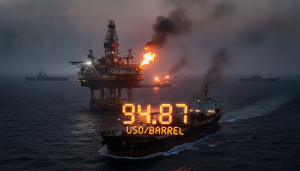
The global energy investment landscape is currently dominated by the precarious situation surrounding the Strait of Hormuz. This critical maritime conduit, responsible for funneling an astonishing one-fifth of the world’s crude oil and liquefied natural gas (LNG) exports, has once again become a flashpoint for geopolitical tensions. The steadfast position of the United States, articulated by Secretary of State Marco Rubio, in directly rejecting any Iranian aspirations to control this vital waterway or impose levies, casts a significant shadow over international shipping routes and the stability of global energy markets. For investors, this creates a complex environment demanding acute attention to both immediate market movements and forward-looking strategic considerations.
US Rejects Iranian Control Over Crucial Chokepoint
The principle of free and unobstructed passage through international waters remains a core tenet of US foreign policy, and nowhere is this more critical than in the Strait of Hormuz. Following the recent cancellation of US-Iran negotiations, tensions have visibly escalated. Secretary Rubio emphatically dismissed any Iranian proposal that would grant Tehran undue authority over the Strait, explicitly stating that any notion of Iran dictating vessel transit, requiring explicit permission, or imposing fees is utterly unacceptable. This firm stance underscores Washington’s view that such a scenario equates to an illegitimate claim over a global trade artery, directly challenging the fundamental structure of energy supply chains.
This firm US position takes place amidst broader regional dynamics. While the proprietary data indicates a fragile three-week ceasefire extension between Israel and Lebanon, even sporadic exchanges of fire highlight the ongoing volatility. Investors are keenly watching the broader US-Iran negotiations, which our reader intent data shows are currently stalled. President Trump has ruled out certain military options and indicated a measured pace for a deal, while Iran insists on the lifting of the US blockade of its ports. The Strait of Hormuz, therefore, remains a direct reflection of this broader, complex, and high-stakes diplomatic standoff, amplifying risk premiums across the energy sector.
Market Reaction: A Volatile Price Environment
The strategic importance of the Strait of Hormuz directly translates into market sensitivity. Since military actions began in late February and the subsequent enforcement of naval blockades, market volatility has surged. As of today, Brent Crude trades at $110.72, showing a modest daily increase of 0.29%, within a day range of $110.49-$112.43. WTI Crude, however, is down 0.46% at $104.59, trading between $104.38 and $106.65. This divergence, though slight today, highlights the regional and fundamental nuances impacting crude benchmarks.
More significantly, the 14-day trend for Brent Crude demonstrates the acute impact of these geopolitical risks. From $99.36 on April 13th, Brent has climbed to $111.7 on April 30th, marking a substantial increase of $12.34, or 12.4%, in just two weeks. This sustained upward momentum underscores the market’s pricing in of significant supply risk due to the prolonged closure and ongoing uncertainty in the Strait. Our reader intent data confirms investors are actively tracking the “2026 weekly trend for crude oil” and seeking a “base-case Brent price forecast for next quarter,” demonstrating the immediate need for clarity in a market driven by supply concerns and geopolitical headlines. The current environment makes any forecast highly contingent on developments in the Strait, pushing investors to closely monitor every shift in the US-Iran dynamic.
Navigating Forward: Upcoming Catalysts and Investor Focus
Against this backdrop of heightened geopolitical tension, the coming weeks present a series of crucial data releases that will offer further guidance and potential catalysts for energy markets. The Baker Hughes Rig Count, scheduled for May 1st and May 8th, will provide immediate insights into North American drilling activity, hinting at potential supply responses to current high prices. Investors will be evaluating whether domestic producers are accelerating output to offset global supply risks.
A pivotal release will be the EIA Short-Term Energy Outlook on May 2nd. This report will be scrutinized for its updated supply/demand balances and price projections, particularly how it incorporates the sustained geopolitical risk premium stemming from the Hormuz situation. Furthermore, weekly inventory reports from the API (May 5th, May 12th) and EIA (May 6th, May 13th) will indicate the immediate impact on crude and product stockpiles, offering real-time indicators of market tightness. Finally, the IEA Oil Market Report on May 12th will provide a comprehensive global perspective, likely addressing the impact of chokepoint disruptions on global inventories and demand. This will be critical for investors concerned about broader supply dynamics and questions such as “Which OPEC+ members are over-producing this month?” as global supply management becomes even more vital in mitigating regional risks.
Investment Implications and Risk Management
For investors, the ongoing standoff at the Strait of Hormuz necessitates a robust risk management strategy. The potential for further escalation, or conversely, a de-escalation, remains fluid and highly unpredictable. While a general ceasefire has held since early April in the broader region, the core issue of Hormuz access remains unresolved. A sustained closure or further imposition of restrictions would inevitably send crude oil benchmarks and LNG spot prices soaring, reflecting an acute supply deficit. Conversely, any credible movement towards reopening the Strait without Iranian control could see a swift, albeit temporary, re-pricing downwards as risk premiums unwind.
Our proprietary data indicates investors are also asking “what about WTI crude in XM trade,” highlighting the need to consider WTI’s relationship to Brent. While both benchmarks are influenced by global supply, WTI’s pricing often reflects North American supply-demand dynamics more directly. However, in a scenario of significant global supply disruption via Hormuz, the Brent-WTI spread would likely widen, with Brent experiencing a greater surge due to its direct exposure to Middle Eastern crude flows. Portfolio diversification, hedging strategies using futures and options, and a keen eye on shipping costs and insurance premiums for Middle East-origin cargoes are paramount. Investors should prepare for continued volatility and prioritize agility in their positions as events unfold in this critical geopolitical chokepoint.