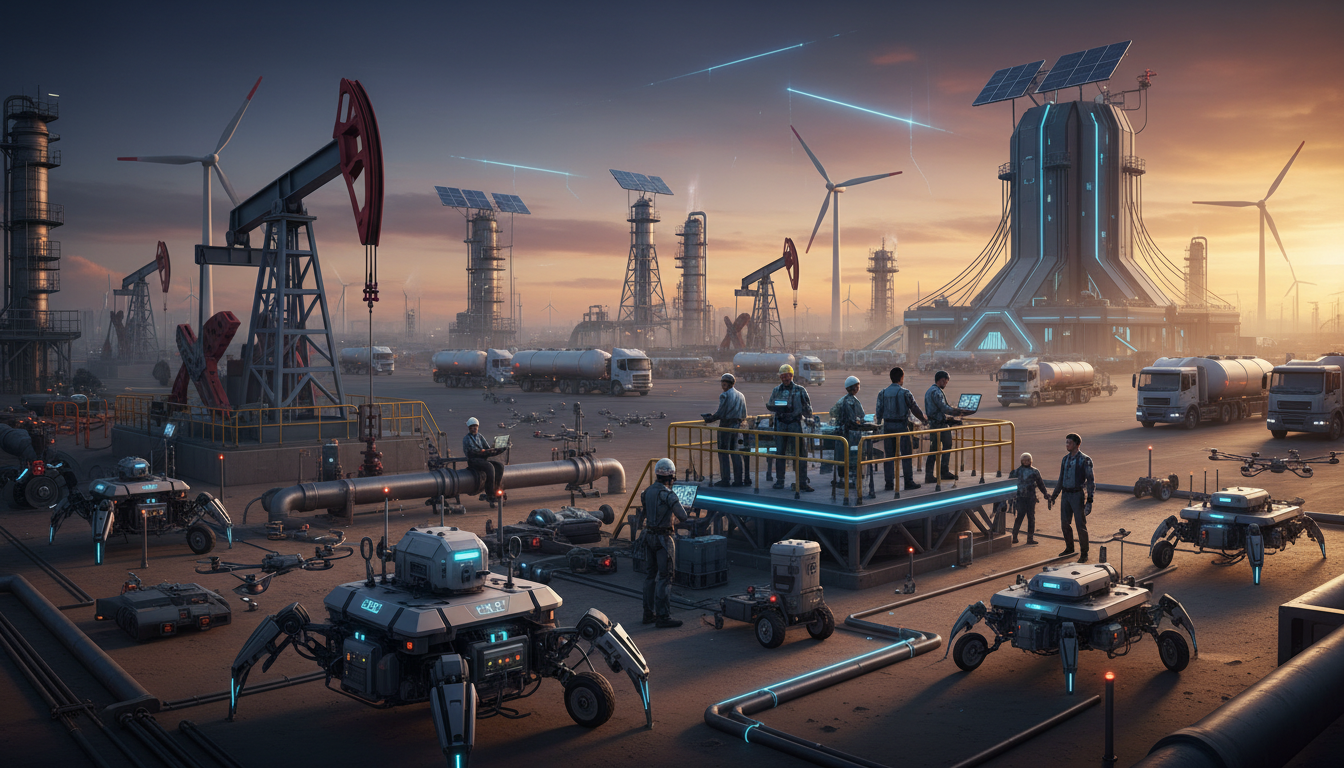
The global energy landscape, particularly within the oil and gas sector, is undergoing a profound transformation driven by technological innovation. While much attention rightly focuses on advancements in extraction, processing, and renewable integration, a silent revolution in artificial intelligence and robotics is reshaping the fundamental economics of labor and data collection across all heavy industries. Savvy investors on OilMarketCap.com must pay close heed to these underlying shifts, often signaled by leading venture capitalists.
One such bellwether is Nabeel Hyatt, a General Partner at Spark Capital, whose career is defined by backing companies that fundamentally alter human interaction with technology. As an early investor in giants like Discord, which redefined online communities, and Cruise, a pioneer in autonomous driving, Hyatt possesses a unique vantage point on disruptive trends. His experience extends to founding and leading tech ventures, including Conduit Labs, acquired by Zynga in 2010.
Today, Hyatt’s insights are particularly relevant as he sits on the board of Instawork, a prominent gig-work platform. Instawork, under the leadership of CEO Sumir Meghani, is making a pivotal move into robotics, launching a new division and developing a data-collection device known as Instacore. This initiative is an ambitious attempt to tackle what some researchers term the “100,000-year problem”—the immense challenge of acquiring sufficient, diverse training data for advanced robotic systems.
Hyatt’s perspective offers a front-row seat to one of AI’s most critical transitions: the evolution from software-centric models, largely trained on internet data, to sophisticated physical AI systems that must learn directly from the complexities of the real world. For the oil and gas industry, where physical operations dominate and data collection is paramount, understanding this shift is not merely academic; it’s essential for strategic investment decisions.
The Imperative for Real-World Robotics Data in Energy and Beyond
The necessity for vast quantities of diverse and detailed data in robotics is becoming increasingly apparent. Robotic companies are not just seeking lab-perfect scenarios; they need models that function reliably in the unpredictable, often harsh conditions of real-world environments. Consider the oil patch or a complex refinery: no two facilities are identical. The operational nuances of an offshore platform in the North Sea differ dramatically from a shale drilling site in the Permian Basin, or a pipeline inspection in the Gulf Coast.
In this nascent field, standardization of “good” video or sensor data for robots remains elusive. Major AI developers have distinct requirements: OpenAI might prioritize certain visual cues, Figure could focus on specific manipulation data, while Boston Dynamics might be concerned with navigation in light industrial settings. Some demand egocentric video from human perspectives, others need teleoperation data for remote control, and still others require precise 3D mapping of physical spaces. The sheer variety—different environments, tasks, angles, and hardware—means that comprehensive, varied data is critical for robust AI development. For the energy sector, this translates into a demand for highly contextualized data that accounts for everything from extreme temperatures and corrosive environments to the complex interplay of human workers and heavy machinery.
This is where Instawork, with its deep understanding of human labor and operational deployment, identifies a unique strategic advantage. The company is positioned to bridge the gap between human on-the-ground intelligence and the technical demands of robotics data acquisition, much like a specialized energy services provider leverages its field expertise for complex operations.
Robots and the Evolving Energy Workforce: A Synergistic Future
A persistent concern across capital-intensive industries like oil and gas is the potential impact of automation on human employment. Will robots replace human labor, or will new opportunities emerge? Hyatt posits a nuanced reality: both will occur, but not in the simplistic “jobs lost” narrative often presented.
In the near term, robots actively create new human jobs. Consider the deployment of inspection drones on pipelines or autonomous vehicles on drilling sites. Humans are needed to map these environments, to train personnel on how to operate alongside these machines, and to perform critical maintenance and repairs when issues arise. This mirrors the historical shift from horse-drawn carriages to automobiles; while stable hands were replaced, an entire new industry of mechanics, engineers, and transportation logistics professionals emerged, ultimately expanding the overall job market. Similarly, the energy sector will see a shift in demand towards roles focused on robot deployment, maintenance, data analysis, and human-robot collaboration.
Instawork’s foray into robotics, first discussed by CEO Sumir Meghani in 2025 and solidifying by Fall 2025, reflects this emerging demand. By the November 2025 board meeting, tangible progress was evident, with engineers deploying cameras and uploading terabytes of data. The arrival of Aaron Bromberg, Instawork’s head of robotics and applied AI, signaled a clear strategic direction, driven by genuine market need.
Operationalizing Robotics: Instawork’s Blueprint for Blended Workforces
The move by Instawork, a labor marketplace, into hardware development might initially appear counterintuitive. However, Hyatt clarifies that this isn’t a pivot to becoming a hardware company for its own sake. Rather, the development of data capture devices like Instacore is a strategic necessity, born from Instawork’s core strength: a vast network of millions of workers. The robotics industry desperately needs humans to collect data in diverse, real-world settings, and Instawork possesses the unparalleled labor infrastructure to quickly deploy these capabilities.
For energy investors, this operational model presents a compelling vision for future workforce management. Imagine a scenario in an oilfield or refinery where a blend of 20 human professionals work alongside five specialized robots. Instawork’s ultimate goal is precisely this synergistic integration. Currently, approximately 80% of their robotics focus is on data collection, with 20% dedicated to field operations like robot wrangling, servicing, and deployment. Over time, these two business lines are expected to converge.
The vision is clear: Instawork aims to be the go-to platform for companies requiring human expertise to complement robotic systems. A restaurant chain deploying service robots could tap Instawork for certified personnel skilled in operating those specific units. In an energy context, this could translate to Instawork providing technicians certified in operating specific inspection drones, autonomous drilling assistants, or remote monitoring systems, drawing on a pool of professionals already experienced in collecting data within light industrial or hazardous environments.
Instawork’s enduring advantage is not merely its technology but its profound relationship with a massive, adaptable workforce and the operational capacity to deploy these individuals into rapidly evolving categories of work, including those that barely existed a few years prior. As the oil and gas industry continues its drive towards greater automation, efficiency, and safety, the model of platforms managing a blended human-robot workforce, capable of collecting vital data and executing complex tasks, represents a significant evolution in operational strategy and a powerful indicator for future investment trends.


