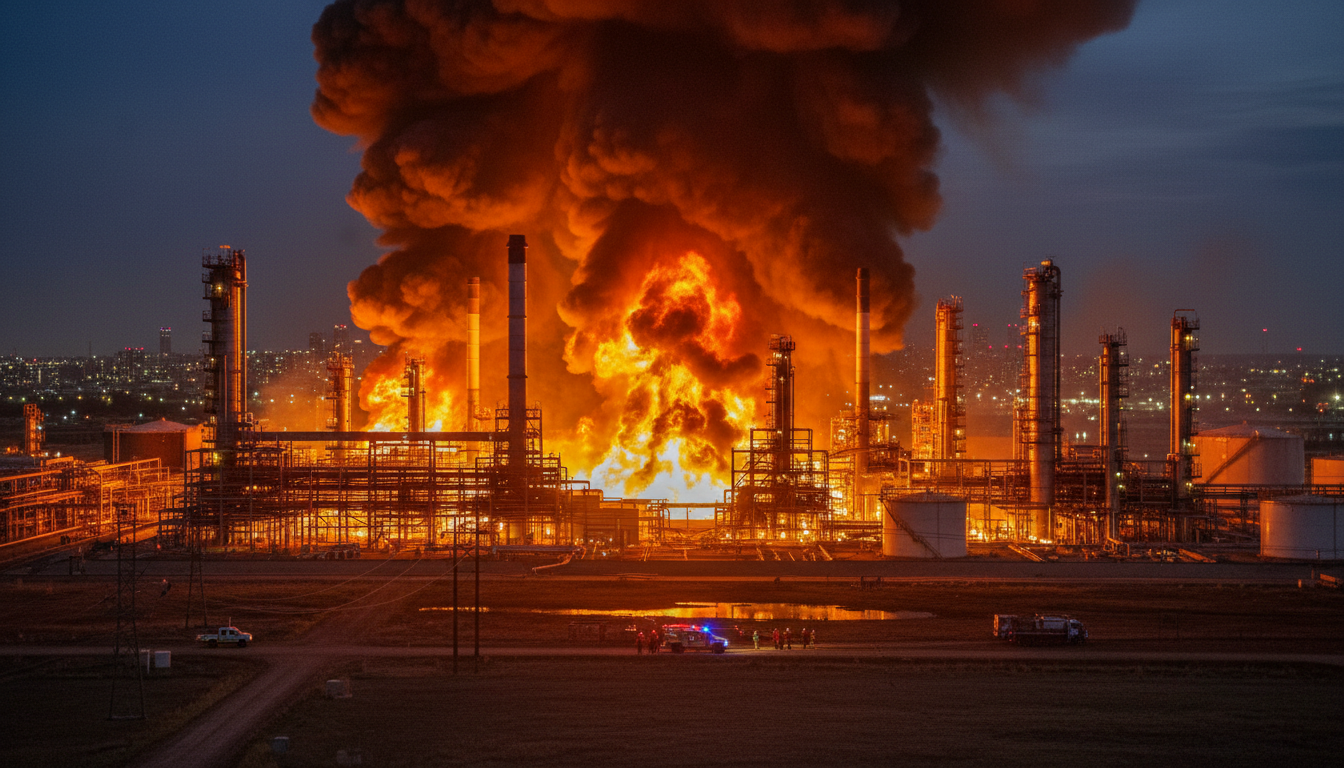
Australian Refinery Fire Ignites Energy Security Fears, Echoing Global Volatility
The Australian energy landscape faces intensified scrutiny following a significant fire at one of the nation’s critical fuel processing facilities. The incident at Viva Energy’s Corio oil refinery in Geelong, situated southwest of Melbourne, has sent ripples through domestic fuel supply chains already contending with broader geopolitical pressures, particularly the fallout from escalating tensions in the Middle East. For investors tracking global energy markets, this event underscores the acute vulnerabilities inherent in concentrated refining capacity and the complex interplay of operational risks with international dynamics.
Operational Setback at a Crucial Processing Hub
Late Wednesday, reports of explosions preceded a major blaze that engulfed a section of the Corio refinery. Emergency services, including 50 firefighters from Fire Rescue Victoria (FRV), battled the “large and intense” fire for approximately 13 hours before bringing it under control on Thursday morning local time. The initial assessment by FRV pointed to an “equipment failure” as the root cause, with the fire being fueled by a “significant leak of liquid hydrocarbons and gases.” While investigations into the exact sequence of events remain ongoing, mechanical failure has been identified as the precursor to the substantial leak that ignited the inferno.
This incident at the Corio facility carries disproportionate weight due to its pivotal role within Australia’s limited refining infrastructure. As one of only two remaining operational processing plants in the country, its output is indispensable. The refinery boasts a substantial processing capacity of up to 120,000 barrels of crude oil per day, producing a diverse array of essential petroleum products including gasoline, diesel, liquefied petroleum gas (LPG), jet fuel, avgas, and Low Aromatic Fuel. Its strategic importance is further magnified by its contribution to Victoria, supplying over 50% of the state’s fuel requirements, and a significant 10% of Australia’s total fuel demand.
Immediate Production Impact and Market Repercussions
The direct consequence of the fire has been an immediate disruption to production. Australian Energy Minister Chris Bowen confirmed on Thursday afternoon that gasoline production has been directly impacted. While jet fuel and diesel output continues, it is operating at reduced levels as a precautionary measure. This curtailed output from such a vital facility inevitably tightens domestic supply, a situation exacerbated by a pre-existing “fuel crisis” context often attributed to the volatile global crude market influenced by the Iran conflict.
For energy investors, the incident highlights the precarious balance of supply and demand in a market with thin domestic margins and high reliance on global imports. Any reduction in local refining capacity necessitates an increase in refined product imports, potentially at higher prices and with extended lead times. The Minister’s caution against panic-buying underscores official concern about potential consumer reactions amplifying market pressures, a common pattern observed during supply shocks.
Government’s Strategic Response to Bolster Fuel Security
In anticipation of and response to heightened fuel security concerns, the Australian government has already implemented several measures to shield consumers and industries from soaring prices. Last month, Canberra took the significant step of halving the fuel excise on both gasoline and diesel for a three-month period. This fiscal intervention aimed to alleviate the financial burden on motorists and businesses grappling with elevated fuel costs, a direct reflection of spiking global oil benchmarks and geopolitical uncertainties.
Furthermore, in a proactive move to buttress national reserves, the Federal Government announced on Thursday that it had successfully secured approximately 100 million liters of additional diesel. These critical shipments, originating from Brunei and South Korea, represent the inaugural deliveries under the government’s newly endowed Strategic Reserve powers. Minister Bowen emphasized that these cargoes are incremental to existing contracted supplies and are mandated to remain within Australia, specifically directed towards industries and regions facing the most acute needs. This strategic acquisition aims to mitigate immediate shortfalls and provide a buffer against further market volatility resulting from the Corio disruption or other unforeseen global events.
Investing in a Volatile Energy Future: The Australian Context
The Corio refinery fire serves as a stark reminder for investors of the operational risks inherent in the energy sector, particularly within refining. It underscores the fragility of fuel supply chains in nations like Australia, which possess limited domestic processing capabilities. While the incident is localized, its impact resonates broadly across the Australian economy, affecting transport, logistics, agriculture, and various industrial sectors reliant on consistent fuel availability.
From an investment perspective, this event amplifies discussions around the future of Australia’s energy independence and the strategic importance of domestic refining. Investors may consider the implications for companies involved in fuel import and distribution, potential government incentives for refining upgrades or new capacity, and the broader resilience of Australia’s energy infrastructure. The government’s swift action to secure additional reserves and reduce excise duties demonstrates a commitment to market stability, yet the underlying vulnerability of concentrated refining assets remains a key consideration for long-term energy investment strategies. The ongoing geopolitical backdrop, marked by events such as the Iran war, only compounds the need for robust, diversified, and resilient energy supply chains, making the Australian situation a microcosm of global energy security challenges.


