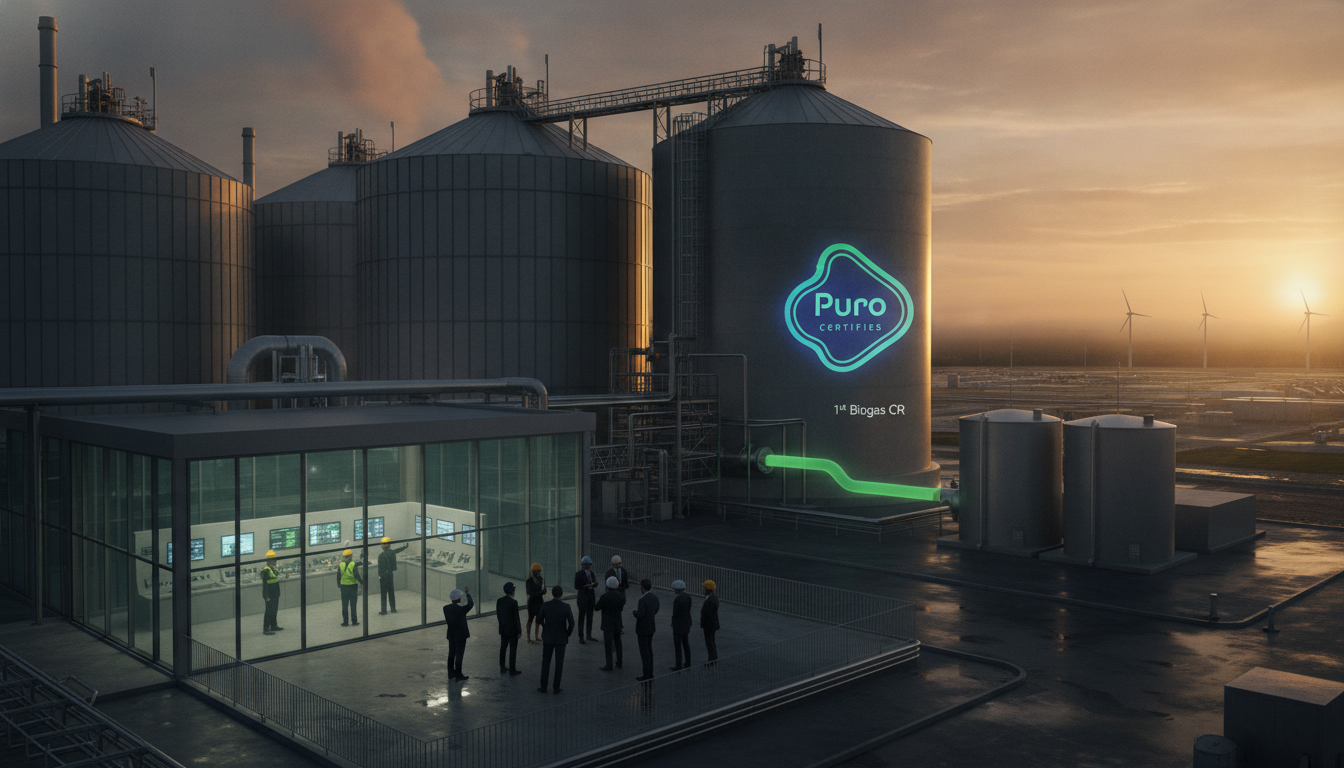
Norway’s VEAS Project Unlocks New Investment Avenues in Biogenic Carbon Capture and Storage
A groundbreaking milestone in carbon removal has recently been achieved in Norway, signaling robust opportunities for investors in the burgeoning carbon capture and storage (CCS) market. The VEAS wastewater treatment plant has successfully initiated the world’s first certified permanent carbon removals stemming from biogenic CO2 captured during biogas production. This innovative project, now officially validated by Puro.earth, demonstrates a scalable model for integrating engineered carbon removal solutions within existing wastewater infrastructure, offering a clear pathway for significant market expansion across Europe.
The pioneering initiative saw Puro.earth issue more than 700 CO2 Removal Certificates (CORCs) for the project’s inaugural four months of operation, covering verified removals conducted between February and May 2026. This certification is not only Puro.earth’s first for a European bioenergy with carbon capture and storage (BECCS) project but also represents the first global instance of validated permanent removals generated from CO2 originating in biogas production. This development directly addresses critical needs for verifiable carbon credits, offering tangible assets to corporate buyers and investors seeking credible decarbonization investments.
Transforming Wastewater Emissions into Valuable Carbon Assets
The VEAS facility, Norway’s largest wastewater treatment plant, serves over 800,000 residents across the municipalities of Oslo, Bærum, and Asker. Traditionally, the organic materials processed at the plant generate biogas, releasing biogenic CO2 into the atmosphere. The new carbon removal system, developed by Inherit Carbon Solutions, fundamentally transforms this waste stream into an economic opportunity.
Central to this process is HoopCO2, which manages the capture and liquefaction of the biogenic CO2. Once liquefied, specialized trucks transport the CO2 to the Northern Lights receiving terminal in Øygarden, west of Bergen. From there, the CO2 moves into temporary onshore storage before being channeled offshore via pipeline. It is then securely injected into geological formations situated approximately 2,600 meters beneath the seabed, where it is projected to remain permanently for millennia.
Northern Lights Joint Venture, a critical enabler in Europe’s carbon transport and storage infrastructure, has been storing fossil-based CO2 offshore since August 2025. The VEAS project marks a pivotal expansion into biogenic CO2 streams, showcasing the versatility and growing demand for its commercial storage services. While the initial agreement with Inherit sees Northern Lights potentially receiving up to 7,000 tonnes of CO2 annually from VEAS, this volume, though modest compared to large industrial capture projects, establishes a precedent for faster, more distributed deployment of carbon removal technologies leveraging existing municipal infrastructure.
Certification Establishes a Credible Market Route for Carbon Credits
The project underwent rigorous validation and verification under the 2024 edition of Puro.earth’s Geologically Stored Carbon methodology. An independent validation and verification body meticulously audited the carbon removals before the CORCs were officially issued in the public Puro Registry. This stringent process ensures transparency and builds confidence for investors and corporate buyers in the integrity and permanence of the carbon credits.
Ongoing monitoring, reporting, and verification protocols are in place to support future CORC issuances, providing Inherit Carbon Solutions with a clear and credible pathway to supply certified removals to a growing market of corporate purchasers as operations expand. For sophisticated carbon removal investors, this certification directly resolves a primary market challenge: unequivocally proving that each tonne of CO2 has been captured, securely stored, and independently verified, thereby de-risking investments in this nascent yet rapidly expanding sector.
Jan-Willem Bode, President of Puro.earth, emphasized the synergy created by the project: “Inherit’s issuance brilliantly illustrates the immense potential when established biogas infrastructure and advanced carbon storage capabilities converge through an efficient, integrated process. Biogenic CO2, which would otherwise contribute to atmospheric emissions, is instead captured and permanently sequestered. This exemplifies the precise kind of innovative BECCS approach our Puro Standard and Registry were designed to support. Inherit is a genuine trailblazer in this domain, and we take immense pride in certifying the world’s inaugural project of this nature. Considering the substantial scale of biogas production across Norway, the Nordics, and indeed, throughout Europe, the regional potential for BECCS is truly significant for investors eyeing the energy transition.”
A Replicable Model for European Decarbonization Investment
This pioneering project offers a compelling blueprint for wastewater utilities and biogas operators across Europe seeking to unlock new revenue streams from carbon removal. It allows facilities to capitalize on existing waste streams without the capital-intensive requirement of developing entirely new biomass supply chains. This model could prove particularly attractive to investors looking to diversify portfolios with assets that leverage existing infrastructure for sustainable returns.
Smaller, distributed installations, such as VEAS, can effectively complement larger, more centralized BECCS plants. While large-scale BECCS projects often demand substantial capital, new infrastructure development, and extended development timelines, the VEAS model demonstrates the viability of a more agile, distributed carbon removal market. This offers a different risk profile and faster time-to-market for certain investment strategies.
Kaja Voss, CEO of Inherit Carbon Solutions, highlighted the market-enabling aspect: “Collaborating with Puro.earth on this certification has provided us with a clear and trustworthy route to bring these credits to market. This project vividly demonstrates the vast potential within the broader biogas supply chain for capturing and permanently storing biogenic CO2. The strong collaboration with HoopCO2 and Northern Lights has been instrumental, and we are incredibly enthusiastic about what this pilot signifies for scaling biogenic CO2 removal from biogas facilities more broadly, opening up new investment horizons.”
For policymakers and governments, the VEAS project illustrates a powerful intersection of carbon removal policy with wastewater management, renewable energy production, and shared CO2 storage networks. For astute carbon credit buyers, it introduces a novel category of durable, high-quality credits directly backed by operational, verified infrastructure. The broader impact of this initiative will undoubtedly hinge on factors such as cost efficiencies, access to expanded storage capacity, and the evolving demand for premium, permanent carbon removals.
Nevertheless, the VEAS project stands as a robust, working reference for how Europe’s extensive biogas sector can seamlessly transition into a pivotal component of the permanent carbon removal economy, offering tangible investment prospects for those committed to accelerating the global energy transition and achieving net-zero emissions targets.


