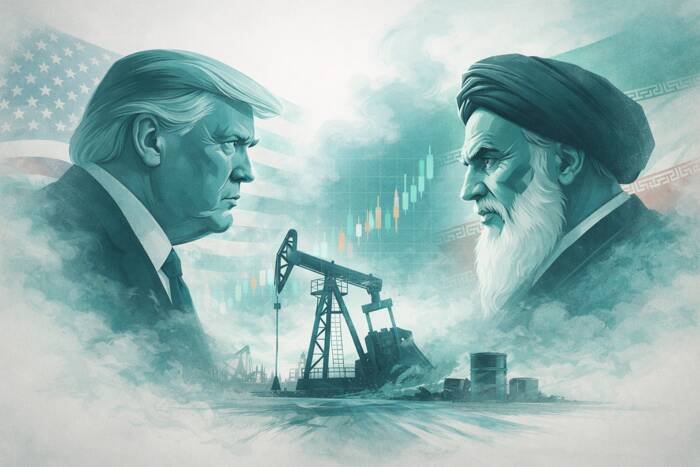
Global financial markets are currently navigating a complex confluence of geopolitical and policy-driven uncertainties, creating a heightened sense of caution among investors. The ongoing tensions in the Middle East, particularly involving the United States and Iran, coupled with renewed ambiguity surrounding U.S. trade policy following a recent Supreme Court ruling, are reshaping asset flows. This dual pressure is fostering a distinct “risk-off” sentiment, driving significant shifts across key asset classes from crude oil and precious metals to global equities. Understanding these interwoven dynamics is crucial for investors seeking to position their portfolios strategically in a volatile environment where headlines can trigger swift market reactions.
Geopolitical Tensions Drive Crude Market Dynamics Amidst Recent Pullback
The specter of conflict in the Middle East, particularly the potential for disruptions in critical shipping lanes like the Strait of Hormuz, remains a primary driver for energy markets. After experiencing a significant correction over the past two weeks, Brent crude had dropped nearly 20% from $118.35 on March 31st to $94.86 by April 20th. However, the latest geopolitical developments are providing fresh upward momentum, challenging this recent bearish trend. As of today, Brent crude trades at $93.92 per barrel, registering a daily gain of 0.73% within a range of $93.52 to $94.21. Similarly, WTI crude is trading at $90.48, up 0.9% for the day, ranging between $89.71 and $90.70. While these daily gains appear modest in isolation, they signify a potential reversal or stabilization point after the steep decline, indicating how quickly markets re-price risk when supply-side concerns escalate. The market’s immediate direction hinges on the de-escalation or intensification of these regional tensions; sustained disruption or military responses would likely see both Brent and WTI push significantly higher.
Trade Policy Uncertainty Bolsters Safe Haven Demand
Beyond the Middle East, a recent Supreme Court ruling against the administration’s global tariffs has introduced a fresh layer of policy uncertainty into the market. This decision not only raises the prospect of substantial tariff refunds but also casts a shadow over the future direction of U.S. trade policy. While new temporary tariffs have been hinted at, suggesting trade tensions may not fully subside, the overall ambiguity fuels volatility in currency and equity markets. This environment naturally strengthens the appeal of safe-haven assets. Gold and silver, for instance, are finding sustained support, benefiting from both geopolitical concerns and the trade policy fog. From an investment perspective, this creates a compelling case for defensive positioning, with sectors like defense stocks also seeing increased interest. Conversely, cyclical sectors such as the airline industry, already sensitive to increased fuel costs, and broader equity indices face renewed pressure as overall risk appetite diminishes across global markets.
Addressing Investor Concerns: Navigating Oil Price Trajectory
Our proprietary reader intent data from this week clearly indicates that investors are grappling with fundamental questions about crude oil’s future. A common query revolves around the immediate direction of prices, often phrased as “is WTI going up or down?” Beyond the short-term, there’s significant interest in longer-term projections, with many asking, “what do you predict the price of oil per barrel will be by end of 2026?” These questions underscore the market’s current uncertainty and the critical need for forward-looking analysis. The interplay of geopolitical risk premiums, global demand recovery, and strategic supply management by major producers will dictate these trajectories. While immediate price action is highly sensitive to daily headlines, the broader 2026 outlook will be shaped by the global economic growth rate, the pace of energy transition, and the long-term commitment of OPEC+ to market stability. Investors are advised to monitor these macro factors closely, alongside the technical indicators, to form a comprehensive view.
Upcoming Catalysts: Key Energy Events to Watch
The next two weeks are packed with critical energy events that will provide essential data points and potential catalysts for market direction. Today, April 21st, the OPEC+ Joint Ministerial Monitoring Committee (JMMC) meeting is taking place, where members will review current market conditions and compliance with production quotas. Any hints of policy shifts or reaffirmed commitments could significantly influence oil prices. Following this, the market will turn its attention to the EIA Weekly Petroleum Status Reports on April 22nd and April 29th, which offer vital insights into U.S. crude oil, gasoline, and distillate inventories, alongside refinery activity and demand trends. These reports are often immediate market movers. Further supply-side intelligence will come from the Baker Hughes Rig Count reports on April 24th and May 1st, indicating future U.S. production activity. Additionally, the API Weekly Crude Inventory reports on April 28th and May 5th will provide an early look at U.S. stock levels. Finally, the EIA’s Short-Term Energy Outlook on May 2nd will offer updated forecasts for supply, demand, and prices, providing a crucial benchmark for longer-term investment strategies. These scheduled events will be instrumental in shaping investor sentiment and price discovery in the volatile energy market.


