The global oil market remains profoundly influenced by the persistent geopolitical tensions emanating from the Middle East. While daily price movements often reflect a multitude of factors, the underlying risk premium associated with the region’s instability consistently keeps investors on high alert. This dynamic environment demands a nuanced understanding, blending real-time market data with forward-looking analytical frameworks to discern potential opportunities and navigate inherent volatilities.
Geopolitical Risk and Current Market Positioning
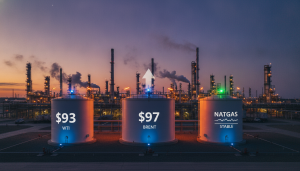
As of today, April 22nd, Brent Crude trades at $93.31 per barrel, showing a modest daily gain of 0.08%, with an intraday range spanning $92.57 to $94.21. Similarly, WTI Crude is priced at $89.7, up 0.03% and moving within an $88.76 to $90.71 range. These seemingly stable daily movements, however, belie a more significant trend. Over the past 14 days, Brent crude has seen a notable correction, declining from $101.16 on April 1st to $94.09 by April 21st, marking a 7% reduction. This recent softening in prices, despite ongoing Middle East tensions, suggests that other market forces are at play, potentially including concerns over global demand growth, robust non-OPEC+ supply, or profit-taking after earlier spikes. Investors are keenly observing whether the current geopolitical premium has been fully priced in, or if any escalation could swiftly reignite bullish sentiment and push prices back towards recent highs. The relative stability in gasoline prices, currently at $3.12 per gallon, down 0.32% today, indicates a degree of demand resilience but also suggests that refining margins might not be under immediate, intense pressure from crude price surges.
Investor Questions: Navigating Future Oil Price Trajectories
Our proprietary reader intent data reveals a consistent theme among investors: a strong desire to understand future oil price movements. Many are asking “is WTI going up or down?” and seeking predictions for “the price of oil per barrel by end of 2026.” This clearly indicates a market grappling with uncertainty and seeking clarity on long-term trends amidst short-term volatility. While specific price targets are inherently speculative, our analysis suggests WTI’s trajectory will be a complex interplay of U.S. shale production resilience, global economic health impacting demand, and, critically, the ongoing Middle East situation. Any significant disruption to shipping lanes or energy infrastructure in the region could quickly tighten global supply, pushing prices upward. Conversely, a de-escalation or stronger-than-expected supply response from non-OPEC+ producers could cap gains. For the end of 2026, the consensus remains fractured, with projections heavily weighted by assumptions regarding global economic growth and OPEC+ production discipline. Geopolitical risk remains the most unpredictable variable, capable of overriding fundamental supply-demand models in an instant.
Upcoming Events: Key Data Points for the Next Fortnight
For investors looking to gain an edge, the next two weeks are packed with critical data releases that will offer deeper insights into the fundamental supply and demand picture. Tomorrow, April 22nd, the EIA Weekly Petroleum Status Report will be released, providing vital statistics on U.S. crude oil and refined product inventories, refinery utilization, and product supplied. This report is a crucial barometer for domestic demand and supply-side health. This will be followed by further EIA reports on April 29th and May 6th, reinforcing its importance. On April 24th, we will see the Baker Hughes Rig Count, an essential indicator of U.S. drilling activity and future production trends. Another Baker Hughes report follows on May 1st. Additionally, the API Weekly Crude Inventory data, available on April 28th and May 5th, offers an early look at U.S. inventory changes ahead of the official EIA figures. Perhaps most significant for broader outlooks is the EIA Short-Term Energy Outlook (STEO) due on May 2nd, which will provide updated forecasts for global and domestic supply, demand, and prices. Investors should carefully analyze these reports for signs of tightening or loosening markets, as they will provide crucial counterpoints or confirmations to the geopolitical narrative.
The Delicate Balance of Supply, Demand, and Geopolitical Influence
The current state of the oil market is a delicate balancing act. On the supply side, OPEC+ continues to manage production, aiming to stabilize prices, while non-OPEC+ producers, particularly the U.S., contribute significantly to global output. Any direct or indirect impact from Middle East tensions on major producing nations or critical shipping chokepoints would immediately disrupt this equilibrium. For instance, heightened maritime security concerns in key transit routes could increase shipping costs and insurance premiums, effectively raising the cost of delivered oil. On the demand side, global economic growth forecasts play a pivotal role. Stronger-than-expected economic performance, particularly from major Asian economies, could significantly boost oil consumption, eroding any existing supply surpluses. Conversely, a global economic slowdown or recession would exert downward pressure on demand, potentially offsetting geopolitical risk premiums. The interplay between these fundamental forces and the unpredictable nature of geopolitical events creates a highly complex and volatile environment for oil investors, where careful analysis of both hard data and unfolding global events is paramount.