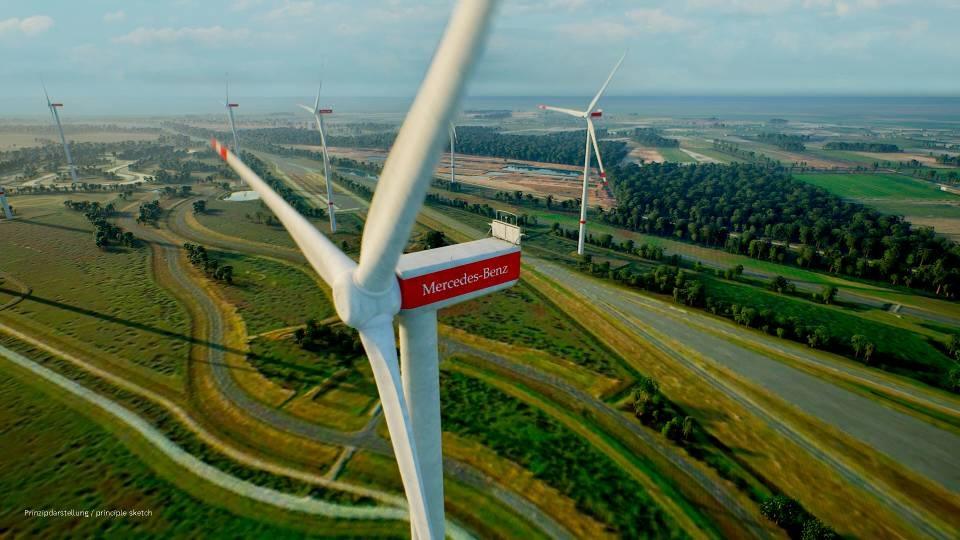
The recent announcement of a substantial 140 MW onshore wind farm project by Mercedes-Benz at its Papenburg test track in northern Germany serves as a potent reminder for oil and gas investors: the energy transition isn’t just a political talking point, but a strategic imperative for major industrial players. This move, designed to cover approximately 20% of the automaker’s annual electricity needs in Germany, highlights a tangible shift in industrial energy procurement. For investors navigating the complex landscape of crude oil and natural gas, understanding these long-term structural changes is as critical as tracking daily price fluctuations or weekly inventory reports.
Shifting Sands: Auto Giants and the Erosion of Industrial Demand
Mercedes-Benz’s decision to self-source a significant portion of its energy needs through a new wind farm, expected to be fully operational with 20 Nordex turbines by 2027, is more than an environmental statement; it’s a calculated economic and strategic play. The company has set ambitious targets: an 80% reduction in CO2 emissions from production by 2030, with renewable energy accounting for 70% of overall needs at its own production sites within the same timeframe, culminating in 100% renewable energy and zero CO2 emissions globally by 2039. This isn’t an isolated incident but a bellwether for how major industrial consumers are re-evaluating their energy supply chains. For the oil and gas sector, this signals a gradual, yet persistent, erosion of demand from large-scale industrial electricity consumption, impacting the long-term outlook for natural gas used in power generation and, indirectly, the refined products that power industrial logistics.
The long-term Power Purchase Agreement (PPA) with energy park developer UKA underscores a commitment beyond mere compliance. It’s about securing stable, predictable energy costs and aligning with broader sustainability goals that resonate with consumers and regulators alike. While 20% of German electricity needs might seem modest in the grand scheme, it’s the direction of travel that matters. As other industrial behemoths follow suit, the cumulative effect on grid demand, and consequently on the fossil fuel inputs to that grid, will become increasingly material. Investors must factor in this accelerating trend of self-sufficiency and renewable integration by major corporations when assessing the long-term viability and growth prospects of conventional energy assets.
Market Realities: Short-Term Volatility vs. Long-Term Transition
Even as industrial giants lay the groundwork for a decarbonized future, the immediate realities of the global energy market continue to dictate short-term investor sentiment. As of today, Brent crude trades at $98.15, marking a 1.25% decline, while WTI crude sits at $89.8, down 1.5%. This recent softness is part of a broader trend; over the past 14 days, Brent crude has seen a significant correction, falling from $112.57 to $98.57, representing a notable 12.4% decrease. This volatility underscores the myriad of factors at play – from geopolitical tensions and economic growth forecasts to speculative positioning and inventory data.
For oil and gas investors, the challenge lies in reconciling these immediate market movements with the longer-term structural shifts highlighted by initiatives like the Mercedes-Benz wind farm. Are current crude price declines purely a function of short-term supply-demand rebalancing, or are they subtly beginning to price in the anticipated, albeit gradual, demand destruction from industrial decarbonization? The market’s immediate focus often remains on the tangible and near-term, such as the upcoming weekly crude inventory reports from API and EIA, which can cause significant intraday swings. Yet, overlooking the strategic pivot of major energy consumers like Mercedes-Benz would be a critical oversight for those with a multi-year investment horizon. The current market snapshot serves as a powerful reminder that while daily price action captures headlines, the underlying currents of energy transition continue to reshape the investment landscape.
OPEC+ Decisions and Investor Focus: Navigating Near-Term Supply Amidst Future Demand Concerns
Investor attention remains heavily concentrated on the supply side, particularly the decisions of key producers. Our proprietary intent data indicates that investors are keenly asking about current OPEC+ production quotas and the models powering real-time crude price information. This intense focus on supply management takes center stage with critical upcoming events. The OPEC+ Joint Ministerial Monitoring Committee (JMMC) convenes tomorrow, April 17th, followed by the full Ministerial Meeting on April 18th. These meetings are pivotal in setting the near-term supply narrative, especially against a backdrop of recent price weakness.
The question for investors is how, or if, the long-term industrial demand shifts exemplified by Mercedes-Benz’s renewable investments will begin to influence OPEC+’s strategic calculus. While immediate decisions will undoubtedly hinge on current market balances, global economic outlooks, and internal member dynamics, the specter of future demand erosion could subtly reinforce a more cautious, supply-constrained approach. Will OPEC+ maintain current production cuts, or even consider deeper ones, to stabilize prices amidst both cyclical economic concerns and structural energy transition pressures? Beyond OPEC+, investors will also be closely watching the Baker Hughes Rig Count reports on April 24th and May 1st for signals on North American production trends. The interplay between these immediate supply-side actions and the long-term demand transformation is where informed investment decisions will be made.
Investment Outlook: Re-evaluating Risk and Opportunity in a Decarbonizing Industrial Landscape
The strategic moves by Mercedes-Benz, a global industrial leader, offer a compelling case study for oil and gas investors to re-evaluate their portfolios. The direct investment in renewable energy by a major automaker signifies a tangible threat to future fossil fuel demand, particularly for natural gas in power generation and potentially refined products used in industrial processes. For upstream oil and gas companies, this trend necessitates a deeper look at long-term demand forecasts and the resilience of their asset bases. Companies with high-cost production or those heavily reliant on industrial consumption in developed markets may face increasing headwinds.
However, this transition also presents opportunities. Oil and gas companies are not monolithic; many are actively diversifying into renewable energy, carbon capture, or hydrogen production, positioning themselves as broader energy providers. Investors should scrutinize which companies are proactively adapting, leveraging their expertise in large-scale project management and energy infrastructure. For midstream operators, the focus shifts to infrastructure adaptability – can existing pipelines and storage facilities be repurposed for new energy vectors, or will new infrastructure be required? The investment landscape demands a nuanced approach, distinguishing between firms prepared for a multi-decade energy evolution and those clinging solely to traditional models. Identifying companies with robust balance sheets, strong free cash flow generation, and a clear strategy for navigating a decarbonizing industrial landscape will be paramount for long-term outperformance in the oil and gas sector.


