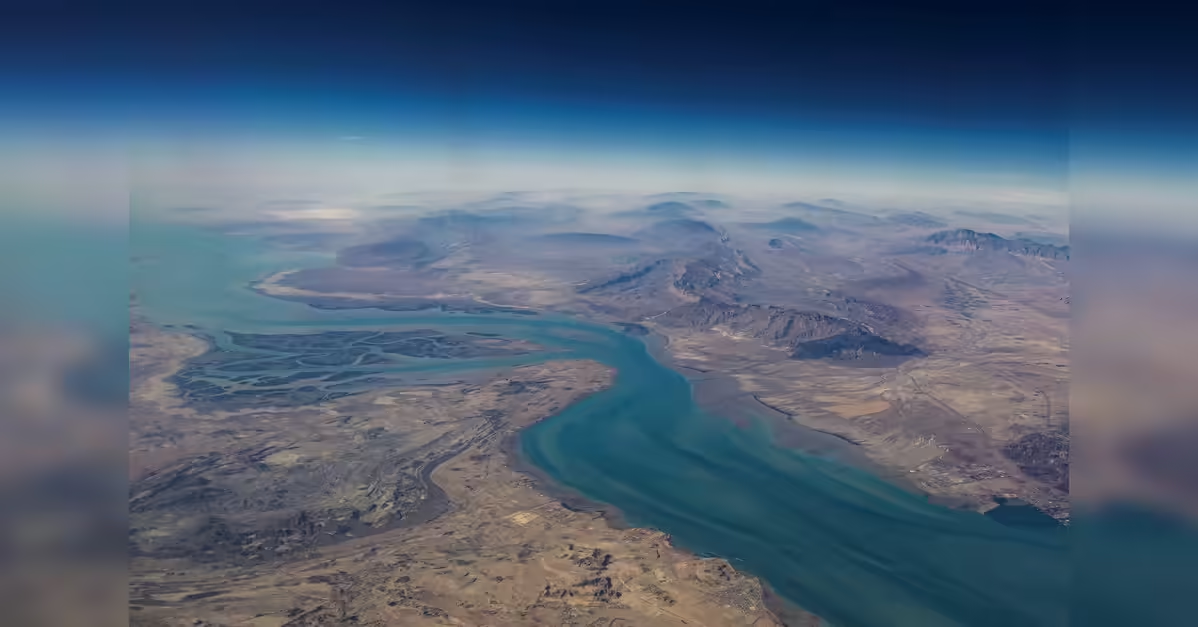
The global oil and gas market is currently navigating a period of intense geopolitical flux, and recent developments in the Strait of Hormuz offer a glimmer of cautious optimism for investors. A potential ceasefire agreement between the US and Iran aims to alleviate weeks of severe disruption in the vital waterway, which had left over 800 vessels, including a significant portion of the world’s energy fleet, effectively trapped. While initial reports suggest a truce designed to facilitate the safe passage of these vessels, the underlying complexities and lingering uncertainties demand careful analysis from an investment perspective. This analysis delves into the immediate market reactions, the forward-looking implications for supply chains, and how investors should interpret this fragile detente in the context of broader energy market dynamics.
Hormuz: A Tentative Reopening and Lingering Doubts
The proposed truce in the Strait of Hormuz is a critical development, potentially unlocking a choke point responsible for a substantial portion of global seaborne oil trade. For weeks, heightened tensions and a series of attacks had severely curtailed traffic, creating an unprecedented supply crunch. Data from Kpler indicates the sheer scale of the disruption, with 426 tankers hauling crude oil and clean fuels, 34 liquefied petroleum gas (LPG) carriers, and 19 liquefied natural gas (LNG) tankers among the more than 800 vessels left in limbo on either side of the strait. The agreement, brokered just hours before a US-imposed deadline, reportedly allows for a temporary reopening. However, the details remain notably vague, presenting a significant challenge for shipowners and insurers.
Iran has signaled a two-week window for safe passage, contingent on coordination with its armed forces and within certain “technical limitations.” In contrast, US President Donald Trump announced a “COMPLETE, IMMEDIATE, and SAFE OPENING.” This discrepancy in language underscores the fragility of the agreement and the potential for misinterpretation or renewed friction. Industry groups, such as the Japanese Shipowners’ Association, have acknowledged the news with cautious optimism but stress the immediate need for clarity before relaying instructions to their members. As Jennifer Parker, adjunct professor at the University of Western Australia Defence and Security Institute, aptly notes, “You don’t switch global shipping flows back on in 24 hours.” The return to normalcy, even if the truce holds, will be a gradual process, as tanker owners, insurers, and crews require genuine assurances of reduced risk, not merely a temporary pause in hostilities. In peacetime, approximately 135 ships transit the strait daily; restoring this rhythm will require sustained confidence.
Market Dynamics: A Cautious Relief Rally Amidst Volatility
The announcement of the Hormuz truce has introduced a degree of relief into the oil markets, though not a complete reversal of recent trends. As of today, Brent Crude trades at $93.92 per barrel, up 0.73% on the day, with an intraday range of $91.39 to $94.86. Similarly, WTI Crude stands at $89.96 per barrel, a 0.32% increase, fluctuating between $87.64 and $91.41. Gasoline prices also show a modest uptick, at $3.13 per gallon, up 0.32%. While these daily gains might suggest a positive reaction, it’s crucial to contextualize them within the broader market movement. Over the past 14 days, Brent Crude has seen a decline of $7.07, or 7%, moving from $101.16 on April 1st to $94.09 on April 21st. This broader downward trajectory indicates that while the truce provides a measure of stability against immediate supply shocks, it hasn’t fundamentally altered the market’s recent bearish leanings, which likely stem from broader demand concerns or other supply factors.
The slight upward movement today, despite the easing of a major supply constraint, suggests that investors are not fully convinced of a prolonged period of stability. The market appears to be pricing in the potential for continued geopolitical risk, even with the temporary reprieve. This reflects the deep-seated uncertainty surrounding the “fine print” of the ceasefire. The fact that prices haven’t plunged further on news of potentially unblocking 800 vessels highlights the market’s underlying nervousness and the perceived fragility of the agreement. Investors remain keenly aware that while a major immediate crisis has been averted, the geopolitical landscape in the Middle East remains highly volatile, making sustained supply security a challenging proposition.
Addressing Investor Concerns: WTI Direction and Long-Term Outlook
Our proprietary reader intent data reveals a consistent theme among investors this week: a strong focus on the direction of WTI and broader oil price predictions for the remainder of 2026. Questions like “is WTI going up or down” and “what do you predict the price of oil per barrel will be by end of 2026?” highlight the prevalent uncertainty. The Hormuz truce offers a complex answer. On one hand, the potential unblocking of hundreds of vessels, including 426 crude and fuel tankers, suggests an easing of supply tightness, which would typically exert downward pressure on prices like WTI. The immediate threat of a full closure and the associated spike in shipping costs and insurance premiums appears to have diminished.
However, the lack of complete clarity and the temporary nature of Iran’s proposed two-week window introduce a counterbalancing factor. Geopolitical risk, even when temporarily mitigated, does not disappear. Investors are rightly concerned about the durability of such agreements and the potential for a swift re-escalation. This lingering uncertainty acts as a floor for prices, preventing a dramatic decline. Therefore, WTI’s direction in the short term will be a tug-of-war between the physical easing of supply bottlenecks and the persistent geopolitical risk premium. For the end-of-2026 outlook, the Hormuz situation serves as a stark reminder that even robust supply-demand fundamentals can be swiftly overridden by unforeseen geopolitical events, making precise long-term forecasts inherently challenging and highly dependent on sustained regional stability.
Forward-Looking Catalysts: Navigating Supply Signals and Outlook Revisions
For investors seeking to understand the true impact of the Hormuz truce on global oil balances, attention must now turn to upcoming data releases and forward-looking analyses. The coming weeks are packed with critical energy events that will provide crucial insights into how this fragile agreement translates into tangible supply movements and market adjustments. The EIA Weekly Petroleum Status Reports, scheduled for April 22nd, April 29th, and May 6th, will be paramount. These reports will offer the first tangible evidence of whether the unblocking of vessels is leading to increased crude and product inventories in key consumer markets, particularly the US. Any significant build-ups could signal an effective easing of supply constraints and potentially exert downward pressure on prices.
Complementing these inventory reports will be the Baker Hughes Rig Count on April 24th and May 1st. While not directly related to Hormuz, these figures provide a pulse on North American production activity. If global supply fears ease, it could influence drilling decisions, further shaping the supply outlook. Perhaps the most significant forward-looking event will be the EIA Short-Term Energy Outlook (STEO) on May 2nd. This comprehensive report will offer updated forecasts for crude oil, natural gas, and refined products, and it will be critical to see how the EIA incorporates the Hormuz truce into its projections for global supply and demand balances for the remainder of 2026. Investors should meticulously scrutinize any revisions to production, consumption, and price forecasts, as these will provide the most authoritative short to medium-term outlook from a leading industry body, directly influencing investment strategies in the wake of this complex geopolitical development.


