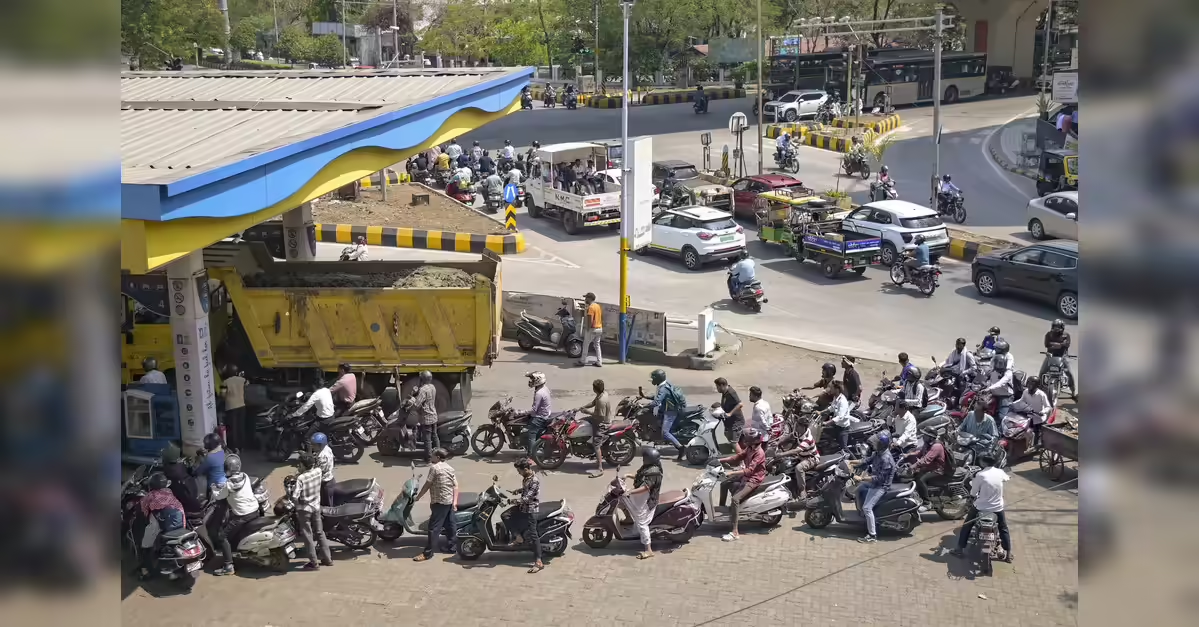
The recent assurance from the Karnataka government regarding the stability of auto gas supply, despite initial disruptions from private distributors, offers a valuable lens through which to examine India’s evolving energy landscape and the critical role of its public sector oil majors. While seemingly a localized issue, this development underscores broader investment themes concerning energy security, the growth of alternative fuels, and the financial resilience of state-owned entities like Indian Oil Corporation (IOC), Bharat Petroleum Corporation Limited (BPCL), and Hindustan Petroleum Corporation Limited (HPCL).
Karnataka’s Auto Gas Stability: A Microcosm of India’s Energy Imperatives
The situation in Karnataka saw the state government intervening swiftly to quell rumors of an auto gas shortage, confirming that public sector oil companies significantly ramped up supplies to compensate for shortfalls from private players. This intervention saw daily auto gas supply from these state-owned firms surge from an average of 56.67 metric tonnes to an impressive 83.58 metric tonnes. This proactive measure not only stabilized local supply but also highlighted the critical role public sector enterprises play in ensuring energy access and stability across India. For investors, this incident is a reminder of the government’s strong hand in the energy sector, often balancing market dynamics with social and economic stability. It also signals the growing demand for auto LPG as a cleaner, more economical fuel alternative for urban transportation in rapidly developing regions, presenting a tangible growth vector for companies positioned in this segment.
Global Crude Dynamics and India’s Refining Giants
This localized assurance on auto gas supply comes amidst a dynamic global crude market that heavily influences the profitability of India’s refining and marketing companies. As of today, Brent Crude trades at $93.79 per barrel, reflecting a 0.59% increase within the day, though its range has been between $91.39 and $94.86. Similarly, WTI Crude stands at $89.8 per barrel, up 0.14%, trading within a daily range of $87.64 to $91.41. These figures indicate a relatively firm crude market, a significant shift from the 14-day trend where Brent declined by approximately $7, or 7%, from $101.16 on April 1st to $94.09 on April 21st. The downward pressure observed in early April has seemingly found a floor, with prices now showing signs of stabilization or slight recovery.
For Indian refiners like IOC, BPCL, and HPCL, global crude prices are paramount. While lower crude prices can reduce input costs, a stable or rising price environment, coupled with robust demand, can enhance refining margins and inventory valuations. Investors, keenly asking whether WTI is “going up or down,” are focused on this delicate balance. The government’s directive to increase auto gas supply, while ensuring public convenience, could mean these companies absorb higher input costs if retail prices are capped, potentially impacting their marketing segment margins. Conversely, it solidifies their market position and reinforces their role as indispensable national energy providers.
Forward Outlook: Public Sector Performance and Upcoming Catalysts
The increased operational load on IOC, BPCL, and HPCL in Karnataka prompts investors to scrutinize their financial health and capacity to meet rising demand for auto LPG and other fuels. Their ability to manage supply chain disruptions and scale operations quickly is a testament to their robust infrastructure, but also a potential drag if these operations are not adequately compensated. The Minister for Food, Civil Supplies & Consumer Affairs, K H Muniyappa, had previously called a meeting on April 10th to address auto LPG supply issues, an initiative that likely paved the way for the enhanced public sector supply we now observe. This demonstrates a clear governmental intent to maintain energy stability, which de-risks the operating environment for these state-backed entities.
Looking ahead, several key energy events will shape the investment landscape for these companies and the broader Indian energy market. The upcoming EIA Weekly Petroleum Status Reports on April 29th and May 6th, along with the Baker Hughes Rig Count on May 1st, will offer fresh insights into global supply-demand dynamics. Crucially, the EIA Short-Term Energy Outlook on May 2nd will provide critical projections that directly address investor queries about the “price of oil per barrel by end of 2026.” These reports will be instrumental in forecasting crude price trajectories, which in turn dictate the profitability of refining and marketing operations for India’s energy behemoths. Investors will be seeking signals on global demand recovery, inventory levels, and production trends to calibrate their positions in the Indian energy sector.
Investing in India’s Growing LPG Ecosystem
The Karnataka situation is a stark reminder of the expanding auto LPG market in India, driven by environmental concerns and cost-effectiveness compared to traditional gasoline. This growth presents significant investment opportunities beyond just the oil marketing companies. Companies involved in LPG infrastructure, distribution networks, cylinder manufacturing, and even vehicle conversions stand to benefit from this secular trend. Investors are increasingly looking for entities that can capitalize on India’s energy transition, even if it’s a gradual shift involving cleaner fossil fuels like LPG as an interim step. The stability brought by public sector intervention reinforces confidence in the market’s long-term potential, mitigating risks associated with supply volatility. As such, while direct questions about specific company performance like “How well do you think Repsol will end in April 2026” highlight broader investor interest in energy company health, the underlying narrative in India points towards robust growth in domestic consumption and a critical role for state-backed enterprises in sustaining this expansion.


